
Explore the NCF-FS 2022: Pedagogy and Assessment, including its key principles, curriculum design, pedagogy, and alignment with NEP 2020 for early childhood education in India.
Table of Contents
1. Introduction : NCF-FS 2022
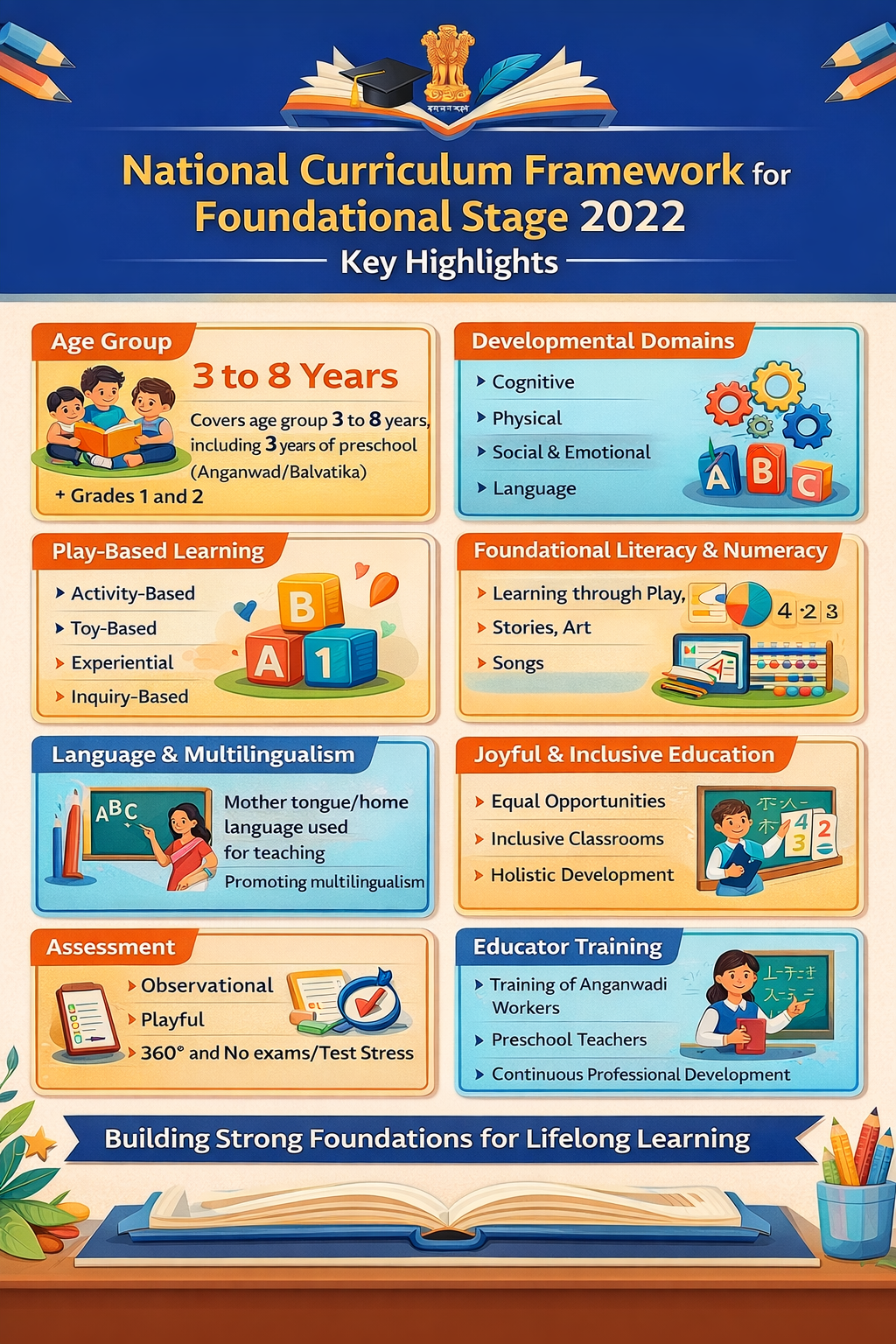
The National Curriculum Framework for the Foundational Stage (NCF-FS) 2022 is a landmark document developed to transform early childhood education in India. It provides guidelines for curriculum design, teaching-learning practices, assessment methods, and school environments for children aged 3 to 8 years. The framework has been developed in alignment with the vision of the National Education Policy (NEP) 2020, which recognizes early childhood education as the most crucial stage in a child’s development.
The foundational stage includes three years of preschool education and two years of primary school (Class 1 and Class 2). This stage focuses on holistic development through play-based and activity-based learning rather than rote memorization. The framework emphasizes the importance of creating joyful, engaging, and inclusive learning environments that nurture children’s cognitive, social, emotional, and physical development.
The NCF-FS 2022 aims to ensure that every child in India achieves foundational literacy and numeracy (FLN) by the end of Grade 3. It also integrates traditional Indian knowledge systems, cultural values, and modern pedagogical approaches to create a balanced and holistic curriculum.
2.Background of NCF-FS 2022
The development of NCF-FS 2022 is part of a broader educational reform initiated by NEP 2020. The policy recommended the creation of a new National Curriculum Framework (NCF) for different stages of education.
Traditionally, early childhood education in India was largely unstructured and varied significantly across schools, anganwadi centers, and private institutions. Many preschool programs lacked standardized curriculum guidelines, resulting in inconsistent learning outcomes.
To address these issues, the Government of India introduced the National Curriculum Framework for the Foundational Stage, which aims to provide a structured yet flexible curriculum that is appropriate for young learners.
The framework has been prepared by the National Council of Educational Research and Training (NCERT) with guidance from experts, educators, and child development specialists.
3. Vision and Objectives of NCF-FS 2022
Vision
The primary vision of the NCF-FS 2022 is to create a strong educational foundation that supports lifelong learning. The framework emphasizes that the early years of childhood are critical for brain development, emotional growth, and the formation of learning habits.
Research suggests that nearly 85% of brain development occurs before the age of six, making early childhood education extremely important.
The vision of the framework is to ensure that all children receive high-quality, inclusive, and equitable early education that prepares them for future learning.
Objectives
The major objectives of NCF-FS 2022 include:
- Ensuring holistic development of children aged 3–8 years.
- Promoting play-based, activity-based, and experiential learning.
- Developing foundational literacy and numeracy skills.
- Encouraging curiosity, creativity, and critical thinking.
- Creating inclusive and child-friendly learning environments.
- Supporting emotional and social development.
- Strengthening the role of teachers and caregivers in early childhood education.
4.Structure of the Foundational Stage
The foundational stage covers five years of education, divided into two major phases:
Preschool Stage (3 Years)
This stage includes children aged 3 to 6 years and typically takes place in:
- Anganwadi centers
- Preschools
- Kindergarten schools
Learning during this stage focuses primarily on play, exploration, and interaction.
Early Primary Stage (Classes 1 and 2)
This stage includes children aged 6 to 8 years. The curriculum continues to emphasize activity-based learning while gradually introducing structured academic concepts such as reading, writing, and basic mathematics.
5.Principles of Early Childhood Education in NCF-FS 2022
The framework is based on several important principles that guide curriculum development and teaching practices.
Play-Based Learning
Play is considered the most natural way for children to learn. The framework encourages activities such as storytelling, games, role play, music, and art to support learning.
Through play-based learning, children develop problem-solving skills, creativity, and social interaction abilities.
Holistic Development
NCF-FS emphasizes the holistic development of children across multiple domains, including:
- Physical development
- Cognitive development
- Emotional development
- Social development
- Language development
Rather than focusing solely on academic achievements, the framework promotes balanced development.
Multilingualism
The framework supports the use of mother tongue or home language as the medium of instruction during the foundational stage. This approach helps children understand concepts more easily and strengthens their connection with their cultural identity.
Inclusivity
The framework ensures that all children, including those from disadvantaged backgrounds or with disabilities, have access to quality education.
Inclusive education involves adapting teaching methods, materials, and classroom environments to meet the needs of diverse learners.
6.Key Components of the Foundational Curriculum
The NCF-FS curriculum is designed around several developmental goals and learning areas.
Physical Development
Physical activities play an important role in early childhood education. The curriculum includes:
- Outdoor games
- Movement activities
- Yoga and physical exercises
These activities help improve motor skills, coordination, and overall health.
Cognitive Development
Cognitive development refers to the development of thinking, reasoning, and problem-solving abilities.
The curriculum encourages children to explore their surroundings, ask questions, and experiment with different ideas.
Activities such as puzzles, sorting games, and pattern recognition help develop cognitive skills.
Language Development
Language development is a major focus of the foundational stage.
Children learn to:
- Listen carefully
- Speak clearly
- Understand stories
- Recognize letters and sounds
Storytelling, rhymes, and conversations are used extensively to support language development.
7.Foundational Literacy and Numeracy
Foundational literacy and numeracy (FLN) form the core learning outcomes of the foundational stage.
Children develop skills such as:
- Recognizing letters and words
- Reading simple sentences
- Writing basic words
- Counting numbers
- Understanding shapes and patterns
The goal is to ensure that every child achieves FLN by the end of Grade 3.
8. Pedagogical Approaches in NCF-FS
The framework recommends several teaching methods suitable for young children.
Activity-Based Learning
Teachers use activities such as drawing, storytelling, experiments, and group projects to engage students.
This method makes learning enjoyable and meaningful.
Experiential Learning
Children learn by doing rather than by memorizing information.
For example:
- Growing plants in the school garden
- Observing animals and insects
- Exploring natural objects
These experiences help children understand concepts better.
Inquiry-Based Learning
Teachers encourage children to ask questions and explore answers through observation and discussion.
This approach develops curiosity and scientific thinking.
9. Role of Teachers in the Foundational Stage
Teachers play a crucial role in implementing the NCF-FS curriculum.
Their responsibilities include:
- Creating a safe and supportive learning environment
- Encouraging children’s curiosity and creativity
- Observing and understanding individual learning needs
- Communicating with parents and caregivers
Teachers are also expected to receive specialized training in early childhood education.
10. Learning Environment
The framework emphasizes the importance of a stimulating and child-friendly learning environment.
Classrooms should include:
- Colorful learning materials
- Books and storytelling corners
- Play areas
- Outdoor learning spaces
The environment should encourage exploration and creativity.
11.Assessment in NCF-FS 2022
Assessment during the foundational stage should be continuous and observation-based.
Traditional written exams are not suitable for young children.
Teachers evaluate children’s development through:
- Observation of classroom activities
- Interaction with children
- Portfolio of student work
- Feedback from parents
Assessment focuses on identifying strengths and areas for improvement rather than ranking students.
12. Role of Parents and Community
Parents and communities play an important role in early childhood education.
The framework encourages strong collaboration between schools and families.
Parents can support learning by:
- Reading stories to children
- Encouraging curiosity
- Providing a supportive home environment
Community participation also helps strengthen early education programs.
13. Implementation of NCF-FS in India
The implementation of NCF-FS requires coordination between various stakeholders.
These include:
- Central and state governments
- Schools and anganwadi centers
- Teachers and caregivers
- Parents and communities
Government initiatives such as Samagra Shiksha and Poshan Abhiyaan support early childhood education programs.
Teacher training programs and curriculum reforms are also being introduced to ensure effective implementation.
14.Challenges in Implementation
Despite its progressive vision, the implementation of NCF-FS faces several challenges.
Some of the major challenges include:
- Lack of infrastructure in rural areas
- Shortage of trained early childhood educators
- Limited awareness among parents
- Resource constraints in anganwadi centers
Addressing these challenges requires strong policy support, funding, and community involvement.
15. Importance of NCF-FS 2022
The National Curriculum Framework for the Foundational Stage represents a major step toward improving early childhood education in India.
Its importance lies in:
- Providing a structured curriculum for young learners
- Promoting play-based and experiential learning
- Ensuring foundational literacy and numeracy
- Supporting holistic child development
By focusing on the early years, the framework aims to build a strong educational foundation that will benefit children throughout their academic journey.
16. Conclusion : NCF-FS 2022
The NCF-FS 2022 is a transformative initiative that aligns with the vision of the National Education Policy 2020. It recognizes the critical importance of early childhood education and provides comprehensive guidelines for curriculum development, teaching methods, assessment, and learning environments.
By emphasizing play-based learning, holistic development, and inclusive education, the framework aims to create joyful and meaningful learning experiences for young children.
If implemented effectively, NCF-FS 2022 can significantly improve learning outcomes and contribute to the development of a strong and equitable education system in India.
Ultimately, investing in early childhood education is investing in the future of the nation.
Please visit for similar topics:https://teacherszone.in/
Please follow us on Facebook:https://www.facebook.com/profile.php?id=61586013442564

17.MCQs on NCF-FS 2022 (NET / JRF Level)
1. The NCF-FS 2022 was released in:
A. 2020
B. 2021
C. 2022
D. 2023
Answer: C
2. NCF-FS 2022 is based on recommendations of which policy?
A. National Policy on Education 1986
B. National Education Policy 2020
C. RTE Act 2009
D. Kothari Commission
Answer: B
3. The Foundational Stage in the new structure covers:
A. 3–8 years
B. 4–10 years
C. 5–9 years
D. 6–11 years
Answer: A
4. The Foundational Stage includes:
A. Preschool + Grades 1–2
B. Grades 1–3 only
C. Preschool only
D. Grades 1–5
Answer: A
5. The Foundational Stage structure follows the:
A. 10+2 system
B. 5+3+3+4 system
C. 6+3+3+4 system
D. 8+4 system
Answer: B
6. NCF-FS 2022 primarily focuses on:
A. Examination reforms
B. Early childhood care and education
C. Higher education reforms
D. Teacher salary reforms
Answer: B
7. The framework emphasizes:
A. Rote learning
B. Memorization
C. Play-based learning
D. Competitive exams
Answer: C
8. ECCE stands for:
A. Early Childhood Care and Education
B. Early Curriculum and Child Education
C. Elementary Child Care Education
D. Early Child Curriculum Education
Answer: A
9. NCF-FS 2022 aims to achieve foundational literacy and numeracy by:
A. Grade 2
B. Grade 3
C. Grade 4
D. Grade 5
Answer: B
10. The initiative for foundational literacy and numeracy is:
A. DIKSHA
B. PM eVIDYA
C. NIPUN Bharat
D. SWAYAM
Answer: C
11. NCF-FS 2022 promotes learning through:
A. Worksheets only
B. Play, stories and activities
C. Exams
D. Lectures
Answer: B
12. The framework recognizes childhood as a period of:
A. Formal instruction
B. Holistic development
C. Competition
D. Strict discipline
Answer: B
13. Foundational Stage includes children in:
A. Anganwadi + primary schools
B. Only private schools
C. Only government schools
D. Only preschools
Answer: A
14. NCF-FS encourages:
A. Stressful learning
B. Joyful learning
C. Competitive learning
D. Isolated learning
Answer: B
15. Learning should be primarily:
A. Teacher-centered
B. Child-centered
C. Exam-centered
D. Curriculum-centered
Answer: B
16. The language of learning in early years should ideally be:
A. English only
B. Mother tongue/home language
C. Sanskrit
D. Any foreign language
Answer: B
17. Which stage follows Foundational Stage?
A. Preparatory Stage
B. Middle Stage
C. Secondary Stage
D. Higher Stage
Answer: A
18. The main objective of NCF-FS is:
A. Skill training
B. Foundational learning development
C. Job preparation
D. Competitive exam preparation
Answer: B
19. Play-based pedagogy promotes:
A. Fear
B. Creativity and curiosity
C. Memorization
D. Punishment
Answer: B
20. NCF-FS supports integration of:
A. Subjects only
B. Learning domains
C. Exams only
D. Homework only
Answer: B
21. NCF-FS recommends which pedagogy?
A. Lecture method
B. Activity-based learning
C. Drill method
D. Dictation method
Answer: B
22. Learning through games is known as:
A. Experimental learning
B. Play-based learning
C. Formal learning
D. Passive learning
Answer: B
23. Storytelling helps develop:
A. Language skills
B. Motor skills
C. Mathematical skills only
D. Discipline
Answer: A
24. Teachers in Foundational Stage should act as:
A. Controllers
B. Facilitators
C. Examiners
D. Administrators
Answer: B
25. NCF-FS emphasizes learning through:
A. Worksheets
B. Exploration and discovery
C. Lectures
D. Homework
Answer: B
26. Learning environment should be:
A. Rigid
B. Fearful
C. Flexible and stimulating
D. Competitive
Answer: C
27. Classroom activities should include:
A. Art and craft
B. Music and movement
C. Storytelling
D. All of the above
Answer: D
28. Play-based learning supports:
A. Cognitive development
B. Emotional development
C. Social development
D. All of the above
Answer: D
29. Assessment at foundational stage should be:
A. Exam-based
B. Continuous and observational
C. Only written tests
D. Board exams
Answer: B
30. The framework promotes learning through:
A. Local culture and context
B. Only textbooks
C. Online lectures
D. Homework
Answer: A
31. Which domain focuses on thinking and reasoning?
A. Cognitive development
B. Physical development
C. Emotional development
D. Social development
Answer: A
32. Physical development includes:
A. Motor skills
B. Language skills
C. Memory skills
D. Emotional skills
Answer: A
33. Social development refers to:
A. Interaction with others
B. Reading ability
C. Writing ability
D. Calculation
Answer: A
34. Emotional development includes:
A. Managing feelings
B. Memorization
C. Writing
D. Calculation
Answer: A
35. Language development includes:
A. Listening and speaking
B. Writing only
C. Reading only
D. Counting
Answer: A
36. Foundational literacy refers to:
A. Basic reading and writing
B. Higher education
C. Skill training
D. Competitive exams
Answer: A
37. Foundational numeracy refers to:
A. Advanced mathematics
B. Basic number understanding
C. Algebra
D. Geometry
Answer: B
38. Early childhood experiences influence:
A. Brain development
B. Personality
C. Learning ability
D. All of the above
Answer: D
39. Holistic development means development of:
A. Cognitive only
B. Emotional only
C. Multiple domains
D. Physical only
Answer: C
40. NCF-FS recognizes that children learn best through:
A. Interaction
B. Participation
C. Exploration
D. All of the above
Answer: D
41. Assessment should focus on:
A. Grades
B. Child progress
C. Exams
D. Competition
Answer: B
42. Observation is used for:
A. Child assessment
B. Punishment
C. Discipline
D. Exams
Answer: A
43. Portfolio assessment includes:
A. Child work samples
B. Exam papers
C. Homework only
D. Attendance
Answer: A
44. Teacher training for NCF-FS is essential for:
A. Effective implementation
B. Exams
C. Homework
D. Administration
Answer: A
45. Parents play a role in:
A. Supporting child learning
B. Conducting exams
C. Writing textbooks
D. Administration
Answer: A
46. Anganwadi workers contribute to:
A. Early childhood education
B. Higher education
C. Secondary education
D. University education
Answer: A
47. Community participation improves:
A. School environment
B. Child learning
C. Educational outcomes
D. All of the above
Answer: D
48. Learning materials should be:
A. Contextual
B. Age-appropriate
C. Engaging
D. All of the above
Answer: D
49. Teacher-child interaction is important for:
A. Language development
B. Emotional support
C. Learning motivation
D. All of the above
Answer: D
50. Inclusive education ensures:
A. Equal opportunities
B. Exclusion
C. Segregation
D. Competition
Answer: A
81. Multilingual education helps in:
A. Cognitive development
B. Cultural identity
C. Better learning outcomes
D. All of the above
Answer: D
82. Local culture in curriculum promotes:
A. Relevance
B. Engagement
C. Identity
D. All of the above
Answer: D
83. Play materials should be:
A. Safe
B. Child-friendly
C. Age-appropriate
D. All of the above
Answer: D
84. Teacher reflection helps improve:
A. Teaching practices
B. Exams
C. Homework
D. Discipline
Answer: A
85. Outdoor play contributes to:
A. Physical development
B. Social development
C. Emotional well-being
D. All of the above
Answer: D
86. Art-based activities support:
A. Creativity
B. Expression
C. Imagination
D. All of the above
Answer: D
87. Music and rhythm activities develop:
A. Language skills
B. Coordination
C. Memory
D. All of the above
Answer: D
88. Early literacy activities include:
A. Storytelling
B. Rhymes
C. Picture reading
D. All of the above
Answer: D
89. Numeracy activities include:
A. Counting games
B. Sorting objects
C. Pattern recognition
D. All of the above
Answer: D
90. Learning should be integrated with:
A. Daily life
B. Local context
C. Culture
D. All of the above
Answer: D
91. Teacher autonomy helps in:
A. Flexible teaching
B. Innovative pedagogy
C. Better classroom practices
D. All of the above
Answer: D
92. The role of play in learning is:
A. Secondary
B. Essential
C. Optional
D. Irrelevant
Answer: B
93. The framework promotes:
A. Stress-free learning
B. Joyful education
C. Child participation
D. All of the above
Answer: D
94. Assessment should avoid:
A. Fear
B. Stress
C. Pressure
D. All of the above
Answer: D
95. Teacher-parent collaboration improves:
A. Child learning outcomes
B. Exams
C. Homework
D. Administration
Answer: A
96. Early childhood education is important because:
A. Brain development occurs rapidly
B. Children learn faster
C. Foundations of learning are built
D. All of the above
Answer: D
97. NCF-FS promotes:
A. Inclusive classrooms
B. Equal learning opportunities
C. Respect for diversity
D. All of the above
Answer: D
98. Curriculum planning should consider:
A. Child interests
B. Developmental stages
C. Local context
D. All of the above
Answer: D
99. The ultimate goal of NCF-FS is:
A. Holistic child development
B. Exams
C. Memorization
D. Competition
Answer: A
100. The success of NCF-FS depends on:
A. Teachers
B. Parents
C. Community
D. All of the above
Answer: D