Concept of Development and Its Relationship with Learning. Includes Hindi & English explanations, PYQs, MCQs, most important for CTET, STETs and other teachers’ exams.
Table of Contents
What is Development? | विकास क्या है?
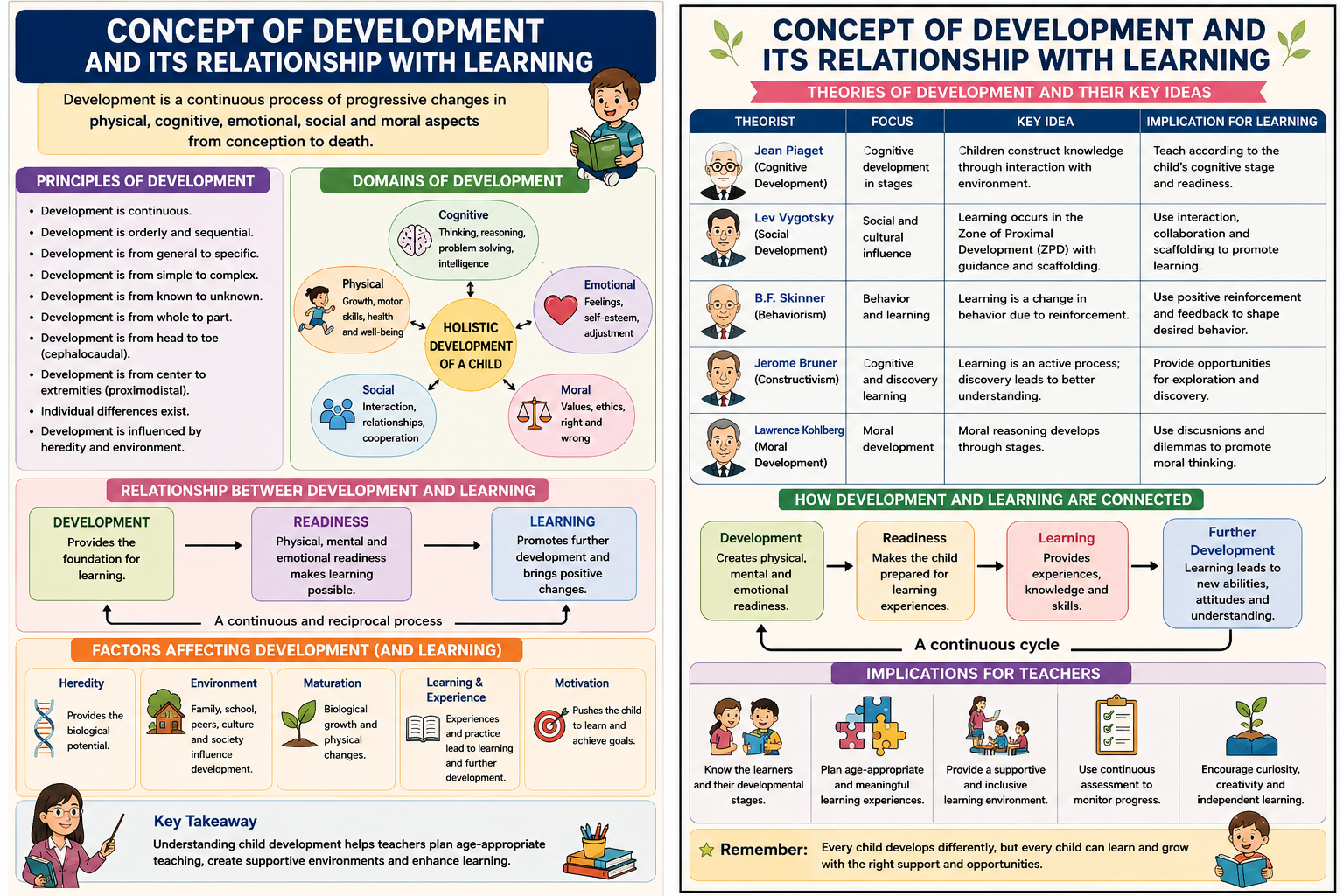
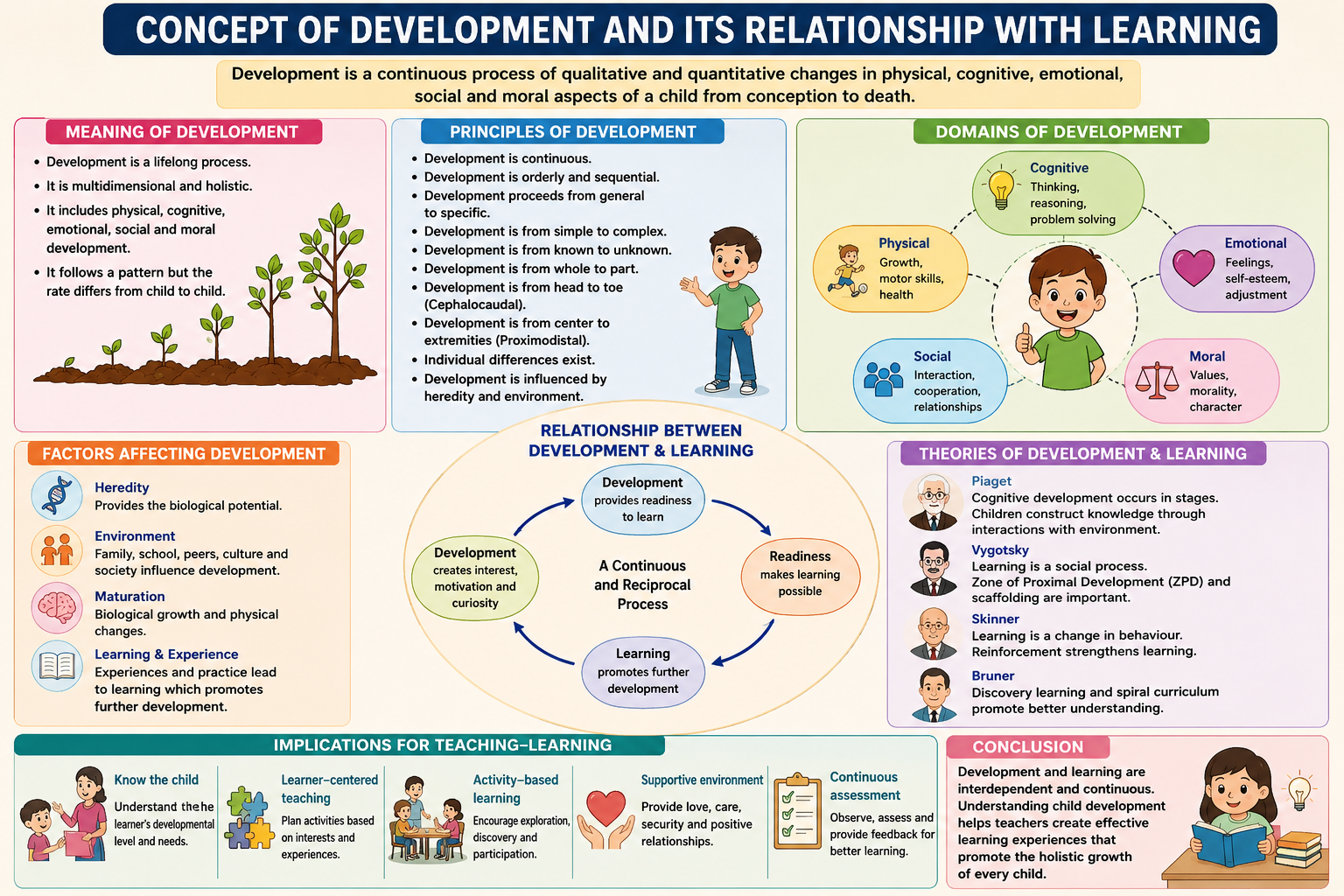
Development refers to the progressive and systematic changes that occur in a human being from conception to death. These changes include physical, cognitive, emotional, social, moral, and language development.
Development is:
- Continuous
- Lifelong
- Sequential
- Predictable
- Holistic
Definition by Elizabeth Hurlock
“Development is a progressive series of changes toward maturity.”
Definition by James Drever
“Development is the progressive change in the organism from birth to death.”
विकास से अभिप्राय गर्भाधान से मृत्यु तक व्यक्ति में होने वाले क्रमिक एवं व्यवस्थित परिवर्तनों से है। इसमें शारीरिक, मानसिक, सामाजिक, भावात्मक, नैतिक तथा भाषा संबंधी विकास शामिल होते हैं।
विकास की मुख्य विशेषताएँ:
- सतत प्रक्रिया
- जीवनपर्यंत प्रक्रिया
- क्रमबद्ध
- पूर्वानुमान योग्य
- समग्र प्रक्रिया
एलिजाबेथ हरलॉक के अनुसार
“विकास परिपक्वता की ओर होने वाले क्रमिक परिवर्तनों की श्रृंखला है।”
जेम्स ड्रेवर के अनुसार
“विकास जन्म से मृत्यु तक होने वाला प्रगतिशील परिवर्तन है।”
Difference Between Growth and Development in Concept of Development and Its Relationship with Learning
वृद्धि एवं विकास में अंतर
| Basis | Growth | Development |
|---|---|---|
| Meaning | Quantitative change | Qualitative + Quantitative change |
| Nature | Physical | Overall personality |
| Scope | Limited | Broad |
| Duration | Stops after maturity | Lifelong |
| आधार | वृद्धि | विकास |
|---|---|---|
| अर्थ | मात्रात्मक परिवर्तन | गुणात्मक + मात्रात्मक परिवर्तन |
| प्रकृति | शारीरिक | संपूर्ण व्यक्तित्व |
| क्षेत्र | सीमित | व्यापक |
| अवधि | परिपक्वता के बाद रुक जाती है | जीवनपर्यंत चलती है |
Characteristics of Development
विकास की विशेषताएँ
1. Development is Continuous
Development starts before birth and continues throughout life.
2. Development is Sequential
Children follow a specific developmental order.
Example:
Crawling → Standing → Walking
3. Development is Holistic
All areas of development are interconnected.
4. Development Varies Among Individuals
Every child develops at a different pace.
5. Development Depends on Heredity and Environment
Genes and surroundings both influence child development.
1. विकास सतत प्रक्रिया है
विकास जन्म से पहले शुरू होकर जीवनभर चलता है।
2. विकास क्रमबद्ध होता है
बालक विकास का एक निश्चित क्रम अपनाते हैं।
उदाहरण:
रेंगना → खड़ा होना → चलना
3. विकास समग्र होता है
विकास के सभी आयाम एक-दूसरे से जुड़े होते हैं।
4. विकास में व्यक्तिगत भिन्नता होती है
हर बालक की विकास गति अलग होती है।
5. विकास आनुवंशिकता एवं वातावरण पर निर्भर करता है
वंशानुक्रम और पर्यावरण दोनों विकास को प्रभावित करते हैं।
Principles of Development
विकास के सिद्धांत
English
Cephalocaudal Principle
Development occurs from head to toe.
Proximodistal Principle
Development proceeds from the center outward.
Principle of Individual Difference
Every child is unique.
Principle of Integration
Children learn simple skills before complex skills.
Principle of Interaction
Development is influenced by heredity and environment together.
मस्तकोधोमुखी सिद्धांत
विकास सिर से पैर की ओर होता है।
निकट-दूर सिद्धांत
विकास केंद्र से बाहरी भागों की ओर होता है।
व्यक्तिगत भिन्नता सिद्धांत
प्रत्येक बालक अलग एवं विशिष्ट होता है।
एकीकरण सिद्धांत
बालक पहले सरल और बाद में जटिल कौशल सीखता है।
अंतःक्रिया सिद्धांत
विकास आनुवंशिकता एवं वातावरण दोनों से प्रभावित होता है।
Meaning of Learning
अधिगम का अर्थ
Learning is a relatively permanent change in behavior due to experience and practice.
Definition by Gates
“Learning is the modification of behavior through experience.”
Definition by Crow and Crow
“Learning is the acquisition of habits, knowledge, and attitudes.”
अधिगम अनुभव एवं अभ्यास के कारण व्यवहार में होने वाला अपेक्षाकृत स्थायी परिवर्तन है।
गेट्स के अनुसार
“अधिगम अनुभव द्वारा व्यवहार में संशोधन है।”
क्रो एवं क्रो के अनुसार
“अधिगम आदतों, ज्ञान एवं दृष्टिकोण का अर्जन है।”
Relationship Between Development and Learning
विकास और अधिगम का संबंध
Development and learning are closely related and interdependent processes.
Key Points
1. Development Influences Learning
A child learns according to developmental readiness.
Example:
A small child cannot solve advanced mathematics.
2. Learning Influences Development
Learning improves cognitive and social development.
3. Learning and Maturation Work Together
Both maturation and learning contribute to child development.
4. Development is Broader than Learning
Learning is one aspect of overall development.
विकास और अधिगम परस्पर संबंधित एवं परस्पर निर्भर प्रक्रियाएँ हैं।
मुख्य बिंदु
1. विकास अधिगम को प्रभावित करता है
बालक अपनी विकासात्मक तैयारी के अनुसार सीखता है।
उदाहरण:
छोटा बच्चा उच्च स्तरीय गणित नहीं सीख सकता।
2. अधिगम विकास को प्रभावित करता है
अधिगम मानसिक एवं सामाजिक विकास को बढ़ाता है।
3. परिपक्वता एवं अधिगम साथ-साथ कार्य करते हैं
बालक का विकास परिपक्वता एवं अधिगम दोनों पर आधारित होता है।
4. विकास अधिगम से व्यापक है
अधिगम विकास का केवल एक भाग है।
Important Theories for CTET CDP
CTET हेतु महत्वपूर्ण सिद्धांत
Jean Piaget Cognitive Development Theory
जीन पियाजे का संज्ञानात्मक विकास सिद्धांत
| Stage | Age | Main Feature |
|---|---|---|
| Sensorimotor | 0–2 years | Learning through senses |
| Preoperational | 2–7 years | Symbolic thinking |
| Concrete Operational | 7–11 years | Logical thinking |
| Formal Operational | 11+ years | Abstract thinking |
CTET Important Point
Children actively construct knowledge.
CTET महत्वपूर्ण बिंदु
बालक सक्रिय रूप से ज्ञान का निर्माण करते हैं।
Lev Vygotsky Theory
लेव वायगोत्स्की का सिद्धांत
Key Concepts
- Social Interaction
- Scaffolding
- Zone of Proximal Development (ZPD)
CTET Important Point
Learning leads development.
CTET महत्वपूर्ण बिंदु
अधिगम विकास को आगे बढ़ाता है।
Kohlberg Moral Development Theory
कोहलबर्ग का नैतिक विकास सिद्धांत
Levels
- Pre-conventional Level
- Conventional Level
- Post-conventional Level
Role of Teacher in Child Development and Learning
बाल विकास एवं अधिगम में शिक्षक की भूमिकाA teacher should:
- Respect individual differences
- Use child-centered teaching
- Encourage creativity
- Provide positive reinforcement
- Create an inclusive classroom environment
शिक्षक को चाहिए कि वह:
- व्यक्तिगत भिन्नताओं का सम्मान करे
- बालक केंद्रित शिक्षण अपनाए
- रचनात्मकता को बढ़ावा दे
- सकारात्मक प्रोत्साहन दे
- समावेशी कक्षा वातावरण बनाए
CTET Previous Year Questions (PYQs)
For More topic Please follow us : https://teacherszone.in/
Please follow us on Facebook : https://www.facebook.com/profile.php?id=100093519306538
CTET पिछले वर्षों के प्रश्न on Development and Its Relationship with Learning
1.
Development is best described as:
A. Sudden changes in behaviour
B. Qualitative and quantitative changes over time
C. Increase in physical growth only
D. Learning through schooling only
Answer: B
2.
Which principle states that development proceeds from general to specific responses?
A. Cephalocaudal principle
B. Proximodistal principle
C. Sequential principle
D. Integration principle
Answer: C
3.
The term “readiness to learn” is most closely associated with:
A. Thorndike
B. Piaget
C. Kohlberg
D. Skinner
Answer: A
4.
According to Piaget, a child in the pre-operational stage cannot:
A. Use symbols
B. Think logically about concrete events
C. Learn language
D. Imitate others
Answer: B
5.
Which of the following is NOT a characteristic of development?
A. Continuous process
B. Predictable sequence
C. Same rate for all children
D. Multidimensional
Answer: C
6.
Learning is most effective when:
A. Punishment is frequently used
B. Learners are passive listeners
C. Teaching matches developmental level
D. Children memorize facts repeatedly
Answer: C
7.
The concept of “Zone of Proximal Development” was proposed by:
A. Piaget
B. Vygotsky
C. Skinner
D. Bruner
Answer: B
8.
Scaffolding helps learners by:
A. Replacing independent thinking
B. Giving permanent assistance
C. Supporting learning temporarily
D. Discouraging exploration
Answer: C
9.
According to Kohlberg, moral development depends primarily on:
A. Rewards and punishments
B. Age only
C. Cognitive development
D. Physical growth
Answer: C
10.
The principle that development occurs in an orderly pattern is called:
A. Individual difference
B. Predictability
C. Maturation
D. Reinforcement
Answer: B
11.
A teacher should consider individual differences because:
A. All children learn identically
B. Developmental rates vary
C. Curriculum should be ignored
D. Intelligence is fixed
Answer: B
12.
Which factor has the greatest influence on development?
A. Heredity only
B. Environment only
C. Interaction of heredity and environment
D. Schooling only
Answer: C
13.
The cephalocaudal trend means development proceeds:
A. From head to toe
B. From toe to head
C. From center outward
D. Randomly
Answer: A
14.
The proximodistal principle implies development proceeds:
A. From simple to complex
B. From whole to parts
C. From center to extremities
D. From toe to head
Answer: C
15.
Which stage of Piaget is characterized by abstract thinking?
A. Sensori-motor
B. Concrete operational
C. Formal operational
D. Pre-operational
Answer: C
16.
A child saying “all four-legged animals are dogs” is showing:
A. Conservation
B. Accommodation
C. Assimilation
D. Reversibility
Answer: C
17.
Modification of existing schemas due to new experiences is:
A. Equilibration
B. Assimilation
C. Accommodation
D. Reinforcement
Answer: C
18.
Development is considered holistic because:
A. Only mental growth matters
B. Different areas influence one another
C. Physical growth is separate
D. Learning is unrelated to emotions
Answer: B
19.
Which domain includes attitudes and emotions?
A. Cognitive
B. Psychomotor
C. Affective
D. Linguistic
Answer: C
20.
Learning without considering developmental readiness may:
A. Increase understanding
B. Cause frustration
C. Improve creativity automatically
D. Ensure mastery
Answer: B
21.
According to Erikson, school-age children face the crisis of:
A. Trust vs mistrust
B. Industry vs inferiority
C. Identity vs role confusion
D. Autonomy vs shame
Answer: B
22.
Failure during the stage of “industry vs inferiority” may lead to:
A. Confidence
B. Inferiority feelings
C. Moral reasoning
D. Identity achievement
Answer: B
23.
Which statement is true about growth and development?
A. Both are identical
B. Growth is quantitative; development is qualitative and quantitative
C. Development refers only to physical changes
D. Growth is broader than development
Answer: B
24.
Play contributes to development by:
A. Wasting instructional time
B. Encouraging rote learning
C. Enhancing social and cognitive skills
D. Reducing imagination
Answer: C
25.
A teacher using peer interaction to improve learning is influenced by:
A. Behaviourism
B. Social constructivism
C. Psychoanalysis
D. Maturation theory
Answer: B
26.
Children learn best when:
A. They fear punishment
B. Content is disconnected from experience
C. Learning is meaningful and active
D. They remain silent
Answer: C
27.
The concept of conservation develops during:
A. Sensori-motor stage
B. Pre-operational stage
C. Concrete operational stage
D. Formal operational stage
Answer: C
28.
Egocentrism is mainly seen in:
A. Adults
B. Pre-operational children
C. Adolescents only
D. Concrete operational children
Answer: B
29.
Which is an example of maturation?
A. Learning multiplication tables
B. Natural ability to walk with age
C. Memorizing poems
D. Practicing handwriting
Answer: B
30.
Learning depends upon:
A. Motivation
B. Readiness
C. Experience
D. All of these
Answer: D
31.
According to Vygotsky, language plays a crucial role in:
A. Physical growth
B. Cognitive development
C. Reflex actions
D. Biological maturation only
Answer: B
32.
Private speech in children helps in:
A. Entertainment only
B. Self-regulation
C. Language delay
D. Punishment avoidance
Answer: B
33.
Which psychologist emphasized reinforcement in learning?
A. Piaget
B. Skinner
C. Vygotsky
D. Erikson
Answer: B
34.
Developmental tasks vary because:
A. Culture influences development
B. All societies are identical
C. Heredity has no role
D. Learning never changes
Answer: A
35.
Which of the following promotes intrinsic motivation?
A. Threats
B. Excessive rewards
C. Interesting activities
D. Punishment
Answer: C
36.
The best classroom environment for development is:
A. Authoritarian
B. Fear-based
C. Supportive and democratic
D. Highly competitive only
Answer: C
37.
Which factor most affects language development?
A. Social interaction
B. Hair colour
C. Height
D. Reflexes
Answer: A
38.
Children differ in learning because of:
A. Heredity
B. Environment
C. Experiences
D. All of these
Answer: D
39.
The ability to think hypothetically emerges during:
A. Sensori-motor stage
B. Pre-operational stage
C. Concrete operational stage
D. Formal operational stage
Answer: D
40.
Continuous assessment is important because development:
A. Stops after childhood
B. Occurs unevenly
C. Is same for all
D. Depends only on exams
Answer: B
41.
Which is the correct sequence of Piaget’s stages?
A. Pre-operational → Sensori-motor → Formal operational → Concrete operational
B. Sensori-motor → Pre-operational → Concrete operational → Formal operational
C. Sensori-motor → Concrete operational → Pre-operational → Formal operational
D. Concrete operational → Sensori-motor → Formal operational → Pre-operational
Answer: B
42.
A child learns more effectively when teaching:
A. Ignores prior knowledge
B. Connects with previous experiences
C. Uses only lectures
D. Discourages questions
Answer: B
43.
Which intelligence theory was proposed by Howard Gardner?
A. Emotional intelligence
B. Multiple intelligences
C. Triarchic intelligence
D. Two-factor theory
Answer: B
44.
According to Gardner, linguistic intelligence refers to:
A. Musical ability
B. Number skills
C. Effective use of language
D. Self-awareness
Answer: C
45.
Learning is a:
A. Temporary change only
B. Permanent change in behaviour due to experience
C. Purely biological process
D. Random activity
Answer: B
46.
Which practice supports inclusive learning?
A. Same teaching method for all
B. Ignoring disabilities
C. Flexible teaching strategies
D. Comparing children constantly
Answer: C
47.
Adolescence is marked by:
A. No emotional changes
B. Identity formation
C. Absence of peer influence
D. Complete maturity
Answer: B
48.
Which statement about intelligence is correct?
A. It is fixed and unchangeable
B. It develops through interaction and experiences
C. Only heredity matters
D. School has no role
Answer: B
49.
Motivation in learning:
A. Hinders attention
B. Reduces participation
C. Energizes behaviour
D. Discourages achievement
Answer: C
50.
Learning disabilities affect:
A. Motivation only
B. Academic processing skills
C. Physical growth only
D. Moral values only
Answer: B
51–100
51.
The best way to promote conceptual understanding is:
A. Rote memorization
B. Meaningful activities
C. Frequent punishment
D. Mechanical drills only
Answer: B
52.
Which theorist emphasized discovery learning?
A. Bruner
B. Skinner
C. Thorndike
D. Freud
Answer: A
53.
Spiral curriculum was proposed by:
A. Piaget
B. Vygotsky
C. Bruner
D. Kohlberg
Answer: C
54.
Children construct knowledge actively according to:
A. Behaviourism
B. Constructivism
C. Psychoanalysis
D. Maturation theory
Answer: B
55.
The major goal of education should be:
A. Memorization
B. Holistic development
C. Competition only
D. Strict discipline only
Answer: B
56.
Socialization mainly helps in:
A. Physical growth only
B. Learning societal norms
C. Reducing intelligence
D. Preventing learning
Answer: B
57.
Which type of play is common in early childhood?
A. Cooperative play
B. Solitary play
C. Competitive play only
D. Formal games only
Answer: B
58.
The role of teacher in constructivist learning is:
A. Dictator
B. Facilitator
C. Passive observer only
D. Examiner only
Answer: B
59.
A learner-centered classroom emphasizes:
A. Memorization
B. Active participation
C. Fear of mistakes
D. Teacher dominance
Answer: B
60.
Development is influenced by critical periods, meaning:
A. Learning can never happen later
B. Certain abilities develop best at specific times
C. Age has no importance
D. Intelligence declines immediately
Answer: B
61.
Which aspect develops fastest during adolescence?
A. Moral stagnation
B. Emotional and social identity
C. Reflexes only
D. Dependency on parents only
Answer: B
62.
According to Kohlberg, punishment-obedience orientation belongs to:
A. Pre-conventional level
B. Conventional level
C. Post-conventional level
D. Moral realism
Answer: A
63.
Transfer of learning occurs when:
A. Previous learning affects new learning
B. Learning is forgotten
C. Punishment is used
D. Motivation decreases
Answer: A
64.
Which intelligence involves understanding others?
A. Intrapersonal
B. Logical
C. Interpersonal
D. Spatial
Answer: C
65.
Emotional development is important because it:
A. Has no relation to learning
B. Influences adjustment and behaviour
C. Is unrelated to society
D. Occurs automatically
Answer: B
66.
The best indicator of readiness to learn is:
A. Chronological age only
B. Child’s developmental level
C. Height and weight only
D. Economic background only
Answer: B
67.
Which is NOT a principle of development?
A. Development is continuous
B. Development follows sequence
C. Development is uniform for all
D. Development is cumulative
Answer: C
68.
A democratic classroom promotes:
A. Fear
B. Creativity and confidence
C. Dependency only
D. Blind obedience
Answer: B
69.
Which psychologist is associated with psychoanalytic theory?
A. Freud
B. Skinner
C. Piaget
D. Bruner
Answer: A
70.
According to Freud, the latent period occurs during:
A. Infancy
B. Preschool years
C. Middle childhood
D. Adulthood
Answer: C
71.
Learning through observation is called:
A. Conditioning
B. Trial and error
C. Observational learning
D. Classical learning
Answer: C
72.
Bandura emphasized:
A. Reinforcement only
B. Social learning
C. Reflex action
D. Unconscious motives only
Answer: B
73.
Self-efficacy means:
A. Dependence on others
B. Belief in one’s abilities
C. Fear of learning
D. Emotional instability
Answer: B
74.
Which factor most enhances retention?
A. Meaningful association
B. Punishment
C. Isolation
D. Fear
Answer: A
75.
Learning disabilities are:
A. Due to laziness only
B. Neurological in nature
C. Result of low morality
D. Same as mental retardation
Answer: B
76.
Inclusive education means:
A. Segregating disabled children
B. Equal opportunities for all learners
C. Teaching gifted students only
D. Ignoring diversity
Answer: B
77.
Children with diverse backgrounds learn best when:
A. Cultural differences are ignored
B. Teachers respect diversity
C. Only one method is used
D. Strict discipline is imposed
Answer: B
78.
Which process helps maintain cognitive balance?
A. Conditioning
B. Equilibration
C. Reinforcement
D. Motivation
Answer: B
79.
Cognitive development mainly refers to:
A. Emotional growth
B. Thinking and reasoning
C. Physical maturity
D. Social interaction only
Answer: B
80.
The first agent of socialization is:
A. School
B. Peer group
C. Family
D. Media
Answer: C
81.
A teacher should avoid comparing students because it:
A. Builds confidence
B. Creates inferiority feelings
C. Improves creativity
D. Promotes inclusion
Answer: B
82.
Which classroom practice develops critical thinking?
A. Open-ended questions
B. Rote repetition
C. Excessive homework only
D. Dictation method
Answer: A
83.
Moral dilemmas are mainly used by:
A. Piaget
B. Skinner
C. Kohlberg
D. Freud
Answer: C
84.
Developmental psychology studies:
A. Human growth across lifespan
B. Animal behaviour only
C. Diseases only
D. Intelligence tests only
Answer: A
85.
Which intelligence is linked with self-awareness?
A. Spatial
B. Intrapersonal
C. Musical
D. Bodily-kinesthetic
Answer: B
86.
An effective teacher:
A. Focuses only on textbook completion
B. Understands developmental needs
C. Punishes mistakes heavily
D. Avoids interaction
Answer: B
87.
Creativity in children should be encouraged because it:
A. Reduces discipline
B. Promotes divergent thinking
C. Lowers achievement
D. Causes confusion
Answer: B
88.
Learning is enhanced when feedback is:
A. Delayed and harsh
B. Immediate and constructive
C. Punitive only
D. Absent
Answer: B
89.
Which of the following best reflects intrinsic motivation?
A. Studying for prizes only
B. Learning due to curiosity
C. Fear of punishment
D. Pressure from parents
Answer: B
90.
A child-centered curriculum focuses on:
A. Needs and interests of learners
B. Teacher convenience only
C. Strict memorization
D. Competitive ranking only
Answer: A
91.
The role of heredity in development refers to:
A. Environmental influence
B. Genetic inheritance
C. Social interaction
D. School experiences
Answer: B
92.
Which is most important for healthy emotional development?
A. Fear-based discipline
B. Secure relationships
C. Isolation
D. Constant criticism
Answer: B
93.
Assessment for learning means:
A. Assessment only at year-end
B. Assessment to improve teaching-learning
C. Ranking students publicly
D. Punishing weak learners
Answer: B
94.
Which stage involves object permanence?
A. Formal operational
B. Sensori-motor
C. Concrete operational
D. Pre-operational
Answer: B
95.
A growth mindset encourages learners to:
A. Avoid challenges
B. Believe abilities can improve
C. Depend only on talent
D. Fear mistakes
Answer: B
96.
The best way to handle learner diversity is:
A. Uniform instruction
B. Flexible pedagogy
C. Ignoring differences
D. Labeling students
Answer: B
97.
Which domain includes muscular coordination skills?
A. Cognitive
B. Psychomotor
C. Affective
D. Moral
Answer: B
98.
Children learn values primarily through:
A. Lectures only
B. Observation and interaction
C. Punishment only
D. Exams only
Answer: B
99.
Development and learning are related because:
A. Development affects readiness for learning
B. Learning has no role in development
C. Development stops learning
D. Both are unrelated
Answer: A
100.
The ultimate aim of understanding child development for teachers is to:
A. Control students strictly
B. Facilitate effective learning experiences
C. Increase examinations
D. Promote competition only
Important One-Liners for CTET Exam on Development and Its Relationship with Learning
CTET परीक्षा हेतु महत्वपूर्ण वन-लाइनर
- Development is lifelong.
- Learning causes behavioral change.
- Development is broader than learning.
- Every child is unique.
- Learning depends upon readiness.
- Piaget focused on cognitive development.
- Vygotsky emphasized social interaction.
- Development is a continuous process from conception to death.
- Development includes physical, cognitive, emotional, social, and moral changes. Growth is quantitative, while development is both quantitative and qualitative.
- Development follows a predictable pattern but differs in rate among individuals.
- Development proceeds from general to specific responses. Development occurs in a sequential and orderly manner. The cephalocaudal principle means development proceeds from head to toe.
- The proximodistal principle means development proceeds from center to extremities.
- Heredity and environment jointly influence development.
- Maturation refers to genetically programmed growth.
- Learning depends on readiness and maturation. Learning is a relatively permanent change in behaviour due to experience. Development and learning are interrelated processes.
- A child learns best when teaching matches developmental level.
- Individual differences are natural and should be respected in classrooms.
- No two children develop at exactly the same rate.
- Development is holistic because all domains are interconnected. Piaget called children “active constructors of knowledge.”
- Piaget’s first stage is the sensori-motor stage.
- Object permanence develops during the sensori-motor stage.
- Egocentrism is a feature of the pre-operational stage.
- Conservation develops during the concrete operational stage.
- Abstract thinking develops during the formal operational stage.
- Assimilation means fitting new experiences into existing schemas.
- Accommodation means modifying schemas according to new experiences.
- Equilibration helps maintain cognitive balance. Vygotsky emphasized the social basis of learning.
- Zone of Proximal Development (ZPD) is the gap between actual and potential learning.
- Scaffolding provides temporary support to learners.
- Language plays a major role in cognitive development.
- Private speech helps children regulate their thinking.
- Bruner emphasized discovery learning. Spiral curriculum was proposed by Bruner.
- Kohlberg explained stages of moral development.
- Moral development depends upon cognitive development.
- Erikson emphasized psychosocial development. “Industry vs Inferiority” is the psychosocial stage of school-age children.
- Adolescence is marked by identity formation. Freud emphasized unconscious motives in behaviour. Behaviourism focuses on observable behaviour.
- Skinner emphasized reinforcement in learning.
- Positive reinforcement strengthens desired behaviour.
- Punishment may suppress behaviour temporarily.
- Bandura proposed social learning theory. Children learn many behaviours through observation and imitation.
- Self-efficacy means belief in one’s own ability. Gardner proposed the theory of multiple intelligences.
- Linguistic intelligence refers to effective use of language.
- Logical-mathematical intelligence involves reasoning and problem-solving. Interpersonal intelligence means understanding others.
- Intrapersonal intelligence means self-awareness. Inclusive education provides equal learning opportunities for all children.
- Learning disabilities are neurological in nature.
- Dyslexia affects reading ability. Dysgraphia affects writing skills.
- Dyscalculia affects mathematical ability. Motivation is essential for effective learning. Intrinsic motivation comes from inner interest and curiosity.
- Extrinsic motivation depends on external rewards.
- Play is essential for healthy child development.
- Play promotes cognitive, emotional, and social growth.
- A learner-centered classroom promotes active participation.
- Constructivism emphasizes active knowledge construction.
- Teachers should act as facilitators rather than dictators.
- Learning is more effective when connected with prior experiences.
- Children learn better through meaningful activities than rote memorization.
- Continuous assessment helps monitor development effectively.
- Fear and anxiety hinder learning.
- Democratic classrooms promote creativity and confidence.
- Emotional development influences academic performance.
- Social interaction enhances learning.
- Peer learning improves communication and cooperation skills.
- Culture strongly influences development and learning.
- Language development is affected by environment and interaction.
- Critical periods are important for certain developmental skills.
- Readiness is essential before introducing new learning tasks.
- Developmental tasks vary across age levels. Intelligence is influenced by both heredity and environment.
- Creativity involves divergent thinking. Open-ended questions develop critical thinking.
- Effective feedback should be immediate and constructive.
- Transfer of learning occurs when past learning affects new learning.
- Learning by doing increases retention.
- Assessment for learning improves the teaching-learning process.
- Children should never be compared publicly.
- Positive classroom climate enhances learning outcomes.
- Curiosity is a natural motivator for learning. Adolescents are highly influenced by peer groups.
- Secure relationships support emotional development.
- Family is the first agency of socialization.
- Schools play an important role in personality development.
- Child-centered education focuses on learner needs and interests.
- Learning is most effective when learners are actively engaged.
- Inclusive classrooms value diversity among learners. Development occurs throughout the lifespan.
- Experience shapes behaviour and personality.
- Education should promote holistic development.
- Cognitive development affects problem-solving ability.
- Teachers should understand developmental psychology for effective teaching.
- The ultimate aim of education is the overall development of the child.