
Explore the concept of school accreditation, its objectives, criteria, and benefits in maintaining educational standards and quality assurance in schools.
Table of Contents
1. Introduction (परिचय)
Education plays a crucial role in the development of individuals and societies. However, providing education alone is not sufficient; ensuring the quality of education is equally important. In this context, the concept of school accreditation has emerged as a powerful mechanism for maintaining and improving educational standards.
शिक्षा किसी भी समाज और राष्ट्र के विकास का आधार है। लेकिन केवल शिक्षा प्रदान करना ही पर्याप्त नहीं है, बल्कि शिक्षा की गुणवत्ता सुनिश्चित करना भी उतना ही आवश्यक है। इसी उद्देश्य से शिक्षा के क्षेत्र में स्कूल प्रत्यायन (School Accreditation) की अवधारणा विकसित हुई।
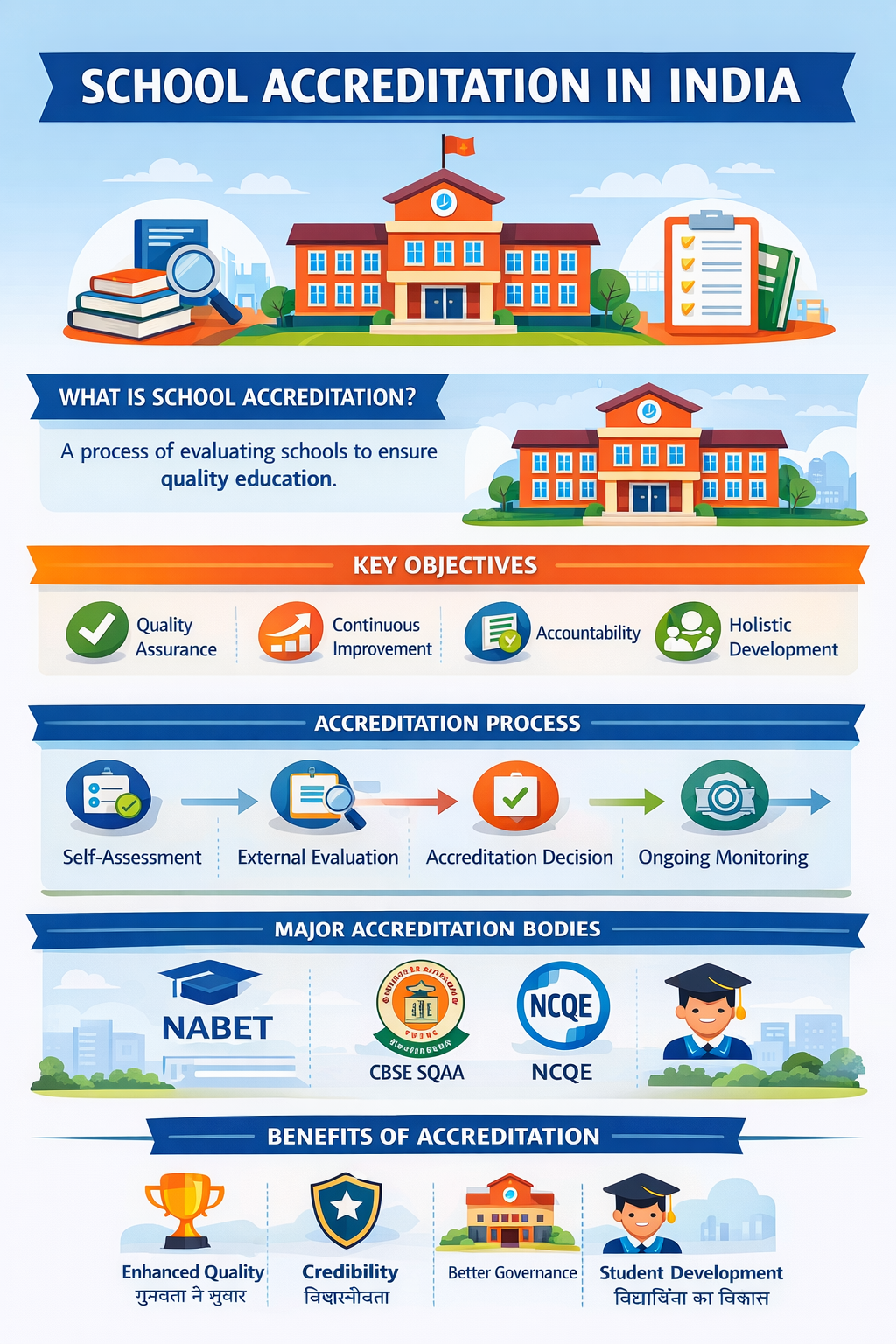
School accreditation is a systematic process through which an educational institution is evaluated against predetermined quality standards. It ensures that schools maintain acceptable levels of academic performance, governance, infrastructure, and student development.
स्कूल प्रत्यायन एक ऐसी प्रक्रिया है जिसमें किसी शैक्षणिक संस्थान का मूल्यांकन पूर्व निर्धारित गुणवत्ता मानकों के आधार पर किया जाता है। यह सुनिश्चित करता है कि विद्यालय शैक्षणिक गुणवत्ता, प्रशासन, संसाधन, और विद्यार्थियों के समग्र विकास के निर्धारित स्तरों को बनाए रखें।
In India, accreditation has gained importance with the growing emphasis on quality assurance, accountability, and continuous improvement in education systems.
भारत में शिक्षा की गुणवत्ता, पारदर्शिता और उत्तरदायित्व सुनिश्चित करने के लिए प्रत्यायन प्रणाली का महत्व लगातार बढ़ता जा रहा है।
2. Meaning of School Accreditation (स्कूल प्रत्यायन का अर्थ)
School accreditation refers to the formal recognition granted to a school that meets certain predetermined educational standards.
स्कूल प्रत्यायन का अर्थ है किसी विद्यालय को निर्धारित गुणवत्ता मानकों को पूरा करने पर आधिकारिक मान्यता प्रदान करना।
It is essentially a quality assurance mechanism that evaluates whether an institution is capable of delivering effective education.
यह मूलतः गुणवत्ता आश्वासन की प्रक्रिया है, जिसके माध्यम से यह देखा जाता है कि कोई विद्यालय प्रभावी शिक्षा प्रदान करने में सक्षम है या नहीं।
According to educational quality frameworks, accreditation involves:
- Self-evaluation by the institution
- External evaluation by experts
- Continuous improvement of educational practices
शैक्षिक गुणवत्ता ढाँचे के अनुसार प्रत्यायन में मुख्यतः तीन चरण होते हैं:
- संस्थान द्वारा स्वमूल्यांकन
- विशेषज्ञों द्वारा बाह्य मूल्यांकन
- गुणवत्ता सुधार के लिए निरंतर प्रयास
Accreditation essentially certifies that a school’s functioning, resources, and educational processes meet recognized standards.
प्रत्यायन यह प्रमाणित करता है कि विद्यालय का संचालन, संसाधन और शैक्षिक प्रक्रियाएँ निर्धारित मानकों के अनुरूप हैं।
3. Definitions of School Accreditation (स्कूल प्रत्यायन की परिभाषाएँ)
Different educational bodies define accreditation in slightly different ways.
1. Quality Assurance Perspective
Accreditation is a formal process of evaluating an institution to determine whether it meets established standards of quality.
प्रत्यायन वह औपचारिक प्रक्रिया है जिसके माध्यम से यह निर्धारित किया जाता है कि कोई संस्थान निर्धारित गुणवत्ता मानकों को पूरा करता है या नहीं।
2. Institutional Perspective
Accreditation is a method through which educational institutions demonstrate credibility, effectiveness, and commitment to quality education.
प्रत्यायन वह माध्यम है जिसके द्वारा शैक्षणिक संस्थान अपनी विश्वसनीयता, प्रभावशीलता और गुणवत्ता के प्रति प्रतिबद्धता प्रदर्शित करते हैं।
3. Continuous Improvement Perspective
Accreditation also acts as a tool for continuous improvement and institutional development.
यह प्रक्रिया संस्थानों को निरंतर सुधार और विकास की दिशा में प्रेरित करती है।
4. Objectives of School Accreditation (स्कूल प्रत्यायन के उद्देश्य)
School accreditation serves several important objectives.
1. Ensuring Quality Education
It ensures that schools maintain minimum standards of education.
यह सुनिश्चित करता है कि विद्यालय न्यूनतम शैक्षिक मानकों को बनाए रखें।
2. Institutional Accountability
It increases accountability of schools toward students, parents, and society.
यह विद्यालयों की विद्यार्थियों, अभिभावकों और समाज के प्रति जवाबदेही को बढ़ाता है।
3. Continuous Improvement
Accreditation encourages schools to continuously improve their teaching and management practices.
यह विद्यालयों को निरंतर सुधार और नवाचार के लिए प्रेरित करता है।
4. Public Confidence
Accredited institutions gain greater trust from stakeholders.
प्रत्यायित संस्थानों पर समाज का विश्वास अधिक होता है।
5. Holistic Development of Students
It ensures that schools focus on the overall development of learners.
यह विद्यार्थियों के समग्र विकास पर बल देता है।
5. Need and Importance of School Accreditation (स्कूल प्रत्यायन की आवश्यकता और महत्व)
In modern education systems, accreditation has become essential.
आधुनिक शिक्षा प्रणाली में प्रत्यायन अत्यंत आवश्यक हो गया है।
1. Quality Assurance in Education
Accreditation ensures that schools follow standard educational practices.
प्रत्यायन यह सुनिश्चित करता है कि विद्यालय मानकीकृत शैक्षिक प्रक्रियाओं का पालन करें।
2. Transparency in Education
It brings transparency in the functioning of schools.
यह विद्यालयों के कार्य संचालन में पारदर्शिता लाता है।
3. Institutional Development
Accreditation helps institutions identify strengths and weaknesses.
यह संस्थानों को उनकी मजबूतियों और कमियों की पहचान करने में मदद करता है।
4. Global Recognition
Accredited institutions often gain national and international recognition.
प्रत्यायन प्राप्त संस्थानों को राष्ट्रीय और अंतरराष्ट्रीय पहचान मिलती है।

6. Key Components of School Accreditation (स्कूल प्रत्यायन के प्रमुख घटक)
Accreditation evaluates schools across several domains.
प्रत्यायन प्रक्रिया में विद्यालयों का मूल्यांकन कई क्षेत्रों में किया जाता है।
1. School Governance
- Leadership
- Management structure
- Decision making
2. Teaching and Learning Processes
- Curriculum implementation
- Teaching methodology
- Student assessment
3. Infrastructure and Resources
- Classrooms
- Laboratories
- Libraries
4. Student Support Services
- Counselling
- Co-curricular activities
- Health and safety
5. Performance Measurement
The evaluation also focuses on performance measurement and improvement systems.
मूल्यांकन में विद्यालय के प्रदर्शन मापन और सुधार तंत्र पर भी ध्यान दिया जाता है।
7. Process of School Accreditation (स्कूल प्रत्यायन की प्रक्रिया)
The accreditation process usually follows several steps.
Step 1: Application
The school applies for accreditation.
विद्यालय प्रत्यायन के लिए आवेदन करता है।
Step 2: Self-Assessment
The institution conducts internal evaluation.
विद्यालय स्वयं का मूल्यांकन करता है।
Step 3: External Assessment
Experts visit the institution and verify information.
विशेषज्ञों की टीम विद्यालय का निरीक्षण करती है।
Step 4: Accreditation Decision
Based on the evaluation report, accreditation is granted.
मूल्यांकन रिपोर्ट के आधार पर प्रत्यायन प्रदान किया जाता है।
Step 5: Continuous Monitoring
Accredited institutions undergo periodic review.
प्रत्यायित संस्थानों का समय-समय पर पुनर्मूल्यांकन किया जाता है।
8. Development of School Accreditation in India (भारत में स्कूल प्रत्यायन का विकास)
The concept of accreditation in India developed gradually as part of educational reforms.
भारत में प्रत्यायन की अवधारणा शिक्षा सुधारों के साथ धीरे-धीरे विकसित हुई।
1. Early Phase (Pre-1990)
Before the 1990s, quality assurance in education was mainly limited to inspection systems.
1990 के पहले शिक्षा की गुणवत्ता मुख्यतः निरीक्षण प्रणाली के माध्यम से देखी जाती थी।
2. Post-1990 Reforms
After economic liberalization, the need for quality assurance increased.
आर्थिक उदारीकरण के बाद शिक्षा में गुणवत्ता सुनिश्चित करने की आवश्यकता बढ़ी।
3. Establishment of Accreditation Bodies
Several accreditation organizations were created.
भारत में कई प्रत्यायन संस्थाएँ स्थापित की गईं।
4. Quality Council of India
The National Accreditation Board for Education and Training (NABET) under the Quality Council of India evaluates educational institutions and ensures quality standards.
भारत में क्वालिटी काउंसिल ऑफ इंडिया के अंतर्गत NABET शैक्षणिक संस्थानों के प्रत्यायन का कार्य करता है।
5. CBSE School Quality Assessment and Accreditation (SQAA)
CBSE also introduced a framework for evaluating school quality.
CBSE ने भी विद्यालयों के लिए School Quality Assessment and Accreditation (SQAA) प्रणाली विकसित की।
This system involves self-evaluation and external peer review.
इस प्रक्रिया में स्वमूल्यांकन और बाहरी विशेषज्ञ मूल्यांकन शामिल होता है।
9. Major Accreditation Bodies in India (भारत में प्रमुख प्रत्यायन संस्थाएँ)
1. NABET (National Accreditation Board for Education and Training)
Ensures quality standards in educational institutions.
2. CBSE SQAA
Focuses on school quality assessment and improvement.
3. NCQE (National Council for Quality Education)
Promotes institutional quality development.
4. State Education Boards and SCERT
Provide guidelines for school quality and standards.
10. Benefits of School Accreditation (स्कूल प्रत्यायन के लाभ)
School accreditation offers multiple benefits.
1. Quality Improvement
Schools adopt systematic methods of teaching and management.
2. Institutional Credibility
Accredited schools gain credibility among parents and society.
3. Better Governance
Accreditation improves school governance and leadership.
4. Professional Development
Teachers receive training and professional development opportunities.
5. Holistic Student Development
It ensures balanced development of students.
11. Challenges in School Accreditation (स्कूल प्रत्यायन की चुनौतियाँ)
Despite its advantages, accreditation also faces challenges.
1. Lack of Awareness
Many schools are not aware of accreditation processes.
2. Financial Constraints
Small schools may lack resources for accreditation.
3. Administrative Burden
Documentation and evaluation processes can be complex.
4. Resistance to Change
Some institutions resist quality reforms.
12. Future of School Accreditation in India (भारत में स्कूल प्रत्यायन का भविष्य)
With the implementation of the National Education Policy 2020, accreditation is expected to play a stronger role in improving school education.
राष्ट्रीय शिक्षा नीति 2020 के बाद स्कूल प्रत्यायन की भूमिका और अधिक महत्वपूर्ण हो गई है।
Future trends may include:
- Digital quality monitoring
- Data-based evaluation
- International benchmarking
- Continuous professional development
भविष्य में प्रत्यायन प्रणाली अधिक प्रौद्योगिकी आधारित और पारदर्शी हो सकती है।
13. Conclusion: School Accreditation(निष्कर्ष)
School accreditation is an essential mechanism for ensuring quality education. It provides a structured framework for evaluating schools and encouraging continuous improvement.
स्कूल प्रत्यायन शिक्षा की गुणवत्ता सुनिश्चित करने का एक महत्वपूर्ण माध्यम है। यह विद्यालयों को संगठित ढंग से अपनी गुणवत्ता का मूल्यांकन करने और सुधार करने का अवसर प्रदान करता है।
In India, the development of accreditation systems has strengthened educational accountability and institutional development. As education systems continue to evolve, accreditation will play a crucial role in building high-quality, learner-centered schools.
भारत में प्रत्यायन प्रणाली के विकास ने शिक्षा में गुणवत्ता, पारदर्शिता और उत्तरदायित्व को मजबूत किया है। भविष्य में यह प्रणाली शिक्षा के समग्र विकास में महत्वपूर्ण भूमिका निभाएगी।
Please follow us on Facebook: https://www.facebook.com/profile.php?id=61586013442564
Please visit for more similar topics: https://teacherszone.in/
14. HOTS MCQs on School Accreditation (CTET / KVS /NVS/EMRS DSSSB / B.Ed / M.Ed Level)
1.
School accreditation primarily aims to ensure:
A. Uniform syllabus across schools
B. Quality assurance in education
C. Government control over schools
D. Teacher promotions
Answer: B
2.
A school conducts self-evaluation of its academic practices before external inspection. This stage is called:
A. Accreditation decision
B. Self-study phase
C. Peer review phase
D. Institutional audit
Answer: B
3.
Which of the following best reflects the philosophy behind school accreditation?
A. Competition among schools
B. Continuous quality improvement
C. Limiting private schools
D. Reducing teacher autonomy
Answer: B
4.
If a school focuses only on infrastructure but neglects teaching-learning quality, accreditation agencies are most likely to:
A. Grant accreditation immediately
B. Reject evaluation
C. Ask for improvements in academic processes
D. Ignore the issue
Answer: C
5.
School accreditation encourages schools to:
A. Maintain secrecy in evaluation
B. Follow rigid curriculum only
C. Reflect on institutional strengths and weaknesses
D. Reduce co-curricular activities
Answer: C
6.
Which organization in India is associated with school accreditation under the Quality Council of India?
A. NCERT
B. National Accreditation Board for Education and Training (NABET)
C. SCERT
D. UGC
Answer: B
7.
The concept of accreditation in education mainly emerged due to:
A. Privatization of education
B. Demand for quality assurance
C. Teacher unions
D. Student protests
Answer: B
8.
Which of the following is a key domain assessed during school accreditation?
A. Political affiliation
B. Infrastructure and resources
C. Student religion
D. School ownership
Answer: B
9.
Accreditation differs from inspection because accreditation:
A. Focuses on punishment
B. Emphasizes continuous improvement
C. Only checks documents
D. Is a one-time activity
Answer: B
10.
A school receiving accreditation must:
A. Stop further evaluation
B. Maintain quality standards continuously
C. Change curriculum immediately
D. Reduce student intake
Answer: B
11.
Which of the following is an example of external evaluation in accreditation?
A. Teacher self-reflection
B. Peer review by experts
C. Student feedback only
D. Internal audit
Answer: B
12.
School accreditation mainly promotes:
A. Administrative control
B. Institutional accountability
C. Teacher transfers
D. Government ownership
Answer: B
13.
Which of the following would most likely improve a school’s accreditation rating?
A. Ignoring student feedback
B. Transparent governance and evaluation
C. Limiting extracurricular activities
D. Increasing class size
Answer: B
14.
The concept of accreditation supports which principle of modern education?
A. Centralized authority
B. Quality assurance and transparency
C. Uniform assessment
D. Elimination of private schools
Answer: B
15.
Which of the following best demonstrates quality culture in a school?
A. Frequent inspections
B. Continuous review and improvement
C. Strict discipline only
D. High fees
Answer: B
16.
A school that regularly analyzes student learning outcomes and modifies teaching strategies is practicing:
A. Accreditation compliance
B. Quality improvement
C. Curriculum limitation
D. Administrative control
Answer: B
17.
Accreditation standards generally focus on:
A. Student admission criteria
B. Holistic institutional performance
C. Only examination results
D. Only infrastructure
Answer: B
18.
Which of the following reflects holistic evaluation in accreditation?
A. Checking only exam results
B. Evaluating teaching, infrastructure, governance, and student welfare
C. Inspecting only classrooms
D. Checking only teacher qualifications
Answer: B
19.
A school failing to meet accreditation standards is usually advised to:
A. Shut down immediately
B. Improve systems and reapply
C. Reduce teachers
D. Increase fees
Answer: B
20.
Accreditation helps parents because it:
A. Guarantees free education
B. Provides reliable information about school quality
C. Eliminates private schools
D. Reduces homework
Answer: B
21.
Which policy in India emphasizes quality assurance in school education?
A. National Education Policy 2020
B. Right of Children to Free and Compulsory Education Act 2009 only
C. National Curriculum Framework 2005
D. Five Year Plan
Answer: A
22.
Which stage of accreditation involves expert teams visiting the school?
A. Application stage
B. External evaluation
C. Accreditation approval
D. Monitoring stage
Answer: B
23.
Accreditation encourages teachers to:
A. Avoid innovation
B. Use reflective teaching practices
C. Focus only on syllabus completion
D. Avoid assessments
Answer: B
24.
Which of the following best reflects institutional accountability?
A. Secret evaluation reports
B. Transparent academic performance reporting
C. Ignoring parents
D. Limiting student participation
Answer: B
25.
The primary difference between recognition and accreditation is that accreditation:
A. Is compulsory
B. Evaluates quality standards in depth
C. Is only for government schools
D. Is only for higher education
Answer: B
26.
Which of the following is a likely outcome of effective school accreditation?
A. Reduced quality monitoring
B. Improved teaching-learning processes
C. Reduced teacher involvement
D. Lower student engagement
Answer: B
27.
In accreditation, self-study reports help institutions to:
A. Hide weaknesses
B. Identify areas for improvement
C. Reduce evaluation time
D. Avoid inspections
Answer: B
28.
Which factor may hinder successful accreditation?
A. Lack of awareness among school leaders
B. Transparent governance
C. Continuous teacher training
D. Student participation
Answer: A
29.
Which approach best aligns with accreditation principles?
A. Teacher-centered rigid teaching
B. Learner-centered education
C. Memorization-based learning
D. Only examination-based evaluation
Answer: B
30.
Which organization provides School Quality Assessment and Accreditation (SQAA) framework?
A. Central Board of Secondary Education (CBSE)
B. National Council of Educational Research and Training
C. University Grants Commission
D. National Institute of Open Schooling
Answer: A
31.
A school introducing teacher professional development programs is improving which accreditation domain?
A. Governance
B. Teaching and learning
C. Infrastructure
D. Finance
Answer: B
32.
Which of the following best reflects evidence-based evaluation in accreditation?
A. Opinion of principal only
B. Data on student learning outcomes
C. Random inspection
D. Verbal reports
Answer: B
33.
Which of the following would weaken the credibility of accreditation?
A. Transparent evaluation
B. Independent peer review
C. Biased assessment
D. Data-based evaluation
Answer: C
34.
A school integrating digital learning tools to improve teaching demonstrates:
A. Administrative reform
B. Quality enhancement
C. Curriculum reduction
D. Policy change
Answer: B
35.
Which of the following is the first step in accreditation?
A. External inspection
B. Application by institution
C. Final approval
D. Monitoring
Answer: B
36.
Which factor ensures sustainability of accreditation outcomes?
A. Continuous monitoring
B. One-time inspection
C. High fees
D. Strict discipline
Answer: A
37.
Which stakeholder group benefits most from improved school accreditation systems?
A. Teachers only
B. Students only
C. All educational stakeholders
D. Government only
Answer: C
38.
Which approach is recommended for schools seeking accreditation improvement?
A. Data-driven decision making
B. Avoiding evaluation
C. Limiting feedback
D. Reducing activities
Answer: A
39.
Which principle underlies modern accreditation systems?
A. Accountability and transparency
B. Authority and control
C. Memorization
D. Rigid administration
Answer: A
40.
A school uses student surveys to improve teaching practices. This reflects:
A. Quality assurance mechanism
B. Curriculum restriction
C. Teacher control
D. Discipline policy
Answer: A
41.
Which factor contributes to global recognition of accredited schools?
A. Standardized quality benchmarks
B. Uniform textbooks
C. High fees
D. Teacher transfers
Answer: A
42.
Which of the following supports holistic student development in accreditation?
A. Only exam preparation
B. Co-curricular and life-skill activities
C. Memorization
D. Strict discipline
Answer: B
43.
Which factor is most essential for effective accreditation implementation?
A. Stakeholder participation
B. Centralized decision making
C. Strict hierarchy
D. Reduced autonomy
Answer: A
44.
Which of the following reflects quality leadership in an accredited school?
A. Ignoring feedback
B. Encouraging innovation and collaboration
C. Maintaining secrecy
D. Avoiding evaluation
Answer: B
45.
Which of the following would likely lead to accreditation denial?
A. Transparent governance
B. Poor academic processes
C. Teacher training programs
D. Student counselling
Answer: B
46.
Accreditation supports which educational goal?
A. Standardized memorization
B. Continuous institutional improvement
C. Curriculum limitation
D. Teacher authority
Answer: B
47.
Which concept is closely related to accreditation?
A. Quality assurance
B. Discipline
C. Inspection
D. Punishment
Answer: A
48.
Which of the following improves institutional credibility?
A. Accredited status
B. High tuition fees
C. Strict rules
D. Competitive exams
Answer: A
49.
Which challenge is common in implementing accreditation in developing countries?
A. Lack of infrastructure and resources
B. Excessive technology
C. Too many inspectors
D. Too much autonomy
Answer: A
50.
Which statement best summarizes the role of school accreditation?
A. It controls schools
B. It ensures quality and accountability in education
C. It increases fees
D. It standardizes teaching methods only
Answer: B