
Comprehensive guide on School Curriculum Principles: Learning and Knowledge, Curricular Areas, School Stages based on, National Curriculum Framework 2005 for CTET, NET, B.Ed and M.Ed exams.
Table of Contents
1. Introduction to School Curriculum Principles (NCF 2005)
Education plays a vital role in shaping the future of society. In India, the National Curriculum Framework 2005 was developed by NCERT to improve the quality of school education. It provides guidelines for curriculum development, pedagogy, and assessment practices in Indian schools.
NCF 2005 emphasizes child-centered learning, constructivist pedagogy, and meaningful understanding of knowledge rather than rote memorization. It suggests that curriculum should help students develop critical thinking, creativity, democratic values, and social responsibility.
The framework identifies important principles related to:
- Perspective of curriculum
- Learning and knowledge
- Curricular areas
- School stages
- Pedagogy and assessment
These principles aim to make education relevant, inclusive, and holistic.
शिक्षा समाज के भविष्य को आकार देने में महत्वपूर्ण भूमिका निभाती है। भारत में National Curriculum Framework 2005 को NCERT द्वारा तैयार किया गया ताकि विद्यालयी शिक्षा की गुणवत्ता में सुधार किया जा सके।
NCF 2005 का मुख्य उद्देश्य है कि शिक्षा बाल-केन्द्रित, अनुभवात्मक तथा रचनात्मक (constructivist) हो, जिसमें रटने के बजाय समझ और चिंतन पर जोर दिया जाए।
इस ढाँचे में निम्न प्रमुख सिद्धांतों को शामिल किया गया है:
- पाठ्यचर्या का दृष्टिकोण (Perspective)
- सीखना और ज्ञान (Learning and Knowledge)
- पाठ्यचर्या के क्षेत्र (Curricular Areas)
- विद्यालय के चरण (School Stages)
- शिक्षण-अधिगम पद्धति और मूल्यांकन
इन सिद्धांतों का उद्देश्य शिक्षा को समावेशी, प्रासंगिक और समग्र बनाना है।
2. Perspective of School Curriculum (पाठ्यचर्या का दृष्टिकोण)
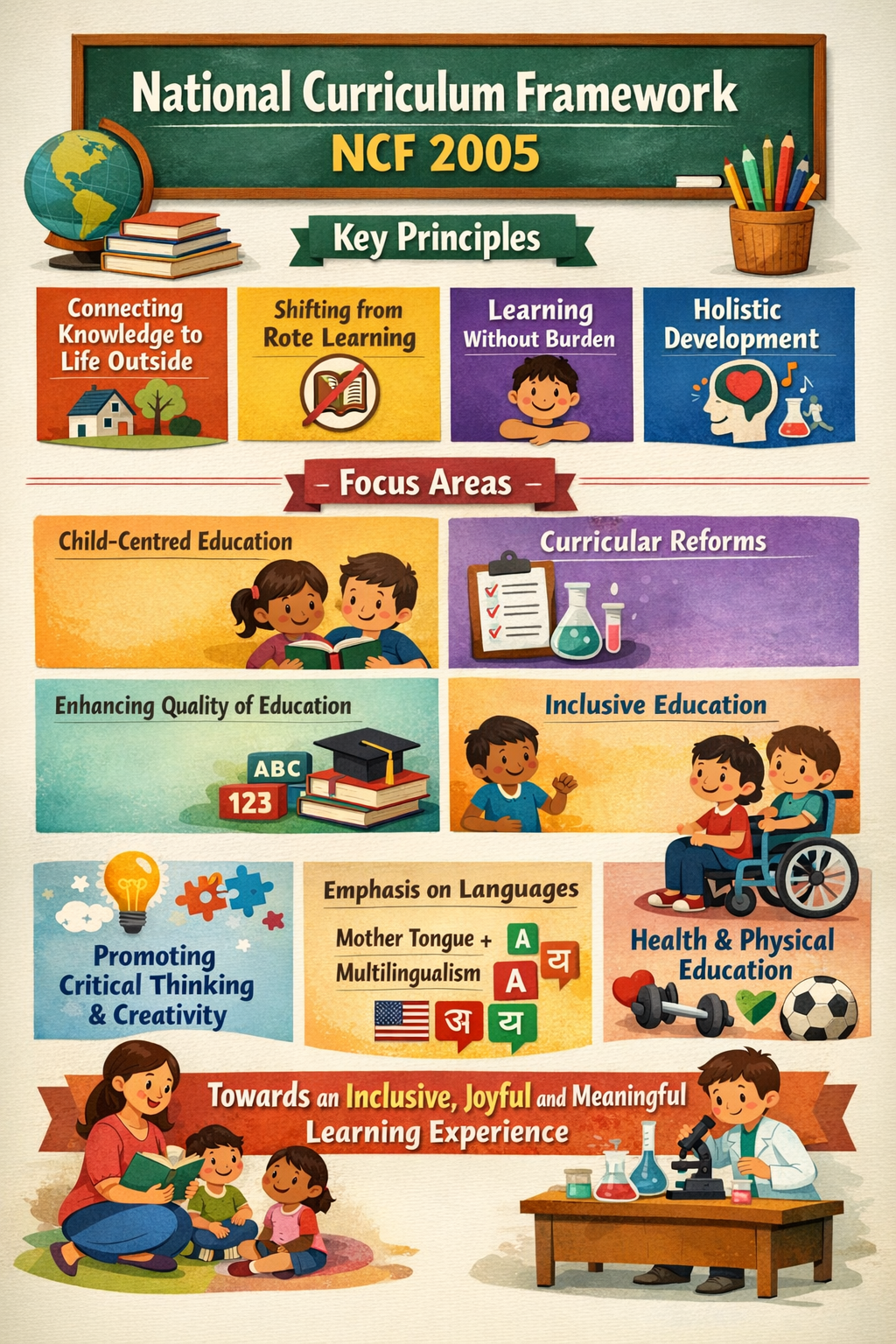
The perspective of curriculum in NCF 2005 focuses on making education meaningful for learners. It stresses that education should connect school knowledge with students’ real-life experiences.
Important perspectives include:
1. Connecting Knowledge with Life
Education should not remain limited to textbooks. Students should relate concepts to everyday life situations.
2. Learning Without Burden
NCF 2005 strongly supports reducing curriculum load and avoiding unnecessary memorization.
3. Child-Centered Education
The learner is placed at the center of the teaching-learning process.
4. Democratic Values
Curriculum should promote equality, justice, and social harmony.
5. Inclusive Education
Education should reach all children regardless of gender, caste, disability, or economic background.
NCF 2005 में पाठ्यचर्या का दृष्टिकोण इस बात पर आधारित है कि शिक्षा विद्यार्थियों के जीवन से जुड़ी हुई हो।
मुख्य बिंदु:
1. ज्ञान को जीवन से जोड़ना
विद्यालय में पढ़ाई जाने वाली सामग्री विद्यार्थियों के दैनिक जीवन से संबंधित होनी चाहिए।
2. बोझ रहित शिक्षा (Learning without Burden)
अनावश्यक रटने और भारी पाठ्यक्रम को कम करने पर जोर दिया गया है।
3. बाल-केन्द्रित शिक्षा
शिक्षण-अधिगम प्रक्रिया में विद्यार्थी को केंद्र में रखा गया है।
4. लोकतांत्रिक मूल्यों का विकास
शिक्षा समानता, न्याय और सामाजिक सद्भाव को बढ़ावा दे।
5. समावेशी शिक्षा
हर बच्चे को शिक्षा का समान अवसर मिले।

3. Learning and Knowledge (सीखना और ज्ञान)
NCF 2005 adopts a constructivist view of learning. According to this view, knowledge is not simply transmitted from teacher to student; rather, learners actively construct knowledge through experiences and interactions.
Important principles include:
1. Active Learning
Students learn better when they actively participate in activities, discussions, and problem-solving.
2. Prior Knowledge
Learning should build upon the learner’s existing knowledge and experiences.
3. Understanding Instead of Memorization
Conceptual understanding is more important than rote learning.
4. Learning Through Interaction
Social interaction and collaboration help students develop deeper understanding.
5. Critical Thinking
Education should encourage questioning, analysis, and reasoning.
NCF 2005 सीखने के लिए रचनावादी (Constructivist) दृष्टिकोण अपनाता है। इसका अर्थ है कि विद्यार्थी अपने अनुभवों के माध्यम से स्वयं ज्ञान का निर्माण करते हैं।
मुख्य सिद्धांत:
1. सक्रिय अधिगम
विद्यार्थी गतिविधियों और चर्चाओं के माध्यम से बेहतर सीखते हैं।
2. पूर्व ज्ञान का महत्व
नई जानकारी विद्यार्थियों के पहले से मौजूद ज्ञान पर आधारित होनी चाहिए।
3. समझ पर जोर
रटने के बजाय अवधारणाओं को समझना महत्वपूर्ण है।
4. सामाजिक अंतःक्रिया से सीखना
समूह कार्य और चर्चा सीखने को प्रभावी बनाते हैं।
5. आलोचनात्मक सोच
शिक्षा में प्रश्न पूछने और विश्लेषण की क्षमता विकसित करनी चाहिए।
4. Curricular Areas (पाठ्यचर्या के क्षेत्र)
NCF 2005 identifies major curricular areas that contribute to the holistic development of learners.
1. Language
Language learning is fundamental because it helps students express ideas and understand concepts.
2. Mathematics
Mathematics develops logical thinking and problem-solving skills.
3. Science
Science education promotes curiosity, experimentation, and understanding of natural phenomena.
4. Social Sciences
Social sciences help students understand society, culture, and democratic values.
5. Art Education
Art develops creativity and emotional expression.
6. Health and Physical Education
Physical education promotes physical fitness and mental well-being.
7. Work and Education
Work education connects learning with practical skills and real-life experiences.
NCF 2005 के अनुसार पाठ्यचर्या के प्रमुख क्षेत्र निम्न हैं:
1. भाषा
भाषा शिक्षा विद्यार्थियों को विचार व्यक्त करने और समझ विकसित करने में सहायता करती है।
2. गणित
गणित तार्किक सोच और समस्या समाधान क्षमता विकसित करता है।
3. विज्ञान
विज्ञान जिज्ञासा और प्रयोगात्मक अधिगम को बढ़ावा देता है।
4. सामाजिक विज्ञान
यह समाज, संस्कृति और लोकतांत्रिक मूल्यों की समझ विकसित करता है।
5. कला शिक्षा
कला रचनात्मकता और भावनात्मक अभिव्यक्ति को विकसित करती है।
6. स्वास्थ्य और शारीरिक शिक्षा
यह शारीरिक स्वास्थ्य और मानसिक संतुलन के लिए महत्वपूर्ण है।
7. कार्य शिक्षा
यह शिक्षा को व्यावहारिक जीवन से जोड़ती है।
5. School Stages (विद्यालयी चरण)
NCF 2005 divides school education into four stages:
1. Foundational Stage (Classes I–II)
Focus on play-based learning, language development, and basic numeracy.
2. Preparatory Stage (Classes III–V)
Development of reading, writing, and conceptual understanding.
3. Middle Stage (Classes VI–VIII)
Introduction of subject-based learning and analytical thinking.
4. Secondary Stage (Classes IX–XII)
Focus on deeper knowledge, critical thinking, and career preparation.
NCF 2005 के अनुसार विद्यालयी शिक्षा को चार चरणों में विभाजित किया गया है:
1. प्रारंभिक चरण (कक्षा 1–2)
खेल आधारित अधिगम और भाषा विकास।
2. प्राथमिक चरण (कक्षा 3–5)
पढ़ने-लिखने और अवधारणात्मक समझ का विकास।
3. उच्च प्राथमिक चरण (कक्षा 6–8)
विषय आधारित अध्ययन और विश्लेषणात्मक सोच।
4. माध्यमिक चरण (कक्षा 9–12)
गहन ज्ञान और करियर तैयारी।
6. Pedagogy in NCF 2005 (शिक्षण पद्धति)
NCF 2005 emphasizes learner-centered pedagogy.
Important strategies include:
- Activity-based learning
- Project-based learning
- Group discussion
- Inquiry-based learning
- Experiential learning
Teachers are expected to act as facilitators rather than mere transmitters of knowledge.
NCF 2005 में शिक्षण पद्धति विद्यार्थी केंद्रित है।
मुख्य पद्धतियाँ:
- गतिविधि आधारित अधिगम
- परियोजना आधारित अधिगम
- समूह चर्चा
- खोज आधारित अधिगम
- अनुभवात्मक अधिगम
यहाँ शिक्षक की भूमिका मार्गदर्शक (Facilitator) की होती है।
7. Assessment in NCF 2005 (मूल्यांकन)
NCF 2005 proposes reforms in assessment practices.
Important features include:
- Continuous and Comprehensive Evaluation (CCE)
- Assessment for learning
- Qualitative feedback
- Reduction of exam stress
Assessment should measure not only academic achievement but also skills, attitudes, and values.
NCF 2005 में मूल्यांकन प्रणाली में सुधार पर जोर दिया गया है।
मुख्य विशेषताएँ:
- सतत एवं समग्र मूल्यांकन (CCE)
- सीखने के लिए मूल्यांकन
- गुणात्मक प्रतिक्रिया
- परीक्षा तनाव में कमी
मूल्यांकन केवल अंक देने के लिए नहीं बल्कि समग्र विकास को मापने के लिए होना चाहिए।
8. Importance of NCF 2005 in School Education
NCF 2005 brought significant changes in Indian school education:
- Promoted child-centered learning
- Reduced rote memorization
- Encouraged constructivist pedagogy
- Introduced continuous evaluation
- Emphasized inclusive education
It remains an important reference for curriculum design even today.
NCF 2005 ने भारतीय शिक्षा प्रणाली में कई महत्वपूर्ण बदलाव किए:
- बाल-केन्द्रित शिक्षा को बढ़ावा
- रटने की प्रवृत्ति में कमी
- रचनावादी शिक्षण पद्धति
- सतत मूल्यांकन
- समावेशी शिक्षा
9. Conclusion (निष्कर्ष)School Curriculum
The National Curriculum Framework 2005 is a milestone in the development of school education in India. It emphasizes meaningful learning, learner participation, and holistic development.
By focusing on curriculum perspective, learning processes, curricular areas, school stages, pedagogy, and assessment, NCF 2005 aims to create an education system that prepares students for both academic success and responsible citizenship.
National Curriculum Framework 2005 भारतीय विद्यालयी शिक्षा के विकास में एक महत्वपूर्ण मील का पत्थर है। यह शिक्षा को समझ, अनुभव और समग्र विकास पर आधारित बनाता है।
पाठ्यचर्या का दृष्टिकोण, अधिगम प्रक्रिया, पाठ्यचर्या क्षेत्र, विद्यालयी चरण, शिक्षण पद्धति और मूल्यांकन के माध्यम से यह ढाँचा विद्यार्थियों को जिम्मेदार नागरिक बनने के लिए तैयार करता है।
Please visit for similar topics: https://teacherszone.in/
Please follow us on Facebook : https://www.facebook.com/profile.php?id=61586013442564
10. MCQs on NCF 2005 (CTET / NET / KVS / DSSSB Level): School Curriculum
Basic Concept Questions School Curriculum
1. The National Curriculum Framework 2005 was developed by:
A. UGC
B. NCERT
C. NIOS
D. AICTE
Answer: B
2. The NCF 2005 is mainly concerned with:
A. School curriculum
B. University education
C. Technical education
D. Adult education
Answer: A
3. NCF 2005 emphasizes:
A. Rote learning
B. Child-centered learning
C. Teacher-centered learning
D. Lecture method
Answer: B
4. NCF 2005 is based on which learning theory?
A. Behaviorism
B. Constructivism
C. Idealism
D. Pragmatism
Answer: B
5. The main objective of NCF 2005 is:
A. Reduce curriculum load
B. Promote meaningful learning
C. Encourage critical thinking
D. All of the above
Answer: D
6. The guiding principle of NCF 2005 is:
A. Learning without burden
B. Rote memorization
C. Teacher authority
D. Exam orientation
Answer: A
7. NCF 2005 recommends linking knowledge with:
A. Examination
B. Real-life experience
C. Memorization
D. Textbooks
Answer: B
8. NCF 2005 focuses on:
A. Activity-based learning
B. Passive learning
C. Mechanical learning
D. Memorization
Answer: A
9. NCF 2005 promotes:
A. Inclusive education
B. Discrimination
C. Segregation
D. Elitism
Answer: A
10. The NCF 2005 encourages:
A. Critical thinking
B. Creativity
C. Problem solving
D. All of the above
Answer: D
11–20 Learning and Knowledge
11. In NCF 2005, knowledge is seen as:
A. Fixed
B. Constructed by learners
C. Memorized
D. Dictated by teacher
Answer: B
12. According to NCF 2005 learning should be:
A. Passive
B. Interactive
C. Mechanical
D. Isolated
Answer: B
13. The constructivist approach emphasizes:
A. Teacher dominance
B. Learner participation
C. Lecture method
D. Memorization
Answer: B
14. Prior knowledge of students is:
A. Ignored
B. Discouraged
C. Important in learning
D. Irrelevant
Answer: C
15. NCF 2005 discourages:
A. Understanding
B. Rote learning
C. Creativity
D. Inquiry
Answer: B
16. Learning is most effective when:
A. Students memorize facts
B. Students actively participate
C. Teacher lectures continuously
D. Students remain silent
Answer: B
17. NCF 2005 encourages:
A. Discussion
B. Group learning
C. Collaborative learning
D. All of the above
Answer: D
18. Learning should involve:
A. Exploration
B. Discovery
C. Inquiry
D. All of the above
Answer: D
19. NCF 2005 supports:
A. Creativity in learning
B. Innovation
C. Critical analysis
D. All of the above
Answer: D
20. Knowledge should be:
A. Contextual
B. Abstract
C. Memorized
D. Isolated
Answer: A
Curriculum Principles
21. The curriculum should connect knowledge with:
A. Life outside school
B. Examinations
C. Memorization
D. Marks
Answer: A
22. NCF 2005 aims to reduce:
A. Curriculum load
B. Learning opportunities
C. Student participation
D. Activities
Answer: A
23. Curriculum should promote:
A. Democratic values
B. Social justice
C. Equality
D. All of the above
Answer: D
24. The curriculum should be:
A. Flexible
B. Rigid
C. Static
D. Unchanging
Answer: A
25. NCF 2005 encourages:
A. Experiential learning
B. Passive learning
C. Mechanical learning
D. Drill practice
Answer: A
26. School curriculum must consider:
A. Child development
B. Social context
C. Cultural diversity
D. All of the above
Answer: D
27. The curriculum should be:
A. Inclusive
B. Exclusive
C. Elitist
D. Segregated
Answer: A
28. NCF 2005 promotes:
A. Gender equality
B. Gender bias
C. Gender discrimination
D. Gender hierarchy
Answer: A
29. Education should encourage:
A. National identity
B. Cultural diversity
C. Social harmony
D. All of the above
Answer: D
30. The curriculum should develop:
A. Knowledge
B. Skills
C. Values
D. All of the above
Answer: D
Curricular Areas
31. Language education helps students:
A. Express ideas
B. Communicate effectively
C. Develop thinking skills
D. All of the above
Answer: D
32. Mathematics education develops:
A. Logical thinking
B. Problem solving
C. Analytical skills
D. All of the above
Answer: D
33. Science education encourages:
A. Curiosity
B. Experimentation
C. Inquiry
D. All of the above
Answer: D
34. Social science helps students understand:
A. Society
B. Culture
C. Democracy
D. All of the above
Answer: D
35. Art education promotes:
A. Creativity
B. Emotional expression
C. Imagination
D. All of the above
Answer: D
36. Health education promotes:
A. Physical fitness
B. Mental health
C. Well-being
D. All of the above
Answer: D
37. Work education connects learning with:
A. Real-life skills
B. Practical work
C. Vocational understanding
D. All of the above
Answer: D
38. Environmental education promotes:
A. Environmental awareness
B. Sustainability
C. Conservation
D. All of the above
Answer: D
39. Curriculum should integrate:
A. Arts
B. Work
C. Physical education
D. All of the above
Answer: D
40. NCF 2005 encourages interdisciplinary learning between:
A. Subjects
B. Experiences
C. Activities
D. All of the above
Answer: D
Pedagogy
41. Teachers should act as:
A. Dictators
B. Facilitators
C. Controllers
D. Examiners
Answer: B
42. Pedagogy should focus on:
A. Student participation
B. Lecture method
C. Rote learning
D. Punishment
Answer: A
43. Activity-based learning encourages:
A. Passive listening
B. Active participation
C. Memorization
D. Silence
Answer: B
44. Project method develops:
A. Research skills
B. Problem solving
C. Teamwork
D. All of the above
Answer: D
45. Inquiry-based learning promotes:
A. Questioning
B. Investigation
C. Discovery
D. All of the above
Answer: D
46. Cooperative learning involves:
A. Group work
B. Competition
C. Individual isolation
D. Memorization
Answer: A
47. Experiential learning means learning through:
A. Experience
B. Lecture
C. Memorization
D. Reading only
Answer: A
48. Child-centered pedagogy emphasizes:
A. Learner needs
B. Teacher authority
C. Exam performance
D. Discipline
Answer: A
49. Classroom interaction should be:
A. One-way
B. Two-way
C. Authoritarian
D. Silent
Answer: B
50. NCF 2005 promotes:
A. Flexible teaching methods
B. Rigid teaching methods
C. Mechanical teaching
D. Lecture dominance
Answer: A
Assessment
51. NCF 2005 emphasizes:
A. Continuous evaluation
B. One-time examination
C. Memorization tests
D. Only final exams
Answer: A
52. Continuous and Comprehensive Evaluation means:
A. Ongoing assessment
B. Holistic evaluation
C. Multiple assessment methods
D. All of the above
Answer: D
53. Assessment should focus on:
A. Understanding
B. Skills
C. Values
D. All of the above
Answer: D
54. Examination stress should be:
A. Increased
B. Reduced
C. Ignored
D. Encouraged
Answer: B
55. Assessment should provide:
A. Feedback
B. Marks only
C. Punishment
D. Ranking
Answer: A
56. Portfolio assessment records:
A. Student progress
B. Test marks
C. Attendance
D. Punishment
Answer: A
57. Formative assessment occurs:
A. During learning
B. After course completion
C. Only in exams
D. Once a year
Answer: A
58. Summative assessment occurs:
A. At the end of learning
B. During teaching
C. During discussion
D. Daily
Answer: A
59. Assessment should encourage:
A. Reflection
B. Improvement
C. Self-evaluation
D. All of the above
Answer: D
60. NCF 2005 promotes assessment for:
A. Learning
B. Ranking
C. Punishment
D. Elimination
Answer: A
11. Previous-Year MCQs on NCF 2005 based on School Curriculum
1. The National Curriculum Framework 2005 recommends connecting knowledge with:
A. Examination system
B. Life outside the school
C. Memorization
D. Teacher authority
Answer: B
Exam: CTET 2015
2. According to NCF 2005, the role of the teacher should be:
A. Authority
B. Facilitator of learning
C. Controller
D. Examiner
Answer: B
Exam: CTET 2014
3. NCF 2005 is based on which theory of learning?
A. Behaviorism
B. Constructivism
C. Idealism
D. Naturalism
Answer: B
Exam: UGC NET 2017
4. Which of the following is discouraged by NCF 2005?
A. Conceptual learning
B. Rote memorization
C. Activity-based learning
D. Experiential learning
Answer: B
Exam: CTET 2016
5. The major aim of NCF 2005 is:
A. Examination success
B. Holistic development of learners
C. Memorization
D. Competitive ranking
Answer: B
Exam: DSSSB TGT 2018
6. Which of the following is emphasized in NCF 2005?
A. Teacher-centered education
B. Child-centered learning
C. Lecture method
D. Drill method
Answer: B
Exam: CTET 2013
7. NCF 2005 emphasizes the importance of:
A. Multiple textbooks
B. Single textbook
C. No textbook
D. Only guidebooks
Answer: A
Exam: KVS PRT 2017
8. The constructivist approach in NCF 2005 means:
A. Knowledge is transmitted
B. Knowledge is constructed by learners
C. Knowledge is memorized
D. Knowledge is dictated
Answer: B
Exam: UGC NET 2018
9. Learning in NCF 2005 is viewed as:
A. Passive process
B. Active process
C. Mechanical process
D. Fixed process
Answer: B
Exam: CTET 2014
10. Which curricular area promotes creativity according to NCF 2005?
A. Mathematics
B. Art education
C. Social science
D. Language
Answer: B
Exam: DSSSB 2019
11. According to NCF 2005, learning should:
A. Ignore prior knowledge
B. Build on prior knowledge
C. Focus on memorization
D. Be teacher controlled
Answer: B
Exam: CTET 2018
12. NCF 2005 supports:
A. Inclusive education
B. Exclusive education
C. Segregated education
D. Selective education
Answer: A
Exam: KVS 2018
13. Which method is encouraged by NCF 2005?
A. Lecture method
B. Project method
C. Drill method
D. Dictation method
Answer: B
Exam: DSSSB 2020
14. Which of the following helps develop critical thinking according to NCF 2005?
A. Memorization
B. Inquiry-based learning
C. Repetition
D. Lecture
Answer: B
Exam: CTET 2019
15. NCF 2005 suggests reducing:
A. Student participation
B. Curriculum load
C. Activities
D. Discussions
Answer: B
Exam: CTET 2015
16. The aim of science education in NCF 2005 is to develop:
A. Curiosity
B. Inquiry
C. Experimentation
D. All of the above
Answer: D
Exam: KVS 2019
17. Social science education aims to promote:
A. National identity
B. Democratic values
C. Social understanding
D. All of the above
Answer: D
Exam: DSSSB 2017
18. NCF 2005 encourages:
A. Cooperative learning
B. Competition only
C. Individual isolation
D. Memorization
Answer: A
Exam: CTET 2018
19. Continuous and Comprehensive Evaluation focuses on:
A. Final exam only
B. Continuous assessment
C. Only oral test
D. Only written exam
Answer: B
Exam: CTET 2016
20. Which is emphasized in assessment by NCF 2005?
A. Memorization
B. Understanding and skills
C. Only marks
D. Ranking
Answer: B
Exam: UGC NET 2019
21. According to NCF 2005 curriculum should:
A. Promote social justice
B. Promote equality
C. Promote democratic values
D. All of the above
Answer: D
Exam: UGC NET 2020
22. The learning environment should be:
A. Fearful
B. Stressful
C. Joyful
D. Competitive
Answer: C
Exam: CTET 2017
23. Work education in NCF 2005 aims to:
A. Promote manual skills
B. Connect education with life
C. Develop practical abilities
D. All of the above
Answer: D
Exam: DSSSB 2018
24. Environmental education promotes:
A. Environmental awareness
B. Conservation
C. Sustainability
D. All of the above
Answer: D
Exam: CTET 2019
25. Language education promotes:
A. Communication skills
B. Thinking ability
C. Expression
D. All of the above
Answer: D
Exam: KVS 2018
26. Mathematics education should emphasize:
A. Problem solving
B. Logical reasoning
C. Conceptual understanding
D. All of the above
Answer: D
Exam: CTET 2016
27. The school curriculum should encourage:
A. Creativity
B. Critical thinking
C. Innovation
D. All of the above
Answer: D
Exam: UGC NET 2021
28. The teacher should promote:
A. Questioning
B. Discussion
C. Exploration
D. All of the above
Answer: D
Exam: CTET 2020
29. NCF 2005 suggests that knowledge should be:
A. Contextual
B. Isolated
C. Memorized
D. Fixed
Answer: A
Exam: UGC NET 2018
30. Assessment should help students:
A. Improve learning
B. Reflect on progress
C. Develop skills
D. All of the above
Answer: D
Exam: CTET 2017
31. Portfolio assessment records:
A. Student achievements
B. Progress over time
C. Learning experiences
D. All of the above
Answer: D
Exam: KVS 2019
32. Formative assessment is conducted:
A. During learning
B. After course completion
C. At the end of year
D. Only in exams
Answer: A
Exam: CTET 2016
33. Summative assessment occurs:
A. At the end of a term
B. During class discussion
C. During project work
D. Daily
Answer: A
Exam: DSSSB 2019
34. NCF 2005 emphasizes reducing:
A. Student curiosity
B. Exam stress
C. Classroom activities
D. Discussion
Answer: B
Exam: CTET 2018
35. Learning should encourage:
A. Exploration
B. Discovery
C. Inquiry
D. All of the above
Answer: D
Exam: UGC NET 2020
36. Pedagogy should be:
A. Child-centered
B. Teacher-centered
C. Exam-centered
D. Content-centered
Answer: A
Exam: CTET 2017
37. NCF 2005 promotes:
A. Inclusive classrooms
B. Segregated classrooms
C. Elite classrooms
D. Competitive classrooms
Answer: A
Exam: DSSSB 2020
38. Teachers should encourage:
A. Dialogue
B. Questioning
C. Reflection
D. All of the above
Answer: D
Exam: UGC NET 2019
39. Assessment should measure:
A. Knowledge
B. Skills
C. Attitudes
D. All of the above
Answer: D
Exam: CTET 2019
40. NCF 2005 emphasizes:
A. Holistic education
B. Examination success
C. Memorization
D. Competition
Answer: A
Exam: UGC NET 2021
School Curriculum