
Learn about the Right of Children to Free and Compulsory Education Act 2009, its constitutional background, provisions, features, amendments, and significance for CTET, NET, B.Ed, and M.Ed exams in English and Hindi.
Table of Contents
(Right of Children to Free and Compulsory Education Act, 2009)
1. Introduction / परिचय/Right of Children to Free and Compulsory Education Act, 2009
Education is the foundation of social, economic, and democratic development. Recognizing its importance, the Government of India enacted the Right of Children to Free and Compulsory Education Act, 2009, commonly known as the RTE Act. The Act guarantees every child the right to elementary education and places legal responsibility on the State to ensure its implementation.
शिक्षा सामाजिक, आर्थिक और लोकतांत्रिक विकास का आधार है। इसी महत्व को ध्यान में रखते हुए भारत सरकार ने बच्चों का नि:शुल्क और अनिवार्य शिक्षा का अधिकार अधिनियम, 2009 (RTE Act) लागू किया। यह अधिनियम प्रत्येक बच्चे को प्रारंभिक शिक्षा का अधिकार प्रदान करता है और इसके क्रियान्वयन की कानूनी जिम्मेदारी राज्य पर डालता है।
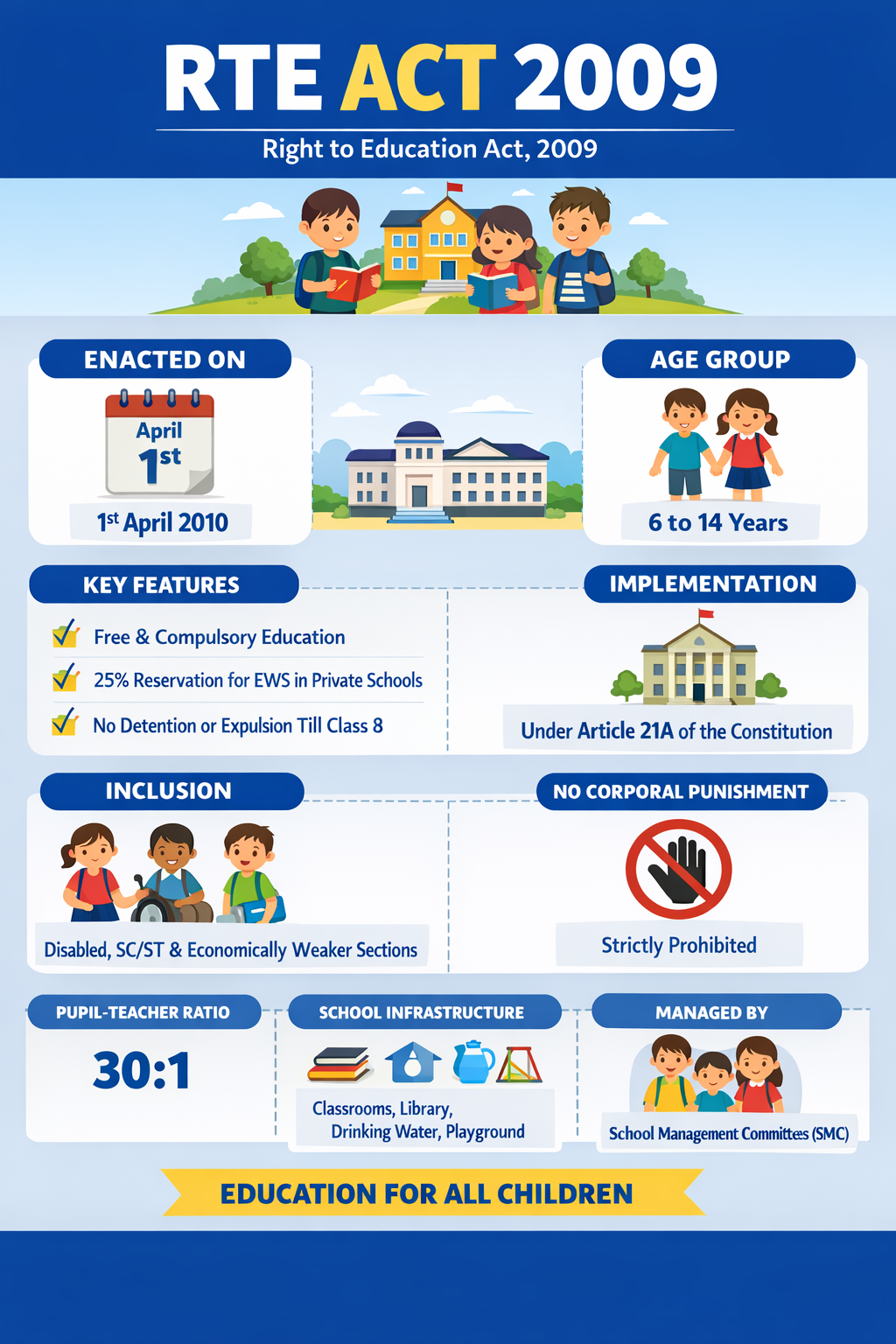
The Act came into force on 1 April 2010 and ensures that every child between the ages of 6 to 14 years receives free and compulsory education in a neighbourhood school.
यह अधिनियम 1 अप्रैल 2010 से लागू हुआ और 6 से 14 वर्ष तक के प्रत्येक बच्चे को पड़ोस के विद्यालय में नि:शुल्क एवं अनिवार्य शिक्षा प्रदान करने की व्यवस्था करता है।
2. Constitutional Background of RTE Act / RTE अधिनियम का संवैधानिक आधार
The Right to Education Act is rooted in the 86th Constitutional Amendment Act, 2002 which made education a fundamental right for children.
RTE अधिनियम का आधार 86वां संविधान संशोधन अधिनियम, 2002 है, जिसने शिक्षा को बच्चों के लिए मौलिक अधिकार बना दिया।
Key Constitutional Provisions / प्रमुख संवैधानिक प्रावधान
- Article 21A
Provides free and compulsory education to children aged 6–14 years. अनुच्छेद 21A
6–14 वर्ष के बच्चों को नि:शुल्क एवं अनिवार्य शिक्षा का अधिकार प्रदान करता है। - Article 45 (Revised)
The State shall provide early childhood care and education for children below six years. अनुच्छेद 45 (संशोधित)
राज्य 6 वर्ष से कम आयु के बच्चों के लिए प्रारंभिक बाल देखभाल और शिक्षा प्रदान करेगा। - Article 51A(k)
It is the duty of parents or guardians to provide opportunities for education to children between 6–14 years. अनुच्छेद 51A (क)
माता-पिता या अभिभावकों का कर्तव्य है कि वे 6–14 वर्ष के बच्चों को शिक्षा दिलाएं।
Thus, the RTE Act operationalizes the constitutional mandate of universal elementary education.
इस प्रकार RTE अधिनियम सार्वभौमिक प्रारंभिक शिक्षा के संवैधानिक प्रावधान को लागू करता है।
3. Objectives of the Right of Children to Free and Compulsory Education Act, 2009 / RTE अधिनियम के उद्देश्य
The main objectives of the Act include:
- Universalization of elementary education
- Ensuring equality and social justice in education
- Eliminating barriers to school access
- Improving quality of education
- Protecting children from discrimination
- प्रारंभिक शिक्षा का सार्वभौमीकरण
- शिक्षा में समानता और सामाजिक न्याय सुनिश्चित करना
- विद्यालय पहुंच में बाधाओं को समाप्त करना
- शिक्षा की गुणवत्ता में सुधार करना
- बच्चों को भेदभाव से बचाना
4. Meaning of “Free and Compulsory Education”/“नि:शुल्क और अनिवार्य शिक्षा” का अर्थ
According to the Act:
Free Education means no child shall be required to pay any fee or charges that prevent them from completing elementary education.
नि:शुल्क शिक्षा का अर्थ है कि कोई भी बच्चा ऐसी फीस या खर्च देने के लिए बाध्य नहीं होगा जो उसकी शिक्षा में बाधा बने।
Compulsory Education means the government must ensure admission, attendance, and completion of elementary education for every child aged 6–14 years.
अनिवार्य शिक्षा का अर्थ है कि सरकार प्रत्येक बच्चे के विद्यालय में प्रवेश, उपस्थिति और शिक्षा पूर्ण कराने की जिम्मेदारी लेगी।
5. Important Features of the Right of Children to Free and Compulsory Education Act, 2009 / RTE अधिनियम की प्रमुख विशेषताएँ
1. Right to Elementary Education
Every child aged 6–14 years has the right to free education in a neighbourhood school.
6–14 वर्ष के प्रत्येक बच्चे को पड़ोस के विद्यालय में नि:शुल्क शिक्षा का अधिकार है।
2. 25% Reservation in Private Schools
Private unaided schools must reserve 25% seats for children from economically weaker sections (EWS).
निजी विद्यालयों में 25% सीटें आर्थिक रूप से कमजोर वर्ग के बच्चों के लिए आरक्षित होती हैं।
3. Age-Appropriate Admission
Children who have never been to school must be admitted to their age-appropriate class.
जो बच्चे पहले कभी स्कूल नहीं गए, उन्हें उनकी आयु के अनुसार कक्षा में प्रवेश दिया जाएगा।
4. Prohibition of Screening Test
Schools cannot conduct screening tests during admission.
विद्यालय प्रवेश के लिए स्क्रीनिंग टेस्ट नहीं ले सकते।
5. Ban on Capitation Fee
Schools cannot charge donations or capitation fees.
विद्यालय किसी भी प्रकार का डोनेशन नहीं ले सकते।
6. Child-Friendly Education
The Act promotes child-centered and activity-based learning.
यह अधिनियम बाल-केन्द्रित और गतिविधि-आधारित शिक्षा को बढ़ावा देता है।
6. Norms and Standards for Schools / विद्यालयों के लिए मानक
The RTE Act prescribes certain norms:
- Proper school building
- Separate toilets for boys and girls
- Safe drinking water
- Library and playground
- Qualified teachers
- उचित विद्यालय भवन
- लड़कों और लड़कियों के लिए अलग शौचालय
- सुरक्षित पेयजल
- पुस्तकालय और खेल का मैदान
- प्रशिक्षित शिक्षक
The Act also specifies Pupil-Teacher Ratio (PTR) and teacher qualifications.
7. Duties of Government and Local Authorities/सरकार और स्थानीय निकायों के कर्तव्य
- Establish neighbourhood schools
- Ensure admission and attendance
- Provide infrastructure and teachers
- Monitor implementation
- पड़ोस के विद्यालय स्थापित करना
- प्रवेश और उपस्थिति सुनिश्चित करना
- आवश्यक संसाधन और शिक्षक उपलब्ध कराना
- अधिनियम के क्रियान्वयन की निगरानी करना
8. Duties of Teachers / शिक्षकों के कर्तव्य
Teachers must:
- Maintain regular attendance
- Complete the curriculum
- Assess student learning
- Promote inclusive education
Teachers are also prohibited from private tuition and non-educational work except census, elections, and disaster relief.
शिक्षकों के प्रमुख कर्तव्य:
- नियमित उपस्थिति बनाए रखना
- पाठ्यक्रम पूरा करना
- छात्रों का मूल्यांकन करना
- समावेशी शिक्षा को बढ़ावा देना
9. Provisions for Child Protection
बाल संरक्षण से संबंधित प्रावधान
The RTE Act strictly prohibits:
- Physical punishment
- Mental harassment
- Discrimination in schools
RTE अधिनियम निम्नलिखित को प्रतिबंधित करता है:
- शारीरिक दंड
- मानसिक उत्पीड़न
- विद्यालयों में भेदभाव
10. School Management Committee (SMC) / स्कूल प्रबंधन समिति
Every government school must form a School Management Committee (SMC).
Functions
- Monitor school functioning
- Prepare school development plans
- Promote community participation
प्रत्येक सरकारी विद्यालय में स्कूल प्रबंधन समिति (SMC) बनाई जाती है।
इसके कार्य:
- विद्यालय के कार्यों की निगरानी
- विकास योजना तैयार करना
- समुदाय की भागीदारी बढ़ाना
11. Amendments to the Right of Children to Free and Compulsory Education Act, 2009 / RTE अधिनियम में संशोधन
1. No-Detention Policy Amendment (2019)
Earlier, students could not be detained till class 8. The amendment allows states to conduct exams and detain students if they fail after re-examination.
पहले कक्षा 8 तक छात्रों को फेल नहीं किया जाता था। 2019 संशोधन के बाद राज्यों को परीक्षा आयोजित करने और असफल छात्रों को रोकने की अनुमति दी गई।
12. Achievements of the Right of Children to Free and Compulsory Education Act, 2009 / RTE अधिनियम की उपलब्धियाँ
- Increased school enrolment
- Reduced dropout rates
- Improved gender equality
- Better school infrastructure
- नामांकन दर में वृद्धि
- ड्रॉपआउट में कमी
- लैंगिक समानता में सुधार
- विद्यालय सुविधाओं में सुधार
13. Challenges in Implementation / कार्यान्वयन में चुनौतियाँ
Despite progress, some challenges remain:
- Lack of infrastructure in rural schools
- Teacher shortages
- Quality of education
- Administrative issues
कुछ प्रमुख चुनौतियाँ:
- ग्रामीण क्षेत्रों में अधोसंरचना की कमी
- शिक्षकों की कमी
- शिक्षा की गुणवत्ता
- प्रशासनिक समस्याएँ
14. Conclusion / निष्कर्ष
The Right of Children to Free and Compulsory Education Act, 2009 is one of the most significant education reforms in India. It transformed elementary education from a welfare measure into a fundamental right and established a rights-based framework for universal education.
बच्चों का नि:शुल्क और अनिवार्य शिक्षा का अधिकार अधिनियम, 2009 भारत की सबसे महत्वपूर्ण शैक्षिक नीतियों में से एक है। इसने शिक्षा को कल्याणकारी योजना से आगे बढ़ाकर मौलिक अधिकार बना दिया और सार्वभौमिक शिक्षा के लिए एक अधिकार-आधारित ढांचा स्थापित किया।
The effective implementation of this Act is essential for achieving inclusive, equitable, and quality education for all children.
Please visit for more topics: https://teacherszone.in/
Please follow us on Facebook: https://www.facebook.com/profile.php?id=61586013442564

15. Exam-Oriented MCQs onRight of Children to Free and Compulsory Education Act, 2009
(CTET / NET / KVS / DSSSB Pattern with Answers)
1. The Right of Children to Free and Compulsory Education Act was enacted in:
A. 2002
B. 2005
C. 2009
D. 2012
Answer: C (2009)
2. The RTE Act came into force on:
A. 15 August 2009
B. 1 April 2010
C. 26 January 2010
D. 1 January 2011
Answer: B (1 April 2010)
3. The RTE Act provides free and compulsory education to children aged:
A. 3–6 years
B. 6–14 years
C. 6–18 years
D. 5–15 years
Answer: B (6–14 years)
4. Which Constitutional Amendment made education a Fundamental Right?
A. 42nd Amendment
B. 73rd Amendment
C. 86th Amendment
D. 91st Amendment
Answer: C (86th Amendment, 2002)
5. Article ______ of the Constitution guarantees the Right to Education.
A. Article 19
B. Article 21A
C. Article 25
D. Article 45
Answer: B (Article 21A)
6. The RTE Act is related to which level of education?
A. Secondary education
B. Elementary education
C. Higher education
D. Vocational education
Answer: B (Elementary education)
7. The RTE Act applies to which of the following schools?
A. Government schools
B. Government-aided schools
C. Private schools
D. All of the above
Answer: D (All of the above)
8. The main objective of the RTE Act is:
A. Higher education expansion
B. Universal elementary education
C. Adult education
D. Technical education
Answer: B
9. The RTE Act is also known as:
A. Education Rights Act
B. Compulsory Education Act
C. Right to Education Act
D. National Education Act
Answer: C
10. The RTE Act is an example of:
A. Directive principle
B. Fundamental right implementation
C. Welfare scheme
D. Education policy
Answer: B
11. According to RTE, private schools must reserve seats for EWS students:
A. 10%
B. 15%
C. 25%
D. 30%
Answer: C (25%)
12. The 25% reservation in private schools applies to:
A. Secondary classes
B. Pre-primary and Class 1
C. Class 5
D. Class 8
Answer: B
13. Under RTE, screening tests for admission are:
A. Allowed
B. Partially allowed
C. Prohibited
D. Compulsory
Answer: C
14. Charging capitation fees by schools is:
A. Allowed
B. Encouraged
C. Prohibited
D. Optional
Answer: C
15. Children who have not attended school earlier must be admitted to:
A. Class 1
B. Nursery
C. Age-appropriate class
D. Class 5
Answer: C
16. According to RTE, the distance of a primary school from a child’s residence should be about:
A. 1 km
B. 3 km
C. 5 km
D. 10 km
Answer: A
17. Upper primary school should be available within:
A. 1 km
B. 2 km
C. 3 km
D. 5 km
Answer: C
18. The RTE Act prohibits:
A. Homework
B. Physical punishment
C. Classroom teaching
D. Exams
Answer: B
19. Which of the following is mandatory under RTE?
A. Library
B. Playground
C. Drinking water
D. All of the above
Answer: D
20. The pupil-teacher ratio (PTR) is specified under:
A. RTE norms
B. NCF 2005
C. NEP 2020
D. UGC guidelines
Answer: A
21. Teacher duties under RTE are given in:
A. Section 21
B. Section 24
C. Section 30
D. Section 15
Answer: B
22. Teachers are not allowed to engage in:
A. Census duty
B. Election duty
C. Private tuition
D. Disaster relief
Answer: C
23. Teachers can be assigned which duty?
A. Election duty
B. Census
C. Disaster relief
D. All of the above
Answer: D
24. Continuous and Comprehensive Evaluation (CCE) was related to:
A. Secondary education
B. RTE Act
C. Higher education
D. Vocational training
Answer: B
25. Under the original RTE Act, students were not detained until:
A. Class 5
B. Class 6
C. Class 8
D. Class 10
Answer: C
26. The “No Detention Policy” was modified in:
A. 2015
B. 2017
C. 2019
D. 2020
Answer: C
27. The RTE Act focuses mainly on:
A. Quality education
B. Inclusive education
C. Universal education
D. All of the above
Answer: D
28. Age-appropriate admission provision is given in:
A. Section 3
B. Section 4
C. Section 6
D. Section 8
Answer: B
29. Who monitors RTE implementation at the national level?
A. UGC
B. NCERT
C. NCPCR
D. CBSE
Answer: C
30. State-level monitoring of RTE is done by:
A. SCPCR
B. UGC
C. AICTE
D. CBSE
Answer: A
31. School Management Committee is mentioned in:
A. Section 21
B. Section 18
C. Section 15
D. Section 10
Answer: A
32. At least ______ members of SMC should be parents.
A. 25%
B. 50%
C. 75%
D. 90%
Answer: C
33. The main function of SMC is:
A. Teacher appointment
B. School development plan
C. Curriculum design
D. Examination
Answer: B
34. SMC promotes:
A. Community participation
B. Private funding
C. Teacher transfer
D. Political activities
Answer: A
35. SMC prepares a plan for:
A. Teacher recruitment
B. School development
C. Curriculum development
D. Examination reforms
Answer: B
36. Under RTE, discrimination in schools is:
A. Allowed
B. Restricted
C. Prohibited
D. Optional
Answer: C
37. Corporal punishment is banned under:
A. Section 15
B. Section 17
C. Section 19
D. Section 25
Answer: B
38. RTE promotes which type of learning?
A. Teacher-centered
B. Child-centered
C. Rote learning
D. Lecture method
Answer: B
39. Children with disabilities are covered under:
A. Inclusive education
B. Special education only
C. Home education only
D. None
Answer: A
40. The RTE Act emphasizes:
A. Punishment-based discipline
B. Fear-free environment
C. Competitive learning
D. Ranking system
Answer: B
46. The RTE Act transformed education from:
A. Privilege to service
B. Welfare scheme to fundamental right
C. Service to privilege
D. Optional activity
Answer: B
47. The RTE Act mainly focuses on:
A. Secondary education
B. Elementary education
C. Higher education
D. Adult literacy
Answer: B
48. Which of the following is NOT a feature of RTE?
A. Capitation fee
B. Inclusive education
C. Free education
D. Compulsory education
Answer: A
49. RTE Act promotes:
A. Equality in education
B. Social justice
C. Universal access
D. All of the above
Answer: D
50. Which organization developed teacher eligibility guidelines under RTE?
A. NCERT
B. NCTE
C. UGC
D. CBSE
Answer: B
51. The RTE Act is related to which concept?
A. Human rights
B. Economic rights
C. Educational rights
D. All of the above
Answer: D
52. The RTE Act ensures:
A. Free textbooks
B. Free uniform in many states
C. Mid-day meals
D. All of the above
Answer: D
53. The RTE Act applies to:
A. Government schools only
B. Private schools only
C. Both government and private schools
D. Higher education institutions
Answer: C
54. Which principle is promoted by RTE?
A. Equity
B. Inclusion
C. Access
D. All of the above
Answer: D
55. RTE Act is a part of:
A. Educational reform
B. Social reform
C. Constitutional reform
D. All of the above
Answer: D
56. The Act aims to reduce:
A. Illiteracy
B. Dropout rate
C. Educational inequality
D. All of the above
Answer: D
57. RTE ensures education in a:
A. Fear-based environment
B. Child-friendly environment
C. Competitive environment
D. Punitive environment
Answer: B
58. The implementation of RTE is the responsibility of:
A. Central government
B. State government
C. Local authorities
D. All of the above
Answer: D
59. The Act aims to achieve:
A. Universal elementary education
B. Universal higher education
C. Vocational training
D. Adult literacy
Answer: A
60. The RTE Act is considered a milestone in:
A. Social justice
B. Educational equality
C. Child rights protection
D. All of the above
Answer: D
16. Previous Year MCQs based on Right to Education Act 2009
1.
The Right to Education Act came into force on:
A. 15 August 2009
B. 1 April 2010
C. 26 January 2010
D. 5 September 2009
Answer: B
2.
The Right to Education Act guarantees free and compulsory education to children aged:
A. 5–14 years
B. 6–14 years
C. 6–18 years
D. 7–14 years
Answer: B
3.
The RTE Act, 2009 is associated with which Article of the Constitution?
A. Article 19
B. Article 21A
C. Article 45
D. Article 51A
Answer: B
4.
Article 21A was inserted by the:
A. 84th Amendment
B. 86th Amendment
C. 42nd Amendment
D. 73rd Amendment
Answer: B
5.
According to RTE, every child has the right to free education in a neighbourhood school till completion of:
A. Secondary education
B. Elementary education
C. Primary education
D. Higher education
Answer: B
6.
Elementary education under the RTE Act refers to:
A. Class I–V
B. Class I–VIII
C. Class I–X
D. Class VI–X
Answer: B
7.
Which body is responsible for monitoring the implementation of the RTE Act?
A. UGC
B. NITI Aayog
C. National Commission for Protection of Child Rights (NCPCR)
D. NCERT
Answer: C
8.
The RTE Act mandates 25% reservation in private schools for:
A. Girls
B. SC/ST students
C. Economically weaker sections
D. Minority students
Answer: C
9.
Under RTE, capitation fee in schools is:
A. Allowed
B. Partially allowed
C. Completely prohibited
D. Optional
Answer: C
10.
RTE Act prohibits:
A. Homework
B. Corporal punishment
C. Co-education
D. Uniform
Answer: B
11.
The RTE Act prohibits screening procedures for admission in:
A. Government schools
B. Private schools
C. Both government and private schools
D. Only residential schools
Answer: C
12.
According to RTE, no child shall be held back or expelled till completion of:
A. Class V
B. Class VIII
C. Class X
D. Class XII
Answer: B
13.
The above provision is known as:
A. Continuous evaluation
B. No Detention Policy
C. Remedial education
D. Inclusive education
Answer: B
14.
The No Detention Policy was modified through amendment in:
A. 2015
B. 2017
C. 2019
D. 2021
Answer: C
15.
Under RTE, teachers should maintain:
A. Stock register
B. Attendance register
C. Pupil cumulative record
D. Student portfolio
Answer: C
16.
Which institution prepares curriculum under RTE guidelines?
A. UGC
B. NCERT
C. CBSE
D. NIOS
Answer: B
17.
The pupil-teacher ratio under RTE at primary level is approximately:
A. 20:1
B. 30:1
C. 40:1
D. 50:1
Answer: B
18.
RTE emphasizes learning through:
A. Memorization
B. Fear and discipline
C. Child-centred learning
D. Teacher domination
Answer: C
19.
According to RTE, teachers should not engage in:
A. Teaching
B. Private tuition
C. Classroom activities
D. Evaluation
Answer: B
20.
Minimum working days for elementary schools under RTE:
A. 180 days
B. 200 days
C. 220 days
D. 240 days
Answer: B
21.
Minimum instructional hours per academic year:
A. 600 hours
B. 800 hours
C. 1000 hours
D. 1200 hours
Answer: B
22.
Which body manages schools at local level under RTE?
A. PTA
B. School Management Committee (SMC)
C. School Board
D. Village Education Committee
Answer: B
23.
SMC should have at least how many parents?
A. 50%
B. 60%
C. 75%
D. 80%
Answer: C
24.
The chairperson of the School Management Committee is usually:
A. Teacher
B. Parent
C. Principal
D. Local MLA
Answer: B
25.
RTE emphasizes Continuous and Comprehensive Evaluation suggested by:
A. NCERT
B. CBSE
C. NCF 2005
D. UGC
Answer: C
26.
The RTE Act aims at achieving:
A. Universalization of secondary education
B. Universalization of elementary education
C. Higher education for all
D. Technical education
Answer: B
27.
Which ministry implements RTE?
A. Ministry of Finance
B. Ministry of Education
C. Ministry of Social Justice
D. Ministry of Labour
Answer: B
28.
The RTE Act mainly focuses on:
A. Teachers’ rights
B. Children’s rights
C. School autonomy
D. Parent rights
Answer: B
29.
RTE Act applies to:
A. Entire India except J&K (initially)
B. Only metropolitan cities
C. Only rural areas
D. Only government schools
Answer: A
30.
RTE ensures age-appropriate admission for children:
A. With entrance test
B. Without entrance test
C. After interview
D. After counseling
Answer: B
31.
Children admitted at higher age must receive:
A. Coaching
B. Special training
C. Tuition
D. Scholarship
Answer: B
32.
Special training should be provided:
A. During school hours
B. Before admission
C. After board exams
D. During vacations
Answer: A
33.
RTE promotes education free from:
A. Homework
B. Fear and anxiety
C. Sports
D. Creativity
Answer: B
34.
RTE emphasizes inclusion of:
A. Gifted children only
B. Disabled children
C. Rich children
D. Private school children
Answer: B
35.
Which act replaced earlier schemes like Sarva Shiksha Abhiyan legally?
A. RTE Act
B. NPE 1986
C. NCF 2005
D. RMSA
Answer: A
36.
School infrastructure norms include:
A. Library
B. Playground
C. Drinking water
D. All of the above
Answer: D
37.
Teacher qualifications are determined by:
A. UGC
B. NCTE
C. AICTE
D. NCERT
Answer: B
38.
Teachers under RTE must complete curriculum within:
A. Specified time
B. Flexible time
C. Unlimited time
D. Optional
Answer: A
39.
Which of the following is a duty of teachers under RTE?
A. Conduct elections
B. Maintain regularity and punctuality
C. Collect fees
D. Take tuition
Answer: B
40.
Private schools must admit disadvantaged children in:
A. Nursery
B. Class I
C. Entry level class
D. Class V
Answer: C
41.
The reimbursement for 25% reservation is provided by:
A. Parents
B. Government
C. NGOs
D. School
Answer: B
42.
The RTE Act focuses on:
A. Quantitative expansion only
B. Quality education with equity
C. Elite education
D. Urban education
Answer: B
43.
RTE prohibits:
A. Detention
B. Expulsion
C. Board exams till elementary level
D. All of the above
Answer: D
44.
Schools not fulfilling RTE norms must comply within:
A. 1 year
B. 2 years
C. 3 years
D. 5 years
Answer: C
45.
The RTE Act is considered a fundamental right because it is linked to:
A. Article 21
B. Article 21A
C. Article 19
D. Article 14
Answer: B
46.
RTE aims to reduce:
A. School buildings
B. Teacher training
C. Dropout rates
D. Curriculum
Answer: C
47.
Under RTE, admission cannot be denied for lack of:
A. Birth certificate
B. Transfer certificate
C. Age proof
D. All of the above
Answer: D
48.
Children belonging to disadvantaged groups include:
A. SC/ST
B. Disabled children
C. Orphans
D. All of the above
Answer: D
49.
RTE encourages learning through:
A. Rote learning
B. Activity-based learning
C. Punishment
D. Memorization
Answer: B
50.
The major objective of the RTE Act is:
A. Free higher education
B. Free elementary education for all children
C. Free college education
D. Free vocational education
Answer: B