
Explore the historical evolution of National Policies in Education in India with special reference to school education, including major education commissions and policies. Useful for KVS, NVS, CTET, B.Ed, M.Ed, CTET, NET, and other teaching exams.
Table of Contents/ National Policies in Education
1. Introduction (National Policies in Education) / परिचय
Education has always played a crucial role in shaping the social, cultural, and economic development of a nation. In India, educational policies have evolved over time to respond to changing social needs, technological advancements, and democratic values. The development of national policies in education reflects the vision of policymakers, educationists, and commissions that aimed to transform the education system.
शिक्षा किसी भी राष्ट्र के सामाजिक, सांस्कृतिक और आर्थिक विकास में महत्वपूर्ण भूमिका निभाती है। भारत में समय-समय पर शिक्षा नीतियाँ विकसित हुई हैं ताकि समाज की बदलती आवश्यकताओं, तकनीकी प्रगति और लोकतांत्रिक मूल्यों के अनुरूप शिक्षा प्रणाली को सुदृढ़ किया जा सके।
The historical development of national education policies in India particularly highlights reforms in school education such as universalization of elementary education, teacher training, curriculum reform, and equality of educational opportunities.
भारत में शिक्षा नीतियों के ऐतिहासिक विकास में विशेष रूप से विद्यालयी शिक्षा के क्षेत्र में सुधारों पर जोर दिया गया है, जैसे प्रारंभिक शिक्षा का सार्वभौमीकरण, शिक्षक प्रशिक्षण, पाठ्यक्रम सुधार और शिक्षा में समान अवसर।
2. Meaning of National Education Policy / राष्ट्रीय शिक्षा नीति का अर्थ
A National Education Policy (NEP) is a comprehensive framework developed by the government to guide the development and regulation of the education system of a country.
राष्ट्रीय शिक्षा नीति वह व्यापक नीति ढांचा है जिसे सरकार द्वारा शिक्षा प्रणाली के विकास और दिशा-निर्देशन के लिए तैयार किया जाता है।
These policies define:
- Educational objectives
- Curriculum and pedagogy
- Teacher education
- School governance
- Educational equity and access
- शिक्षा के उद्देश्य
- पाठ्यक्रम और शिक्षण विधियाँ
- शिक्षक शिक्षा
- विद्यालय प्रशासन
- शिक्षा में समानता और पहुँच
3. Historical Development of National Policies in Education/भारत में शिक्षा नीतियों का ऐतिहासिक विकास
The evolution of educational policies in India can be understood through various commissions and policy initiatives before and after independence.
भारत में शिक्षा नीतियों का विकास स्वतंत्रता से पहले और बाद में विभिन्न आयोगों और समितियों के माध्यम से हुआ।
4. Early Educational Policy Developments (Pre-Independence)/स्वतंत्रता से पूर्व शिक्षा नीति का विकास
During British rule, several policy initiatives influenced the development of education in India.
ब्रिटिश शासन के दौरान कई शैक्षिक नीतियाँ लागू की गईं जिन्होंने भारतीय शिक्षा प्रणाली को प्रभावित किया।
Important Milestones / प्रमुख मील के पत्थर
- Wood’s Despatch
Known as the “Magna Carta of English Education in India”.
It emphasized systematic education and teacher training. इसे भारत में अंग्रेजी शिक्षा का “मैग्ना कार्टा” कहा जाता है।
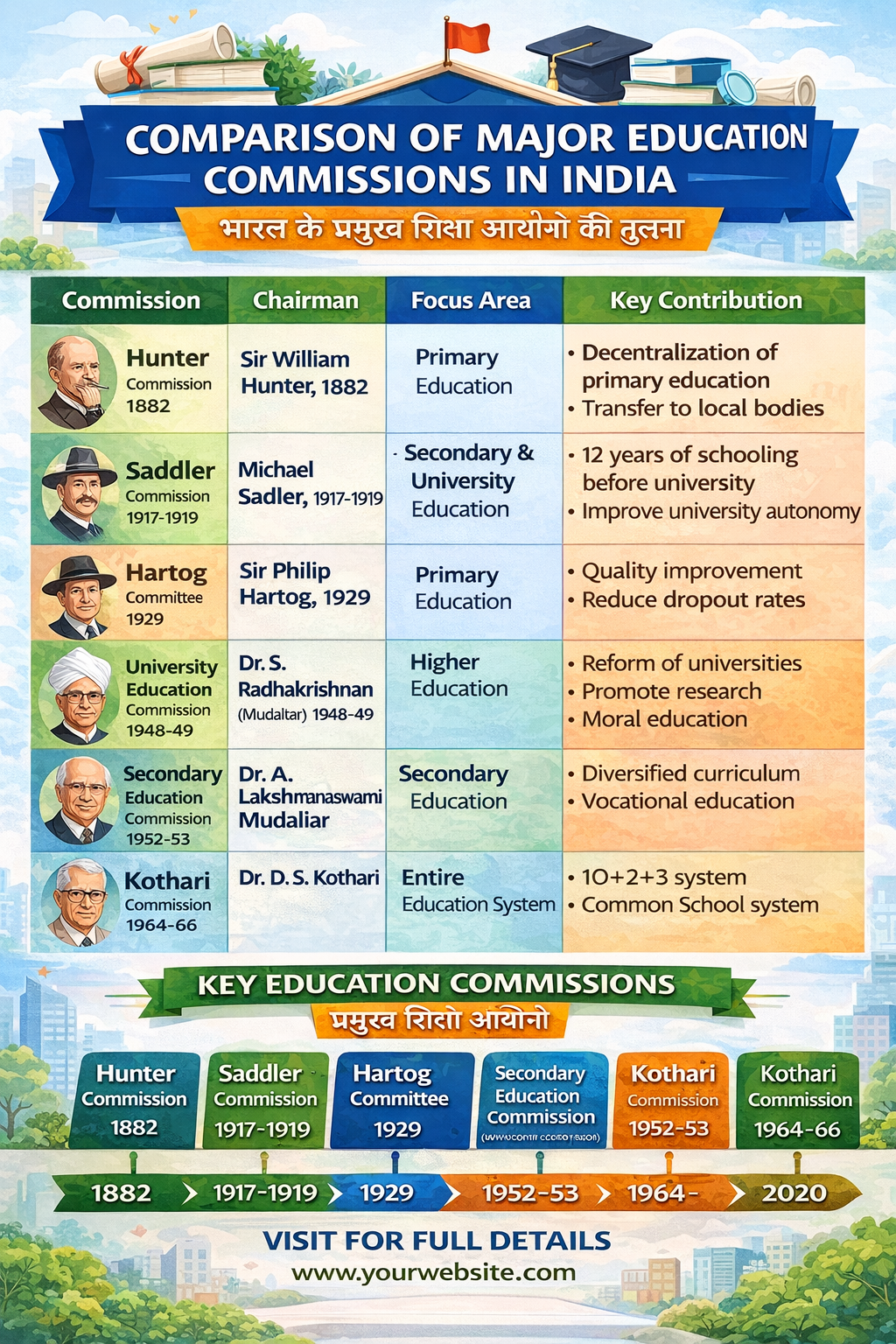
- Hunter Commission
Focused on primary education and local administration of schools. इस आयोग ने प्राथमिक शिक्षा के विकास और स्थानीय निकायों की भूमिका पर बल दिया।
- Sadler Commission
Examined university education and recommended improvements in school education.
- Wardha Scheme of Basic Education
Proposed by Mahatma Gandhi, emphasizing craft-based learning and self-reliance.
5. Education Policies After Independence
स्वतंत्रता के बाद शिक्षा नीतियाँ
After independence, India recognized education as a key instrument for national development.
स्वतंत्रता के बाद भारत ने शिक्षा को राष्ट्रीय विकास का महत्वपूर्ण साधन माना।
Several commissions were appointed to reform the education system.
शिक्षा प्रणाली में सुधार के लिए कई आयोग गठित किए गए।
6. University Education Commission (1948–49)/विश्वविद्यालय शिक्षा आयोग (1948–49)
The University Education Commission, chaired by Sarvepalli Radhakrishnan, focused mainly on higher education but also influenced school education.
Key recommendations:
- Improvement of teacher training
- Development of moral education
- Strengthening secondary education
- शिक्षक प्रशिक्षण में सुधार
- नैतिक शिक्षा पर जोर
- माध्यमिक शिक्षा का सुदृढ़ीकरण
7. Secondary Education Commission (1952–53)/माध्यमिक शिक्षा आयोग (1952–53)
The Secondary Education Commission, chaired by A. Lakshmanswami Mudaliar, examined the problems of secondary education.
Major recommendations:
- Diversified curriculum
- Multipurpose schools
- Vocational education
- Guidance and counseling services
- विविध पाठ्यक्रम
- बहुउद्देश्यीय विद्यालय
- व्यावसायिक शिक्षा
- मार्गदर्शन और परामर्श सेवाएँ
8. Education Commission (1964–66)/ शिक्षा आयोग (1964–66)
The Kothari Commission is one of the most significant commissions in Indian education.
It was chaired by Daulat Singh Kothari.
Major Recommendations
- Common School System
- 10+2+3 education structure
- Equal educational opportunity
- Science and technology education
- सामान्य विद्यालय प्रणाली
- 10+2+3 शिक्षा संरचना
- समान शैक्षिक अवसर
- विज्ञान एवं प्रौद्योगिकी शिक्षा
9. National Policy on Education (1968)
राष्ट्रीय शिक्षा नीति 1968
The first national education policy in India was introduced in 1968.
Key objectives:
- Free and compulsory education up to 14 years
- Three-language formula
- Promotion of science education
- National integration
- 14 वर्ष तक नि:शुल्क और अनिवार्य शिक्षा
- त्रिभाषा सूत्र
- विज्ञान शिक्षा को बढ़ावा
- राष्ट्रीय एकता
10. National Policy on Education (1986) / राष्ट्रीय शिक्षा नीति 1986
The National Policy on Education 1986 was a major reform policy.
Main features:
- Universalization of elementary education
- Operation Blackboard
- Teacher education reform
- Adult education programs
- प्रारंभिक शिक्षा का सार्वभौमीकरण
- ऑपरेशन ब्लैकबोर्ड
- शिक्षक शिक्षा सुधार
- वयस्क शिक्षा कार्यक्रम
11. Programme of Action (1992) / कार्य योजना 1992
In 1992, the NPE 1986 was revised through the Programme of Action (POA).
Major goals:
- Expansion of primary schools
- Quality improvement
- Focus on girls’ education
- प्राथमिक विद्यालयों का विस्तार
- शिक्षा की गुणवत्ता में सुधार
- बालिका शिक्षा पर विशेष ध्यान
12. Major School Education Initiatives
विद्यालयी शिक्षा से संबंधित प्रमुख कार्यक्रम
Several programs were launched to strengthen school education:
- District Primary Education Programme (DPEP)
- Sarva Shiksha Abhiyan (SSA)
- Mid-Day Meal Scheme
- जिला प्राथमिक शिक्षा कार्यक्रम
- सर्व शिक्षा अभियान
- मध्याह्न भोजन योजना
13. National Education Policy 2020 / राष्ट्रीय शिक्षा नीति 2020
The latest education reform is the National Education Policy 2020.
Important features related to school education:
- 5+3+3+4 curriculum structure
- Early childhood education
- Competency-based learning
- Digital education
- 5+3+3+4 पाठ्यक्रम संरचना
- प्रारंभिक बाल शिक्षा
- दक्षता-आधारित शिक्षा
- डिजिटल शिक्षा
14. Importance of Studying Education Policies / शिक्षा नीतियों के अध्ययन का महत्व
Studying education policies helps teachers and researchers understand the evolution of educational reforms.
शिक्षा नीतियों का अध्ययन शिक्षकों और शोधकर्ताओं को शिक्षा सुधारों के विकास को समझने में मदद करता है।
- Understanding educational reforms
- Policy implementation in schools
- Improving quality of education
- शिक्षा सुधारों की समझ
- विद्यालयों में नीति का कार्यान्वयन
- शिक्षा की गुणवत्ता में सुधार
15. Challenges in Implementing School Education Policies
विद्यालयी शिक्षा नीतियों के क्रियान्वयन में चुनौतियाँ
- Infrastructure gaps
- Teacher shortages
- Regional disparities
- Financial constraints
- अधोसंरचना की कमी
- शिक्षकों की कमी
- क्षेत्रीय असमानताएँ
- वित्तीय सीमाएँ
16. Conclusion National Policies in Education / निष्कर्ष/
The historical study of national education policies reveals the continuous efforts of the Indian government to improve school education and ensure equal opportunities for all learners.
राष्ट्रीय शिक्षा नीतियों का ऐतिहासिक अध्ययन यह दर्शाता है कि भारत सरकार ने विद्यालयी शिक्षा को बेहतर बनाने और सभी छात्रों को समान अवसर प्रदान करने के लिए लगातार प्रयास किए हैं।
From early commissions to modern policies like NEP 2020, education reforms have aimed at making the education system inclusive, equitable, and quality-oriented.
प्रारंभिक आयोगों से लेकर आधुनिक नीतियों जैसे NEP 2020 तक, शिक्षा सुधारों का उद्देश्य शिक्षा प्रणाली को समावेशी, समान और गुणवत्तापूर्ण बनाना रहा है।
Please visit us for similar topics: https://teacherszone.in/
Please follow us on Facebook:https://www.facebook.com/profile.php?id=61586013442564
17. Exam-Oriented MCQs on National Policies in Education
1. Which policy is known as the “Magna Carta of English Education in India”?
A. Hunter Commission
B. Wood’s Despatch
C. Macaulay’s Minute
D. Sadler Commission
Answer: B
2. The year of Wood’s Despatch was:
A. 1835
B. 1854
C. 1882
D. 1904
Answer: B
3. Who is associated with the Wardha Scheme of Basic Education?
A. Rabindranath Tagore
B. Mahatma Gandhi
C. Zakir Husain
D. S. Radhakrishnan
Answer: B
4. The Hunter Commission was established in:
A. 1854
B. 1882
C. 1902
D. 1917
Answer: B
5. The main focus of the Hunter Commission was:
A. University education
B. Primary education
C. Technical education
D. Teacher education
Answer: B
6. The Sadler Commission was related to:
A. Primary education
B. Secondary education
C. University education
D. Vocational education
Answer: C
7. The Wardha Scheme emphasized:
A. Craft-based education
B. Computer education
C. Distance education
D. Higher education
Answer: A
8. The concept of “Basic Education” was introduced in:
A. 1937
B. 1947
C. 1950
D. 1960
Answer: A
9. The Basic Education scheme emphasized:
A. Activity-based learning
B. Craft and productive work
C. Self-reliance
D. All of the above
Answer: D
10. Which commission recommended decentralization of primary education?
A. Sadler Commission
B. Hunter Commission
C. Hartog Committee
D. Mudaliar Commission
Answer: B
11. The Hartog Committee was appointed in:
A. 1929
B. 1937
C. 1948
D. 1952
Answer: A
12. The Hartog Committee focused on:
A. Quality of primary education
B. Higher education
C. Vocational training
D. Teacher training
Answer: A
13. Which commission recommended improvement in secondary education after independence?
A. Mudaliar Commission
B. Kothari Commission
C. Hunter Commission
D. Sadler Commission
Answer: A
14. The Mudaliar Commission was established in:
A. 1948
B. 1952
C. 1964
D. 1968
Answer: B
15. The chairman of the Mudaliar Commission was:
A. Zakir Husain
B. A. Lakshmanswami Mudaliar
C. D. S. Kothari
D. S. Radhakrishnan
Answer: B
16. The Radhakrishnan Commission was related to:
A. Secondary education
B. Primary education
C. University education
D. Technical education
Answer: C
17. The University Education Commission was established in:
A. 1948
B. 1952
C. 1964
D. 1970
Answer: A
18. The chairman of the University Education Commission was:
A. S. Radhakrishnan
B. D. S. Kothari
C. Zakir Husain
D. Mudaliar
Answer: A
19. Which commission recommended the 10+2+3 pattern?
A. Mudaliar Commission
B. Kothari Commission
C. Hartog Committee
D. Sadler Commission
Answer: B
20. The Kothari Commission worked during:
A. 1952–53
B. 1964–66
C. 1975–76
D. 1985–86
Answer: B
21. The first National Policy on Education in India was announced in:
A. 1965
B. 1968
C. 1975
D. 1986
Answer: B
22. NPE 1968 was based on the recommendations of:
A. Mudaliar Commission
B. Kothari Commission
C. Hartog Committee
D. Sadler Commission
Answer: B
23. The three-language formula was introduced in:
A. NPE 1968
B. NPE 1986
C. NPE 1992
D. NEP 2020
Answer: A
24. The main aim of NPE 1968 was:
A. Universal elementary education
B. Vocational education
C. Digital education
D. Higher education
Answer: A
25. The promotion of science education was emphasized in:
A. NPE 1968
B. NPE 1986
C. NPE 1992
D. NEP 2020
Answer: A
26. Which principle was emphasized in the National Policy on Education 1968?
A. Equality of educational opportunity
B. Privatization of education
C. Computer education
D. Distance learning
Answer: A
27. The NPE 1968 emphasized which language policy?
A. Two-language formula
B. Three-language formula
C. Four-language formula
D. One-language formula
Answer: B
28. The NPE 1968 recommended compulsory education up to the age of:
A. 10 years
B. 12 years
C. 14 years
D. 16 years
Answer: C
29. The concept of “Common School System” was recommended by:
A. Mudaliar Commission
B. Kothari Commission
C. Hartog Committee
D. Sadler Commission
Answer: B
30. The Kothari Commission gave the famous slogan:
A. Education for employment
B. Education and national development
C. Education and productivity
D. Education for democracy
Answer: B
31. Which commission emphasized science education strongly?
A. Hunter Commission
B. Kothari Commission
C. Hartog Committee
D. Mudaliar Commission
Answer: B
32. Which commission recommended work experience in school curriculum?
A. Sadler Commission
B. Kothari Commission
C. Hartog Committee
D. Radhakrishnan Commission
Answer: B
33. The National Policy on Education 1968 emphasized:
A. Teacher status improvement
B. National integration
C. Development of Indian languages
D. All of the above
Answer: D
34. Which policy emphasized the modernization of education?
A. NPE 1968
B. NPE 1986
C. NPE 1992
D. NEP 2020
Answer: B
35. The National Policy on Education 1986 emphasized:
A. Equality of educational opportunities
B. Adult education
C. Women’s education
D. All of the above
Answer: D
36. Operation Blackboard mainly aimed to improve:
A. Teacher salary
B. School infrastructure
C. University education
D. Distance education
Answer: B
37. The concept of Navodaya Vidyalayas was introduced in:
A. NPE 1968
B. NPE 1986
C. NPE 1992
D. NEP 2020
Answer: B
38. Navodaya Vidyalayas mainly aim to provide quality education to:
A. Urban students
B. Rural talented children
C. Private school students
D. Technical students
Answer: B
39. Which policy emphasized universal elementary education strongly?
A. NPE 1968
B. NPE 1986
C. NPE 1992
D. NEP 2020
Answer: B
40. Programme of Action (POA) 1992 was related to:
A. NPE 1968
B. NPE 1986
C. NPE 1992 revision
D. NEP 2020
41. The National Policy on Education 1986 was introduced during the tenure of:
A. Indira Gandhi
B. Rajiv Gandhi
C. Morarji Desai
D. Atal Bihari Vajpayee
Answer: B
42. Operation Blackboard was launched under:
A. NPE 1968
B. NPE 1986
C. SSA
D. RMSA
Answer: B
43. Operation Blackboard aimed to:
A. Improve school infrastructure
B. Provide computers
C. Train teachers abroad
D. Promote private education
Answer: A
44. NPE 1986 emphasized:
A. Universalization of elementary education
B. Adult literacy
C. Women education
D. All of the above
Answer: D
45. The Programme of Action (POA) was introduced in:
A. 1986
B. 1992
C. 2000
D. 2005
Answer: B
46. The Programme of Action 1992 focused on:
A. Expanding primary education
B. Improving quality of education
C. Women education
D. All of the above
Answer: D
47. District Primary Education Programme (DPEP) aimed to:
A. Improve primary education
B. Improve higher education
C. Improve vocational training
D. Improve adult education
Answer: A
48. The DPEP was launched in:
A. 1990
B. 1994
C. 1998
D. 2001
Answer: B
49. Sarva Shiksha Abhiyan focuses on:
A. Secondary education
B. Higher education
C. Universal elementary education
D. Technical education
Answer: C
50. Sarva Shiksha Abhiyan was launched in:
A. 2001
B. 2005
C. 2007
D. 2010
Answer: A
51. The Mid-Day Meal Scheme aims to:
A. Increase enrollment
B. Improve nutrition
C. Reduce dropout rate
D. All of the above
Answer: D
52. The Right to Education Act was implemented in:
A. 2008
B. 2009
C. 2010
D. 2012
Answer: C
53. The Right to Education Act ensures education for children aged:
A. 5–14 years
B. 6–14 years
C. 6–16 years
D. 7–14 years
Answer: B
54. The RTE Act was based on which constitutional amendment?
A. 42nd Amendment
B. 73rd Amendment
C. 86th Amendment
D. 91st Amendment
Answer: C
55. Article ______ of the Constitution guarantees Right to Education.
A. Article 19
B. Article 21A
C. Article 45
D. Article 51
Answer: B
56. The RTE Act promotes:
A. Inclusive education
B. Equality
C. Access to schooling
D. All of the above
Answer: D
57. Continuous and Comprehensive Evaluation (CCE) was introduced under:
A. RTE Act
B. SSA
C. NEP 2020
D. NCF 2005
Answer: A
58. The aim of RTE Act is:
A. Universal elementary education
B. Universal higher education
C. Vocational training
D. Technical education
Answer: A
59. The National Curriculum Framework 2005 emphasized:
A. Constructivist learning
B. Rote learning
C. Teacher-centered learning
D. Lecture method
Answer: A
60. NCF 2005 emphasized:
A. Child-centered education
B. Experiential learning
C. Activity-based learning
D. All of the above
Answer: D
61. Sarva Shiksha Abhiyan (SSA) was launched in:
A. 1995
B. 2001
C. 2005
D. 2010
Answer: B
62. The Mid-Day Meal Scheme was introduced nationally in:
A. 1995
B. 2001
C. 2005
D. 2010
Answer: A
63. The District Primary Education Programme (DPEP) started in:
A. 1994
B. 1998
C. 2001
D. 2005
Answer: A
64. The aim of SSA is:
A. Universal elementary education
B. Higher education
C. Technical education
D. Vocational training
Answer: A
65. The Mid-Day Meal Scheme mainly aims to:
A. Improve enrollment
B. Reduce dropout
C. Improve nutrition
D. All of the above
Answer: D
81. The latest education policy of India is:
A. NPE 1986
B. NPE 1992
C. NEP 2020
D. NEP 2015
Answer: C
82. The new school structure in NEP 2020 is:
A. 10+2
B. 5+3+3+4
C. 8+4
D. 6+3+3
Answer: B
83. The foundational stage in NEP 2020 covers ages:
A. 3–8 years
B. 6–10 years
C. 8–11 years
D. 10–14 years
Answer: A
84. NEP 2020 emphasizes:
A. Experiential learning
B. Competency-based learning
C. Digital education
D. All of the above
Answer: D
85. NEP 2020 recommends teaching in mother tongue until:
A. Grade 3
B. Grade 5
C. Grade 8
D. Grade 10
Answer: B
86. The aim of NEP 2020 is:
A. Access
B. Equity
C. Quality
D. All of the above
Answer: D
87. ECCE stands for:
A. Early Childhood Care and Education
B. Elementary Child Care Education
C. Early Child Curriculum Education
D. Educational Child Care Evaluation
Answer: A
88. NEP 2020 emphasizes:
A. Multidisciplinary learning
B. Rote learning
C. Memorization
D. Lecture method
Answer: A
89. The focus of NEP 2020 in school education is:
A. Foundational literacy and numeracy
B. Vocational training
C. Digital learning
D. All of the above
Answer: D
90. NEP 2020 aims to achieve universal school education by:
A. 2025
B. 2030
C. 2035
D. 2040
Answer: B
91. The policy emphasizes:
A. Inclusive education
B. Gender equality
C. Equity
D. All of the above
Answer: D
92. Vocational education in NEP 2020 starts from:
A. Class 3
B. Class 6
C. Class 8
D. Class 10
Answer: B
93. The policy encourages:
A. Experiential learning
B. Project-based learning
C. Inquiry-based learning
D. All of the above
Answer: D
94. NEP 2020 focuses on:
A. Holistic development
B. Critical thinking
C. Creativity
D. All of the above
Answer: D
95. Digital education is promoted through:
A. DIKSHA platform
B. SWAYAM
C. E-Pathshala
D. All of the above
Answer: D
96. School education under NEP 2020 aims for:
A. Equity
B. Inclusion
C. Quality
D. All of the above
Answer: D
97. NEP 2020 emphasizes:
A. Student-centered learning
B. Teacher-centered learning
C. Rote learning
D. Lecture method
Answer: A
98. The policy aims to improve:
A. Literacy rate
B. School enrollment
C. Learning outcomes
D. All of the above
Answer: D
99. NEP 2020 encourages:
A. Multilingualism
B. Critical thinking
C. Innovation
D. All of the above
Answer: D
100. NEP 2020 aims to transform India into:
A. Knowledge society
B. Developed nation
C. Global knowledge superpower
D. Industrial nation
Answer: C