
Understand the National Education Policy 2020:major reforms and impact, new 5+3+3+4 education structure, multidisciplinary learning, and how it will transform education in India.
Table of Contents
1. Introduction-National Education Policy 2020 / परिचय
Education is the foundation of a nation’s development. A strong education system contributes to economic growth, social equality, technological advancement, and national integration. Recognizing the importance of education in nation-building, the Government of India periodically reforms its education system through policies and commissions.
शिक्षा किसी भी राष्ट्र के विकास की आधारशिला होती है। एक मजबूत शिक्षा प्रणाली आर्थिक विकास, सामाजिक समानता, तकनीकी प्रगति और राष्ट्रीय एकता को बढ़ावा देती है। इसी महत्व को ध्यान में रखते हुए भारत सरकार समय-समय पर शिक्षा प्रणाली में सुधार के लिए विभिन्न शिक्षा नीतियाँ और आयोग स्थापित करती रही है।
The National Education Policy 2020 (NEP 2020) is the most recent and comprehensive reform in the Indian education system. It was approved by the Government of India on 29 July 2020, replacing the previous National Policy on Education 1986 (modified in 1992).
राष्ट्रीय शिक्षा नीति 2020 (NEP 2020) भारत की शिक्षा प्रणाली में हाल के समय का सबसे व्यापक सुधार है। इसे 29 जुलाई 2020 को भारत सरकार द्वारा मंजूरी दी गई। इसने 1986 की राष्ट्रीय शिक्षा नीति (1992 में संशोधित) को प्रतिस्थापित किया।
The policy aims to transform India into a global knowledge superpower by creating an education system that is inclusive, flexible, multidisciplinary, and rooted in Indian values while also preparing learners for global challenges.
इस नीति का उद्देश्य भारत को वैश्विक ज्ञान महाशक्ति बनाना है। इसके लिए एक ऐसी शिक्षा प्रणाली विकसित करने का प्रयास किया गया है जो समावेशी, लचीली, बहुविषयक और भारतीय मूल्यों पर आधारित हो, साथ ही छात्रों को वैश्विक चुनौतियों के लिए तैयार करे।
The policy was drafted based on the recommendations of the Kasturirangan Committee, headed by eminent scientist Dr. K. Kasturirangan.
इस नीति का मसौदा प्रसिद्ध वैज्ञानिक डॉ. के. कस्तूरीरंगन की अध्यक्षता वाली समिति की सिफारिशों के आधार पर तैयार किया गया।
2.Historical Background of Education Policies in India/भारत में शिक्षा नीतियों का ऐतिहासिक विकास
The Indian education system has evolved through several commissions and policies.
भारतीय शिक्षा प्रणाली का विकास विभिन्न आयोगों और नीतियों के माध्यम से हुआ है।
Important education commissions include:
1. University Education Commission (1948–49)
This commission was headed by Dr. S. Radhakrishnan. It focused on improving university education and recommended reforms in curriculum, teaching methods, and academic standards.
यह आयोग डॉ. एस. राधाकृष्णन की अध्यक्षता में स्थापित किया गया था। इसका उद्देश्य विश्वविद्यालय शिक्षा की गुणवत्ता में सुधार करना था।
2. Secondary Education Commission (1952–53)
This commission was chaired by Dr. A. Lakshmanaswami Mudaliar. It emphasized diversification of courses and improvement of secondary education.
इस आयोग की अध्यक्षता डॉ. लक्ष्मणस्वामी मुदालियर ने की थी। इसने माध्यमिक शिक्षा के सुधार और विविध पाठ्यक्रमों की सिफारिश की।
3. Education Commission (1964–66)
Also known as the Kothari Commission, this commission provided a comprehensive framework for the Indian education system.
इसे कोठारी आयोग के नाम से जाना जाता है। इसने भारतीय शिक्षा प्रणाली के लिए व्यापक सुधारों का सुझाव दिया।
It recommended:
- Common school system
- Equal educational opportunities
- 10+2+3 education structure
- Education expenditure of 6% of GDP
4. National Policy on Education 1968
This was the first national education policy of India. It focused on national integration and equal access to education.
5. National Policy on Education 1986
The 1986 policy focused on universalization of education, teacher education, women’s education, and adult literacy.
However, due to rapid technological advancement, globalization, and changing employment patterns, a new policy was required.
इसी कारण एक नई शिक्षा नीति की आवश्यकता महसूस हुई, जिसके परिणामस्वरूप राष्ट्रीय शिक्षा नीति 2020 लागू की गई।
3.Vision of National Education Policy 2020 / राष्ट्रीय शिक्षा नीति 2020 की दृष्टि
The vision of NEP 2020 is to create an education system that contributes to transforming India into an equitable and vibrant knowledge society.
NEP 2020 की दृष्टि एक ऐसी शिक्षा प्रणाली का निर्माण करना है जो भारत को एक न्यायसंगत और ज्ञान आधारित समाज में बदल सके।
The policy emphasizes:
- Holistic development
- Critical thinking
- Creativity
- Scientific temper
- Ethical and moral values
इस नीति में समग्र विकास, आलोचनात्मक सोच, रचनात्मकता, वैज्ञानिक दृष्टिकोण और नैतिक मूल्यों पर जोर दिया गया है।
4.Objectives of National Education Policy 2020 / राष्ट्रीय शिक्षा नीति 2020 के उद्देश्य
The main objectives of NEP 2020 include:
1. Universal Access to Education
The policy aims to ensure that every child has access to quality education.
2. Quality Education
Improving teaching methods, curriculum design, and evaluation systems.
3. Holistic Development
Promoting cognitive, social, emotional, and physical development.
4. Skill Development
Encouraging vocational education and practical skills.
5. Inclusive Education
Ensuring education for disadvantaged groups such as:
- Women
- Rural populations
- Scheduled Castes and Tribes
- Children with disabilities
5.Structural Reform in School Education in National Education Policy 2020 / स्कूल शिक्षा में संरचनात्मक सुधार
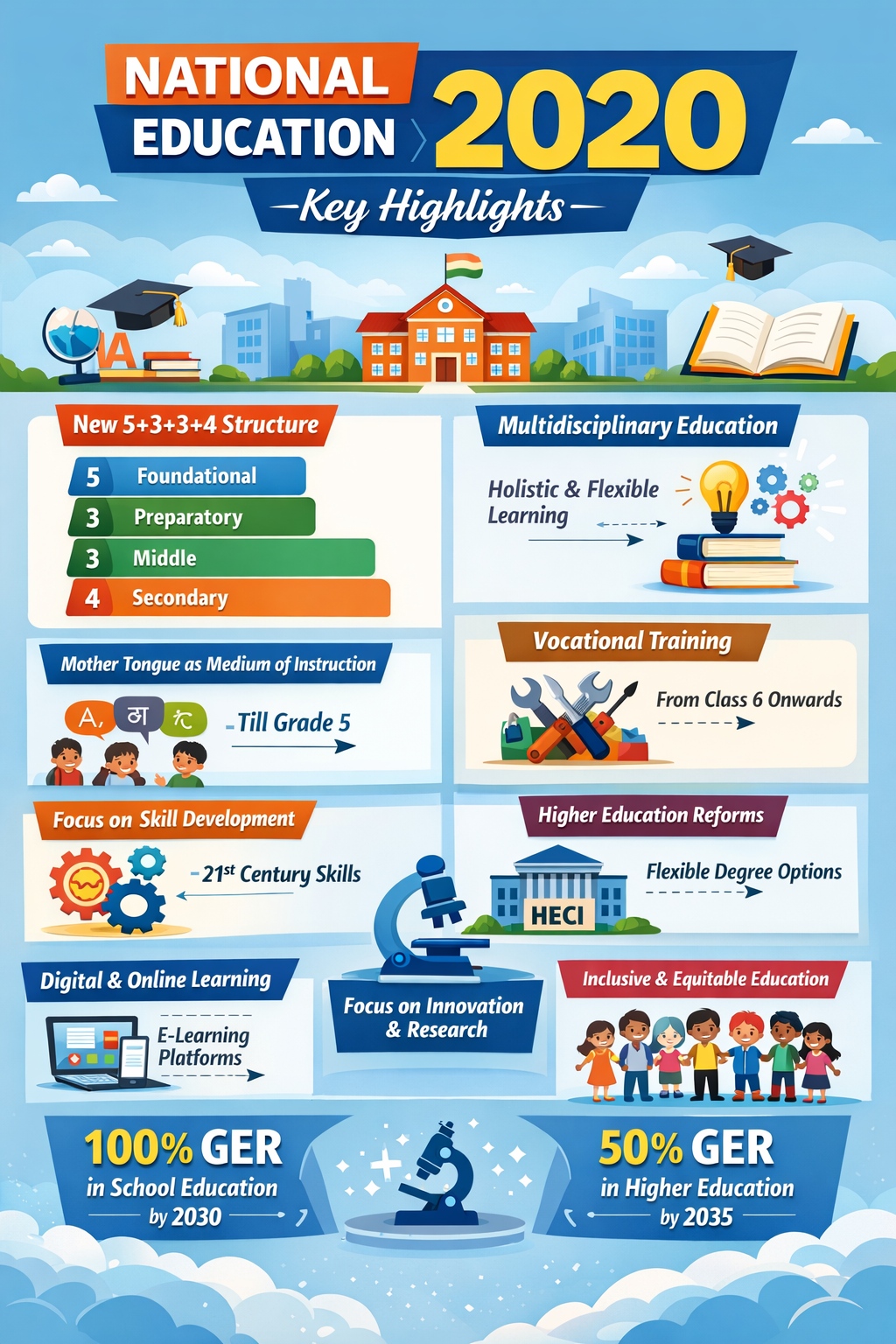
One of the most significant reforms introduced by NEP 2020 is the replacement of the 10+2 system with the 5+3+3+4 structure.
NEP 2020 में सबसे महत्वपूर्ण सुधारों में से एक 10+2 प्रणाली के स्थान पर 5+3+3+4 संरचना का लागू होना है।
1. Foundational Stage (3–8 years)
Includes:
- 3 years of pre-school
- Classes 1–2
Focus:
- Play-based learning
- Language development
- Basic literacy and numeracy
2. Preparatory Stage (8–11 years)
Includes classes 3–5.
Focus:
- Discovery-based learning
- Interactive classroom activities
3. Middle Stage (11–14 years)
Includes classes 6–8.
Focus:
- Experiential learning
- Introduction of subjects such as science, mathematics, arts, and social science.
4. Secondary Stage (14–18 years)
Includes classes 9–12.
Focus:
- Multidisciplinary learning
- Flexibility in subject choice.
6.Early Childhood Care and Education (ECCE) in National Education Policy 2020 / प्रारंभिक बाल्यावस्था देखभाल और शिक्षा
NEP 2020 recognizes the importance of early childhood education.
NEP 2020 में प्रारंभिक बाल शिक्षा को अत्यंत महत्वपूर्ण माना गया है।
Research shows that 85% of brain development occurs before the age of six.
इसी कारण नीति में 3–6 वर्ष के बच्चों के लिए शिक्षा पर विशेष ध्यान दिया गया है।
The policy proposes:
- Strengthening Anganwadi centers
- Training Anganwadi workers
- Developing play-based curriculum.
7.Medium of Instruction and Language Policy in National Education Policy 2020/शिक्षण माध्यम और भाषा नीति
NEP 2020 emphasizes the use of mother tongue or regional language as the medium of instruction until Grade 5.
NEP 2020 में कक्षा 5 तक शिक्षा मातृभाषा या स्थानीय भाषा में देने की सिफारिश की गई है।
Benefits include:
- Better understanding
- Improved learning outcomes
- Preservation of cultural identity.
The policy also supports the three-language formula.
8. Vocational Education in National Education Policy 2020/ व्यावसायिक शिक्षा
NEP 2020 aims to integrate vocational education into mainstream education.
NEP 2020 का लक्ष्य व्यावसायिक शिक्षा को मुख्यधारा की शिक्षा से जोड़ना है।
Students will learn skills such as:
- Coding
- Carpentry
- Gardening
- Entrepreneurship
The policy aims that 50% of learners should receive vocational education by 2025.

9.Reform in Assessment and Examination System in National Education Policy 2020 / परीक्षा और मूल्यांकन प्रणाली में सुधार
The policy seeks to move away from rote learning and focus on competency-based assessment.
NEP 2020 रटने की प्रवृत्ति को कम करने और कौशल आधारित मूल्यांकन को बढ़ावा देने पर जोर देती है।
Changes include:
- Reduced board exam pressure
- Continuous assessment
- Development of critical thinking skills.
10.Higher Education Reforms in National Education Policy 2020/ उच्च शिक्षा में सुधार
NEP 2020 introduces several major reforms in higher education.
NEP 2020 में उच्च शिक्षा में कई महत्वपूर्ण सुधार किए गए हैं।
Multidisciplinary Education
Universities will offer multidisciplinary programs where students can choose subjects from different streams.
Multiple Entry and Exit System
Students can exit and re-enter higher education programs.
Example:
- 1 year – Certificate
- 2 years – Diploma
- 3 years – Bachelor Degree
- 4 years – Bachelor Degree with Research
11.Academic Bank of Credits (ABC) in National Education Policy 2020 / अकादमिक बैंक ऑफ क्रेडिट
Academic Bank of Credits allows students to store academic credits digitally.
अकादमिक बैंक ऑफ क्रेडिट छात्रों को अपने शैक्षणिक क्रेडिट को डिजिटल रूप में सुरक्षित रखने की सुविधा देता है।
This allows flexibility in completing degrees.
12.National Research Foundation in National Education Policy 2020/ राष्ट्रीय अनुसंधान फाउंडेशन
The National Research Foundation aims to promote research culture in universities.
राष्ट्रीय अनुसंधान फाउंडेशन का उद्देश्य विश्वविद्यालयों में शोध को बढ़ावा देना है।
13.Teacher Education Reforms in National Education Policy 2020 / शिक्षक शिक्षा में सुधार
Teachers play a vital role in the success of education reforms.
शिक्षा सुधारों की सफलता में शिक्षकों की महत्वपूर्ण भूमिका होती है।
NEP 2020 proposes:
- Four-year integrated B.Ed program
- Continuous professional development
- Merit-based recruitment.
By 2030, the four-year B.Ed degree will be mandatory.
14.Digital Education and Technology Integration in National Education Policy 2020 / डिजिटल शिक्षा और तकनीक का समावेशन
NEP 2020 promotes the use of digital technology in education.
NEP 2020 शिक्षा में डिजिटल तकनीक के उपयोग को बढ़ावा देती है।
Examples include:
- Online learning platforms
- Virtual laboratories
- Digital libraries.
The National Educational Technology Forum (NETF) will guide technology integration.
15.Government Initiatives for Implementation in National Education Policy 2020 / नीति के कार्यान्वयन के लिए सरकारी पहल
The government has launched several initiatives to implement NEP 2020.
सरकार ने NEP 2020 को लागू करने के लिए कई पहल शुरू की हैं।
Examples include:
- National Curriculum Framework
- Digital education platforms
- Teacher training programs.
16.Challenges in Implementation in National Education Policy 2020 / कार्यान्वयन की चुनौतियाँ
Despite its ambitious goals, NEP 2020 faces several challenges.
हालांकि NEP 2020 एक महत्वाकांक्षी नीति है, लेकिन इसके कार्यान्वयन में कई चुनौतियाँ हैं।
Major challenges include:
- Infrastructure limitations
- Shortage of trained teachers
- Digital divide
- Funding requirements.
17. Expected Impact of National Education Policy 2020/NEP 2020 का संभावित प्रभाव
If implemented effectively, NEP 2020 can significantly transform the Indian education system.
यदि इसे प्रभावी रूप से लागू किया जाए, तो NEP 2020 भारतीय शिक्षा प्रणाली को पूरी तरह बदल सकती है।
Expected outcomes include:
- Improved learning outcomes
- Increased employability
- Enhanced research culture
- Development of skilled workforce.
18.Conclusion of National Education Policy 2020 / निष्कर्ष
The National Education Policy 2020 represents a landmark reform in India’s education system. It aims to create a learner-centered, flexible, and multidisciplinary education system that prepares students for the challenges of the modern world.
राष्ट्रीय शिक्षा नीति 2020 भारत की शिक्षा प्रणाली में एक ऐतिहासिक सुधार है। इसका उद्देश्य एक ऐसी शिक्षा प्रणाली विकसित करना है जो छात्र-केंद्रित, लचीली और बहुविषयक हो।
If implemented successfully, NEP 2020 can transform India into a global knowledge hub and empower future generations.
यदि इसे सफलतापूर्वक लागू किया गया, तो NEP 2020 भारत को एक वैश्विक ज्ञान केंद्र में बदल सकती है।
Please follow us on Facebook: https://www.facebook.com/profile.php?id=61586013442564
Please visit for more similar topics: https://teacherszone.in/
19. MCQs on National Education Policy 2020
1.
The National Education Policy 2020 replaced which earlier policy?
A. Education Policy 1968
B. Education Policy 1986
C. Education Policy 1992
D. Education Policy 2005
Answer: B
2.
Which committee prepared the draft of National Education Policy 2020?
A. Yashpal Committee
B. Kasturirangan Committee
C. Mudaliar Committee
D. Kothari Committee
Answer: B
3.
The National Education Policy 2020 was approved in which year?
A. 2018
B. 2019
C. 2020
D. 2021
Answer: C
4.
National Education Policy 2020 proposes replacing the 10+2 system with:
A. 4+4+4+4
B. 3+3+4+4
C. 5+3+3+4
D. 6+3+3+2
Answer: C
5.
The first stage of the new school structure in National Education Policy 2020 is called:
A. Preparatory Stage
B. Foundational Stage
C. Middle Stage
D. Secondary Stage
Answer: B
6.
The Foundational Stage covers which age group?
A. 3–8 years
B. 6–10 years
C. 8–11 years
D. 11–14 years
Answer: A
7.
The Preparatory Stage covers which classes?
A. Classes 1–2
B. Classes 3–5
C. Classes 6–8
D. Classes 9–10
Answer: B
8.
Which stage includes Classes 6–8 under National Education Policy 2020?
A. Preparatory Stage
B. Middle Stage
C. Secondary Stage
D. Foundational Stage
Answer: B
9.
The Secondary Stage in National Education Policy 2020 includes:
A. Classes 8–10
B. Classes 9–12
C. Classes 10–12
D. Classes 11–12
Answer: B
10.
National Education Policy 2020 recommends that the medium of instruction up to Grade 5 should preferably be:
A. English
B. Hindi
C. Mother tongue or regional language
D. Sanskrit
Answer: C
11.
National Education Policy 2020 emphasizes learning based on:
A. Rote memorization
B. Competency-based education
C. Lecture method
D. Textbook memorization
Answer: B
12.
Vocational education is proposed to start from which class?
A. Class 4
B. Class 5
C. Class 6
D. Class 8
Answer: C
13.
The policy aims to achieve 100% Gross Enrollment Ratio (GER) in school education by:
A. 2025
B. 2030
C. 2035
D. 2040
Answer: B
14.
Which organization will act as the apex body for higher education regulation?
A. UGC
B. AICTE
C. HECI
D. NAAC
Answer: C
15.
HECI stands for:
A. Higher Education Council of India
B. Higher Education Commission of India
C. Human Education Council of India
D. Higher Education Committee of India
Answer: B
16.
National Education Policy 2020 aims to achieve 50% GER in higher education by:
A. 2030
B. 2035
C. 2040
D. 2025
Answer: B
17.
The Academic Bank of Credits (ABC) is introduced for:
A. Scholarship distribution
B. Student attendance
C. Credit transfer and accumulation
D. Teacher promotion
Answer: C
18.
The four-year multidisciplinary undergraduate program will include:
A. Major subjects only
B. Multiple exit options
C. Only theoretical courses
D. Only online courses
Answer: B
19.
The policy emphasizes multidisciplinary education in:
A. Schools only
B. Colleges only
C. Both schools and higher education
D. Research institutes only
Answer: C
20.
National Education Policy 2020 proposes establishing National Research Foundation (NRF) to:
A. Train teachers
B. Promote research and innovation
C. Conduct exams
D. Provide scholarships
Answer: B
21.
The PARAKH institution in National Education Policy 2020 relates to:
A. Teacher training
B. Assessment and evaluation
C. Curriculum design
D. School construction
Answer: B
22.
PARAKH stands for:
A. Performance Assessment Review and Analysis of Knowledge for Holistic Development
B. Performance Authority for Research and Knowledge
C. Public Assessment Resource Authority
D. None of these
Answer: A
23.
Which scheme focuses on Early Childhood Care and Education (ECCE)?
A. Mid-Day Meal
B. Anganwadi system
C. Samagra Shiksha
D. SSA
Answer: B
24.
The three-language formula is promoted in:
A. NEP 2020
B. RTE Act
C. SSA
D. RMSA
Answer: A
25.
National Education Policy 2020 encourages coding education from:
A. Class 3
B. Class 5
C. Class 6
D. Class 8
Answer: C
26.
The policy emphasizes experiential learning, which means:
A. Memorizing facts
B. Learning by doing
C. Only theoretical knowledge
D. Exam preparation
Answer: B
27.
National Education Policy 2020 encourages board exam reforms to:
A. Increase difficulty
B. Reduce pressure and rote learning
C. Increase the number of exams
D. Focus on memorization
Answer: B
28.
The policy suggests twice a year board exams to:
A. Increase pressure
B. Improve opportunities for students
C. Reduce learning time
D. Eliminate exams
Answer: B
29.
Which institution will regulate teacher education?
A. UGC
B. NCTE
C. HECI
D. NAAC
Answer: B
30.
National Education Policy 2020 recommends minimum qualification for teachers by 2030 as:
A. B.Ed
B. 4-year integrated B.Ed
C. M.Ed
D. Ph.D
Answer: B
31.
National Education Policy 2020 emphasizes holistic development, which includes:
A. Academic learning only
B. Physical, emotional, and cognitive development
C. Only sports
D. Only arts
Answer: B
32.
The policy encourages bagless days for:
A. Relaxation
B. Vocational exposure and practical learning
C. Holidays
D. Exams
Answer: B
33.
Which digital platform is promoted for online education?
A. SWAYAM
B. DIKSHA
C. Both A and B
D. None
Answer: C
34.
National Education Policy 2020 promotes flexibility in subject choices in:
A. School only
B. Higher education only
C. Both
D. None
Answer: C
35.
Which stage emphasizes play-based learning?
A. Foundational Stage
B. Preparatory Stage
C. Middle Stage
D. Secondary Stage
Answer: A
36.
National Education Policy 2020 promotes development of which type of skills among students?
A. Rote memorization
B. Critical thinking and creativity
C. Only theoretical knowledge
D. Only exam-oriented learning
Answer: B
37.
The concept of school complexes or clusters in National Education Policy 2020 aims to:
A. Close small schools
B. Share resources among nearby schools
C. Increase school fees
D. Reduce teachers
Answer: B
38.
National Education Policy 2020emphasizes inclusive education for:
A. Only gifted students
B. Only rural students
C. Children with disabilities and diverse backgrounds
D. Only urban students
Answer: C
39.
The Gender Inclusion Fund introduced in National Education Policy 2020 mainly supports:
A. Boys’ education
B. Girls’ education and gender equality
C. Teacher salaries
D. School infrastructure only
Answer: B
40.
National Education Policy 2020 highlights the importance of digital literacy among:
A. Teachers only
B. Students only
C. Both teachers and students
D. Administrators only
Answer: C
41.
The policy promotes multilingualism in education to:
A. Reduce language learning
B. Improve cognitive development and cultural understanding
C. Replace English completely
D. Promote only one language
Answer: B
42.
National Education Policy 2020 includes provisions for adult education to:
A. Reduce literacy programs
B. Promote lifelong learning and literacy
C. Replace formal education
D. Provide only vocational training
Answer: B
43.
The policy promotes Open and Distance Learning (ODL) mainly to:
A. Reduce classroom teaching
B. Increase access to education
C. Replace universities
D. Limit higher education
Answer: B
44.
National Education Policy 2020 encourages technology integration in teaching to:
A. Replace teachers
B. Improve learning outcomes
C. Increase exam difficulty
D. Eliminate classrooms
Answer: B
45.
Teachers are encouraged to undergo continuous professional development (CPD) under National Education Policy 2020.
A. True
B. False
C. Only for private school teachers
D. Only for university teachers
Answer: A
46.
School complexes or clusters aim to improve:
A. Competition among schools
B. Resource sharing and collaboration
C. Teacher transfers
D. School closures
Answer: B
47.
National Education Policy 2020 promotes assessment for learning, which means:
A. Assessment only at the end of the year
B. Continuous assessment supporting learning improvement
C. Only board examinations
D. Only written exams
Answer: B
48.
Students’ report cards under National Education Policy 2020 will reflect:
A. Only exam marks
B. Holistic progress including skills and activities
C. Only attendance
D. Only sports performance
Answer: B
49.
National Education Policy 2020 promotes life skills education, including:
A. Communication and teamwork
B. Only academic knowledge
C. Only technical skills
D. Only exam preparation
Answer: A
50.
The policy encourages research culture in universities to:
A. Reduce teaching
B. Promote innovation and knowledge creation
C. Limit higher education
D. Increase exams
Answer: B
51.
NEP 2020 emphasizes 21st century skills such as:
A. Memorization
B. Critical thinking and problem solving
C. Only theoretical knowledge
D. Only vocational skills
Answer: B
52.
Which body will act as the single overarching umbrella body for higher education (excluding medical and legal education)?
A. UGC
B. AICTE
C. HECI
D. NAAC
Answer: C
53.
The School Quality Assessment and Accreditation Framework (SQAAF) is related to:
A. School infrastructure
B. Quality evaluation of schools
C. Student scholarships
D. Teacher salary
Answer: B
54.
NEP 2020 recommends reducing the curriculum content to:
A. Increase syllabus
B. Promote rote learning
C. Enhance conceptual understanding
D. Increase exam pressure
Answer: C
55.
Which of the following is a key feature of NEP 2020?
A. Subject rigidness
B. Multidisciplinary learning
C. Single-stream education
D. Limited subject choice
Answer: B
56.
The Gender Inclusion Fund in NEP 2020 is mainly aimed at:
A. Teacher training
B. Promoting girls’ education
C. Infrastructure development
D. Higher education research
Answer: B
57.
NEP 2020 emphasizes holistic report cards that include:
A. Academic scores only
B. Teacher evaluation only
C. Self, peer, and teacher assessment
D. Only exam marks
Answer: C
58.
The policy proposes multiple entry and exit options in:
A. School education
B. Higher education
C. Primary education
D. Vocational training only
Answer: B
59.
A student exiting after one year of undergraduate study will receive:
A. Diploma
B. Certificate
C. Degree
D. Postgraduate diploma
Answer: B
60.
A student exiting after two years of undergraduate study will receive:
A. Certificate
B. Diploma
C. Bachelor Degree
D. Ph.D.
Answer: B
61.
A Bachelor’s Degree with Research is awarded after:
A. 3 years
B. 4 years
C. 5 years
D. 6 years
Answer: B
62.
NEP 2020 recommends establishment of MERUs, which stands for:
A. Multidisciplinary Education and Research Universities
B. Modern Education Resource Units
C. Multilingual Education Research Units
D. Multi Educational Research Units
Answer: A
63.
The policy promotes open and distance learning mainly to:
A. Increase exam pressure
B. Improve access to education
C. Reduce enrollment
D. Replace classroom teaching
Answer: B
64.
The National Educational Technology Forum (NETF) aims to:
A. Conduct exams
B. Promote technology integration in education
C. Provide scholarships
D. Manage universities
Answer: B
65.
The policy emphasizes teacher autonomy in:
A. Administrative work
B. Curriculum delivery and pedagogy
C. Salary decisions
D. Student admissions
Answer: B
66.
NEP 2020 encourages internships with local craftsmen for students from:
A. Class 4
B. Class 5
C. Class 6
D. Class 9
Answer: C
67.
Which type of learning is emphasized in the Foundational Stage?
A. Lecture-based learning
B. Play-based learning
C. Lecture and exam method
D. Textbook memorization
Answer: B
68.
NEP 2020 promotes arts integration in education to:
A. Reduce syllabus
B. Enhance creativity and engagement
C. Increase exam marks
D. Replace science subjects
Answer: B
69.
The policy encourages sports integration to promote:
A. Competition only
B. Holistic development
C. Physical punishment
D. Sports specialization only
Answer: B
70.
The policy aims to universalize Early Childhood Care and Education (ECCE) by:
A. 2025
B. 2030
C. 2035
D. 2040
Answer: B
71.
NEP 2020 promotes mother tongue as medium of instruction till at least:
A. Grade 3
B. Grade 5
C. Grade 8
D. Grade 10
Answer: B
72.
Which institution will maintain Academic Bank of Credits (ABC)?
A. UGC
B. HECI
C. Government of India
D. Individual universities
Answer: B
73.
NEP 2020 promotes flexible curricular structures to encourage:
A. Rote learning
B. Multidisciplinary learning
C. Limited subject choice
D. Single-stream education
Answer: B
74.
The policy recommends regular teacher professional development of:
A. 20 hours per year
B. 50 hours per year
C. 100 hours per year
D. 200 hours per year
Answer: B
75.
NEP 2020 encourages peer tutoring to:
A. Increase competition
B. Improve collaborative learning
C. Replace teachers
D. Reduce teaching
Answer: B
76.
The National Curriculum Framework (NCF) will be developed by:
A. NCERT
B. CBSE
C. UGC
D. NCTE
Answer: A
77.
The policy emphasizes formative assessment instead of:
A. Continuous assessment
B. Summative rote-based exams
C. Classroom teaching
D. Practical learning
Answer: B
78.
NEP 2020 aims to increase public investment in education to:
A. 4% of GDP
B. 5% of GDP
C. 6% of GDP
D. 8% of GDP
Answer: C
79.
Which organization will set professional standards for teachers?
A. NCTE
B. NCERT
C. SCERT
D. CBSE
Answer: A
80.
NEP 2020 promotes Indian knowledge systems in curriculum to:
A. Reduce modern knowledge
B. Preserve cultural heritage
C. Replace science education
D. Focus only on history
Answer: B
81.
The policy recommends holistic and multidisciplinary education in universities.
A. True
B. False
C. Only for science streams
D. Only for arts streams
Answer: A
82.
NEP 2020 promotes flexible subject choices in secondary school.
A. True
B. False
C. Only science subjects
D. Only arts subjects
Answer: A
83.
The policy suggests integration of vocational and academic education.
A. True
B. False
C. Only vocational education
D. Only academic education
Answer: A
84.
Which institution will promote research funding across disciplines?
A. UGC
B. NRF
C. NAAC
D. AICTE
Answer: B
85.
The policy promotes inclusive education for students with disabilities.
A. True
B. False
C. Only private schools
D. Only government schools
Answer: A
86.
NEP 2020 encourages multilingual education.
A. True
B. False
C. Only Hindi medium
D. Only English medium
Answer: A
87.
The policy aims to reduce drop-out rates in schools.
A. True
B. False
C. Only in rural areas
D. Only in urban areas
Answer: A
88.
NEP 2020 promotes digital infrastructure for education.
A. True
B. False
C. Only for universities
D. Only for private schools
Answer: A
89.
Which learning approach is emphasized in NEP 2020?
A. Teacher-centered learning
B. Student-centered learning
C. Memorization-based learning
D. Exam-centered learning
Answer: B
90.
NEP 2020 promotes critical thinking among students.
A. True
B. False
C. Only at university level
D. Only in science subjects
Answer: A
91.
The policy encourages community participation in education.
A. True
B. False
C. Only teachers participate
D. Only students participate
Answer: A
92.
NEP 2020 promotes flexibility in curriculum and pedagogy.
A. True
B. False
C. Only for higher education
D. Only for primary education
Answer: A
93.
The policy promotes interdisciplinary research.
A. True
B. False
C. Only for science
D. Only for arts
Answer: A
94.
NEP 2020 encourages online and digital learning platforms.
A. True
B. False
C. Only in private institutions
D. Only in rural schools
Answer: A
95.
The policy emphasizes ethical and constitutional values in education.
A. True
B. False
C. Only moral education
D. Only religious education
Answer: A
96.
NEP 2020 promotes research culture in higher education institutions.
A. True
B. False
C. Only private universities
D. Only IITs
Answer: A
97.
The policy encourages global collaboration in education.
A. True
B. False
C. Only for research
D. Only for private institutions
Answer: A
98.
NEP 2020 promotes holistic development of learners.
A. True
B. False
C. Only academic development
D. Only physical development
Answer: A
99.
The policy encourages innovation and creativity among students.
A. True
B. False
C. Only arts students
D. Only science students
Answer: A
100.
The ultimate aim of NEP 2020 is to create:
A. Rote learners
B. Global citizens with knowledge and skills
C. Exam-oriented students
D. Memorization experts
Answer: B