
Explore the Role of School in Achieving the Aims of Education: Indian Perspective. Learn about the functions of schools. A comprehensive topic for KVS, NVS, EMRS, CTET, B.Ed, M.Ed., and other teaching exams
Table of Contents/Role of School in Achieving the Aims of Education
1. Introduction:Role of School in Achieving the Aims of Education: (परिचय)
Education is considered the foundation of a progressive society. It helps individuals develop knowledge, skills, values, and attitudes necessary for personal growth and social development. However, achieving the aims of education requires organized institutions that guide learners in a systematic manner. The school is one of the most important institutions responsible for fulfilling the aims of education.
शिक्षा किसी भी प्रगतिशील समाज की आधारशिला मानी जाती है। यह व्यक्ति को ज्ञान, कौशल, मूल्य और दृष्टिकोण प्रदान करती है जो उसके व्यक्तिगत तथा सामाजिक विकास के लिए आवश्यक होते हैं। लेकिन शिक्षा के उद्देश्यों को प्राप्त करने के लिए ऐसी संस्थाओं की आवश्यकता होती है जो शिक्षण-अधिगम की प्रक्रिया को व्यवस्थित रूप से संचालित कर सकें। विद्यालय ऐसी ही एक महत्वपूर्ण संस्था है जो शिक्षा के उद्देश्यों को प्राप्त करने में केंद्रीय भूमिका निभाती है।
According to modern educational thinkers, schools act as organized centers of learning where intellectual, social, emotional, and moral development of students takes place.
आधुनिक शिक्षा शास्त्रियों के अनुसार विद्यालय एक ऐसा संगठित केंद्र है जहाँ विद्यार्थियों का बौद्धिक, सामाजिक, भावनात्मक और नैतिक विकास होता है।
2. Meaning of School (विद्यालय का अर्थ)
A school is a formal educational institution where children receive structured learning experiences under the guidance of trained teachers.
विद्यालय एक औपचारिक शैक्षणिक संस्था है जहाँ बच्चों को प्रशिक्षित शिक्षकों के मार्गदर्शन में व्यवस्थित शिक्षा प्रदान की जाती है।
Schools provide a planned environment for the development of students through curriculum, teaching methods, and co-curricular activities.
विद्यालय पाठ्यक्रम, शिक्षण विधियों और सह-पाठ्यक्रम गतिविधियों के माध्यम से विद्यार्थियों के विकास के लिए एक योजनाबद्ध वातावरण प्रदान करते हैं।
3. Meaning of Aims of Education (शिक्षा के उद्देश्यों का अर्थ)
The aims of education refer to the goals or objectives that education seeks to achieve in the development of individuals and society.
शिक्षा के उद्देश्य उन लक्ष्यों को दर्शाते हैं जिन्हें शिक्षा के माध्यम से व्यक्ति और समाज के विकास के लिए प्राप्त करना होता है।
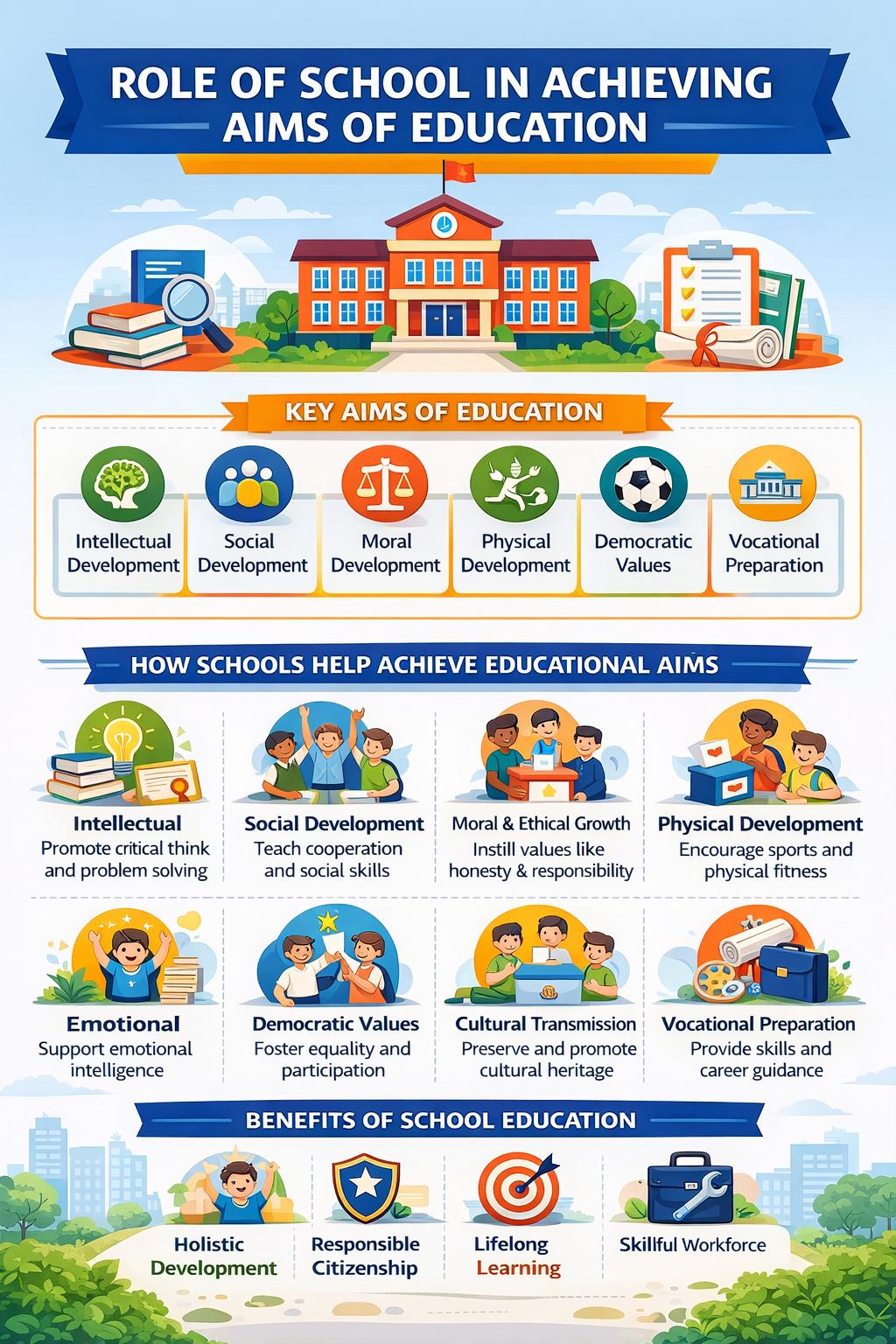
Major aims of education include:
- Intellectual development
- Moral and ethical development
- Social development
- Physical development
- Vocational competence
- Democratic values
शिक्षा के प्रमुख उद्देश्यों में शामिल हैं:
- बौद्धिक विकास
- नैतिक विकास
- सामाजिक विकास
- शारीरिक विकास
- व्यावसायिक कौशल
- लोकतांत्रिक मूल्यों का विकास
4. School as an Agency of Education (शिक्षा की संस्था के रूप में विद्यालय)
Schools are considered the most organized and systematic agencies of education.
विद्यालय शिक्षा की सबसे संगठित और व्यवस्थित संस्थाओं में से एक माने जाते हैं।
They provide structured learning experiences through:
- Curriculum
- Teaching-learning activities
- Evaluation systems
- Co-curricular programs
विद्यालय निम्न माध्यमों से शिक्षण-अधिगम को व्यवस्थित करते हैं:
- पाठ्यक्रम
- शिक्षण-अधिगम गतिविधियाँ
- मूल्यांकन प्रणाली
- सह-पाठ्यक्रम कार्यक्रम
5. Role of School in Achieving Aims of Education
(शिक्षा के उद्देश्यों की प्राप्ति में विद्यालय की भूमिका)
Schools play a crucial role in fulfilling the aims of education.
विद्यालय शिक्षा के उद्देश्यों को प्राप्त करने में अत्यंत महत्वपूर्ण भूमिका निभाते हैं।
Below are the major roles of schools.
6. Intellectual Development (बौद्धिक विकास)
One of the primary roles of schools is to promote intellectual growth among students.
विद्यालय का मुख्य उद्देश्य विद्यार्थियों के बौद्धिक विकास को बढ़ावा देना है।
Schools help students:
- Develop critical thinking
- Acquire knowledge
- Improve problem-solving skills
- Enhance creativity
विद्यालय विद्यार्थियों में निम्न क्षमताओं का विकास करते हैं:
- आलोचनात्मक सोच
- ज्ञान अर्जन
- समस्या समाधान कौशल
- रचनात्मकता
Through effective teaching methods and curriculum, schools cultivate scientific thinking and rational understanding.
Please follow us on Facebook:https://www.facebook.com/profile.php?id=61586013442564
Please visit for similar topics: https://teacherszone.in/
7. Social Development (सामाजिक विकास)
Schools act as miniature societies where students learn social values and behaviors.
विद्यालय समाज का लघु रूप होते हैं जहाँ विद्यार्थी सामाजिक मूल्यों और व्यवहारों को सीखते हैं।
Students learn:
- Cooperation
- Discipline
- Respect for diversity
- Social responsibility
विद्यालय विद्यार्थियों को सिखाते हैं:
- सहयोग
- अनुशासन
- विविधता का सम्मान
- सामाजिक जिम्मेदारी
8. Moral and Ethical Development (नैतिक और चारित्रिक विकास)
Another important role of schools is the development of moral values.
विद्यालय विद्यार्थियों में नैतिक मूल्यों के विकास में महत्वपूर्ण भूमिका निभाते हैं।
Schools promote values such as:
- Honesty
- Integrity
- Respect
- Responsibility
विद्यालय निम्न मूल्यों को बढ़ावा देते हैं:
- ईमानदारी
- सत्यनिष्ठा
- सम्मान
- जिम्मेदारी
Through moral education and role modeling by teachers, schools contribute to character building.
9. Physical Development (शारीरिक विकास)
Education is not limited to intellectual development; physical development is equally important.
शिक्षा केवल बौद्धिक विकास तक सीमित नहीं है; शारीरिक विकास भी उतना ही महत्वपूर्ण है।
Schools promote physical health through:
- Sports activities
- Physical education
- Health education
- Yoga and fitness programs
विद्यालय खेलकूद और स्वास्थ्य शिक्षा के माध्यम से विद्यार्थियों के शारीरिक विकास को प्रोत्साहित करते हैं।
10. Emotional Development (भावनात्मक विकास)
Schools provide opportunities for students to express emotions and develop emotional intelligence.
विद्यालय विद्यार्थियों को भावनात्मक अभिव्यक्ति और भावनात्मक बुद्धिमत्ता के विकास के अवसर प्रदान करते हैं।
Activities like:
- Group discussions
- Cultural programs
- Art and music
help students develop emotional balance.
11. Development of Democratic Values (लोकतांत्रिक मूल्यों का विकास)
Schools play an important role in promoting democratic values.
विद्यालय लोकतांत्रिक मूल्यों के विकास में महत्वपूर्ण भूमिका निभाते हैं।
Students learn:
- Equality
- Justice
- Freedom
- Tolerance
विद्यालय विद्यार्थियों में समानता, न्याय और सहिष्णुता जैसे मूल्यों का विकास करते हैं।
12. Cultural Transmission (संस्कृति का संरक्षण और प्रसार)
Schools help in preserving and transmitting cultural heritage.
विद्यालय संस्कृति के संरक्षण और प्रसार में महत्वपूर्ण भूमिका निभाते हैं।
Students learn about:
- Traditions
- Customs
- National values
- Cultural diversity
विद्यालय विद्यार्थियों को संस्कृति और परंपराओं से परिचित कराते हैं।
13. Vocational Preparation (व्यावसायिक तैयारी)
Modern education emphasizes skill development.
आधुनिक शिक्षा में कौशल विकास पर विशेष जोर दिया जाता है।
Schools prepare students for future careers through:
- Skill education
- Career guidance
- Vocational training
विद्यालय विद्यार्थियों को भविष्य के रोजगार के लिए तैयार करते हैं।

14. Development of Scientific Attitude (वैज्ञानिक दृष्टिकोण का विकास)
Schools encourage scientific thinking among students.
विद्यालय विद्यार्थियों में वैज्ञानिक दृष्टिकोण विकसित करते हैं।
Students learn to:
- Question assumptions
- Analyze information
- Use evidence for decision making
15. Promoting Inclusive Education (समावेशी शिक्षा को बढ़ावा देना)
Modern schools promote inclusive education where all learners are treated equally.
आधुनिक विद्यालय समावेशी शिक्षा को बढ़ावा देते हैं जिसमें सभी विद्यार्थियों को समान अवसर प्रदान किए जाते हैं।
Inclusive schools support:
- Children with disabilities
- Diverse socio-economic backgrounds
- Gender equality
16. Role of Teachers in Achieving Educational Aims / (शिक्षा के उद्देश्यों की प्राप्ति में शिक्षक की भूमिका)
Teachers are the most important agents in achieving educational aims.
शिक्षा के उद्देश्यों को प्राप्त करने में शिक्षक सबसे महत्वपूर्ण भूमिका निभाते हैं।
Teachers:
- Facilitate learning
- Guide students
- Encourage creativity
- Promote critical thinking
17. School Environment and Learning (विद्यालय का वातावरण और अधिगम)
A positive school environment is essential for effective learning.
अच्छा विद्यालयी वातावरण प्रभावी अधिगम के लिए आवश्यक है।
Key elements include:
- Safe environment
- Supportive teachers
- Collaborative learning
- Respectful relationships
18. Challenges Faced by Schools (विद्यालयों के सामने चुनौतियाँ)
Despite their important role, schools face many challenges.
विद्यालयों को कई चुनौतियों का सामना करना पड़ता है।
Some major challenges include:
- Lack of infrastructure
- Teacher shortages
- Inequality in education
- Technological gaps
19. Role of Schools in the 21st Century in Role of School in Achieving the Aims of Education(21वीं सदी में विद्यालय की भूमिका)
In the modern world, the role of schools is expanding.
आधुनिक युग में विद्यालयों की भूमिका और अधिक व्यापक हो गई है।
Schools must now focus on:
- Digital literacy
- Critical thinking
- Innovation and creativity
- Global citizenship
20. Conclusion /Role of School in Achieving the Aims of Education (निष्कर्ष)
Schools play a vital role in achieving the aims of education. They provide a structured environment where students develop intellectually, socially, morally, and physically.
विद्यालय शिक्षा के उद्देश्यों की प्राप्ति में अत्यंत महत्वपूर्ण भूमिका निभाते हैं। वे ऐसा वातावरण प्रदान करते हैं जहाँ विद्यार्थियों का बौद्धिक, सामाजिक, नैतिक और शारीरिक विकास होता है।
Through curriculum, teaching methods, and supportive environments, schools help build responsible citizens who contribute to the progress of society.
विद्यालय शिक्षा के माध्यम से ऐसे जिम्मेदार नागरिक तैयार करते हैं जो समाज और राष्ट्र के विकास में योगदान देते हैं।
21. HOTS MCQs with Answers
Role of School in Achieving Aims of Education
1.
A school organizes community service programs where students participate in environmental campaigns. Which aim of education is mainly achieved?
A. Intellectual development
B. Social responsibility
C. Vocational education
D. Physical development
Answer: B. Social responsibility
2.
A teacher encourages students to question traditional ideas and explore new perspectives. This approach mainly develops:
A. Memorization
B. Critical thinking
C. Discipline
D. Teacher authority
Answer: B. Critical thinking
3.
A school gives equal importance to academics, sports, arts, and moral education. This approach represents:
A. Specialized education
B. Holistic development
C. Examination-oriented education
D. Vocational training only
Answer: B. Holistic development
4.
Which school activity best reflects the development of democratic values among students?
A. Teacher-centered lecture
B. Student participation in school parliament
C. Memorization of civics textbook
D. Competitive examinations
Answer: B. Student participation in school parliament
5.
If a school focuses only on examinations and ignores co-curricular activities, which aim of education is most affected?
A. Intellectual development
B. Holistic development
C. Vocational development
D. Curriculum completion
Answer: B. Holistic development
6.
Which school practice most effectively promotes moral development?
A. Strict disciplinary rules
B. Value education through real-life examples
C. Frequent testing
D. Homework assignments
Answer: B. Value education through real-life examples
7.
Schools are often described as miniature societies because they:
A. Follow government regulations
B. Reflect social interaction and diversity
C. Focus only on academic learning
D. Control student behavior
Answer: B. Reflect social interaction and diversity
8.
A teacher connects science lessons with environmental problems in society. This method mainly develops:
A. Rote learning
B. Scientific attitude
C. Administrative skills
D. Political awareness
Answer: B. Scientific attitude
9.
Which school activity contributes most to the transmission of culture?
A. Teaching mathematics formulas
B. Organizing cultural festivals
C. Conducting written exams
D. Completing the syllabus
Answer: B. Organizing cultural festivals
10.
Providing vocational courses and career counseling in schools fulfills which aim of education?
A. Cultural development
B. Vocational development
C. Moral education
D. Intellectual curiosity
Answer: B. Vocational development
11.
A school where students are encouraged to freely express opinions reflects:
A. Authoritarian education
B. Democratic education
C. Rigid discipline
D. Examination culture
Answer: B. Democratic education
12.
Which example best represents inclusive education in schools?
A. Teaching only talented students
B. Providing equal learning opportunities for all students
C. Limiting admissions
D. Focusing only on high achievers
Answer: B. Providing equal learning opportunities for all students
13.
Group discussions and collaborative learning mainly promote:
A. Social skills
B. Memorization
C. Examination performance
D. Teacher authority
Answer: A. Social skills
14.
Which function of school contributes most to character building?
A. Classroom discipline only
B. Value-based education and teacher role modeling
C. Homework evaluation
D. Time management
Answer: B. Value-based education and teacher role modeling
15.
Promoting respect for cultural diversity in schools helps achieve:
A. National integration
B. Intellectual development
C. Vocational development
D. Examination success
Answer: A. National integration
16.
Encouraging students to solve real-life problems mainly develops:
A. Emotional development
B. Intellectual development
C. Physical development
D. Moral development
Answer: B. Intellectual development
17.
Sports activities, yoga, and health education in schools mainly promote:
A. Physical development
B. Cultural education
C. Vocational development
D. Social equality
Answer: A. Physical development
18.
Which factor most influences the success of schools in achieving educational aims?
A. Teacher quality
B. Student age
C. School location
D. Classroom size
Answer: A. Teacher quality
19.
Which teaching method best encourages creativity among students?
A. Lecture method
B. Project-based learning
C. Dictation method
D. Repetition method
Answer: B. Project-based learning
20.
A school encouraging experimentation and innovation among students mainly promotes:
A. Intellectual curiosity
B. Memorization
C. Discipline
D. Curriculum completion
Answer: A. Intellectual curiosity
21.
Activities such as art, music, and drama mainly support:
A. Emotional development
B. Physical development
C. Intellectual development
D. Vocational development
Answer: A. Emotional development
22.
Group projects and teamwork in schools mainly promote:
A. Social cooperation
B. Intellectual competition
C. Individual performance
D. Memorization
Answer: A. Social cooperation
23.
Which principle is essential for achieving democratic education in schools?
A. Teacher authority
B. Student participation
C. Strict discipline
D. Uniform curriculum
Answer: B. Student participation
24.
Inquiry-based learning mainly develops:
A. Memorization
B. Scientific temperament
C. Administrative skills
D. Examination performance
Answer: B. Scientific temperament
25.
Schools contribute to nation building mainly by:
A. Increasing competition
B. Developing responsible citizens
C. Conducting exams
D. Teaching history
Answer: B. Developing responsible citizens
26.
School assemblies and value-based talks mainly promote:
A. Moral development
B. Vocational development
C. Intellectual development
D. Physical fitness
Answer: A. Moral development
27.
Cooperative learning activities in schools mainly support:
A. Socialization
B. Memorization
C. Examination performance
D. Individual competition
Answer: A. Socialization
28.
Skill-based education programs help students:
A. Adapt to changing societal needs
B. Memorize textbooks
C. Avoid practical work
D. Focus only on theory
Answer: A. Adapt to changing societal needs
29.
Which factor ensures effective achievement of educational aims in schools?
A. Curriculum alone
B. Balanced curriculum and co-curricular activities
C. Examination system only
D. Infrastructure only
Answer: B. Balanced curriculum and co-curricular activities
30.
Teaching students about international cultures and global issues promotes:
A. Global citizenship
B. Local identity only
C. National isolation
D. Curriculum limitation
Answer: A. Global citizenship
31.
Environmental awareness programs in schools mainly promote:
A. Ecological responsibility
B. Intellectual competition
C. Physical strength
D. Memorization
Answer: A. Ecological responsibility
32.
Encouraging curiosity and questioning attitudes in schools promotes:
A. Lifelong learning
B. Memorization
C. Examination success
D. Discipline
Answer: A. Lifelong learning
33.
Participation in student councils mainly develops:
A. Leadership skills
B. Memorization skills
C. Examination preparation
D. Physical fitness
Answer: A. Leadership skills
34.
Holistic education in schools requires:
A. Balanced academic and co-curricular activities
B. Examination-focused learning
C. Teacher authority
D. Strict discipline
Answer: A. Balanced academic and co-curricular activities
35.
Discussing moral dilemmas in classrooms helps students develop:
A. Ethical decision-making
B. Memorization
C. Physical development
D. Vocational skills
Answer: A. Ethical decision-making
36.
Promoting gender equality in schools fulfills which educational aim?
A. Social justice
B. Intellectual development
C. Vocational education
D. Cultural preservation
Answer: A. Social justice
37.
Teaching national history and cultural traditions helps develop:
A. National identity
B. Scientific thinking
C. Vocational skills
D. Physical development
Answer: A. National identity
38.
Participation in co-curricular activities mainly contributes to:
A. Personality development
B. Examination success
C. Memorization
D. Curriculum completion
Answer: A. Personality development
39.
Life skills education mainly prepares students for:
A. Practical life challenges
B. Memorization of textbooks
C. Physical development only
D. Cultural preservation only
Answer: A. Practical life challenges
40.
Inquiry-based teaching strategies mainly encourage:
A. Independent thinking
B. Memorization
C. Teacher authority
D. Dictation learning
Answer: A. Independent thinking
41.
Group discussions in classrooms help students develop:
A. Conflict resolution skills
B. Memorization
C. Physical strength
D. Examination performance
Answer: A. Conflict resolution skills
42.
Encouraging tolerance and diversity in schools promotes:
A. Social harmony
B. Intellectual competition
C. Discipline
D. Memorization
Answer: A. Social harmony
43.
Providing counseling services in schools mainly supports:
A. Mental well-being
B. Curriculum completion
C. Examination preparation
D. Physical development
Answer: A. Mental well-being
44.
Sports and physical education mainly achieve which aim of education?
A. Physical development
B. Moral development
C. Intellectual development
D. Vocational development
Answer: A. Physical development
45.
Which factor improves the effectiveness of schools in achieving educational aims?
A. Positive school climate
B. Strict discipline only
C. Heavy curriculum
D. Frequent tests
Answer: A. Positive school climate
46.
Encouraging experimentation and creative thinking mainly develops:
A. Innovation
B. Memorization
C. Discipline
D. Examination success
Answer: A. Innovation
47.
Providing equal educational opportunities helps achieve:
A. Social mobility
B. Cultural isolation
C. Academic competition only
D. Memorization
Answer: A. Social mobility
48.
Environmental education programs mainly promote:
A. Ecological awareness
B. Intellectual competition
C. Physical strength
D. Memorization
Answer: A. Ecological awareness
49.
Interaction between teachers and students mainly strengthens:
A. Socialization process
B. Memorization
C. Examination success
D. Physical development
Answer: A. Socialization process
50.
Which statement best describes the role of schools in achieving educational aims?
A. Schools provide only academic knowledge
B. Schools promote holistic development of students
C. Schools focus mainly on examinations
D. Schools emphasize discipline only
Answer: B. Schools promote holistic development of students