
Right of Persons with Disability Act-2016: History, Key Features, Schemes & 100 MCQs for CTET/B.Ed/NET.KVS/NVS. EMRS and other teaching exams
Right of Persons with Disability Act, 2016 (RPwD Act) – History, Guidelines, Schemes and Educational Importance
दिव्यांगजन अधिकार अधिनियम, 2016 – इतिहास, दिशानिर्देश, योजनाएँ और शैक्षिक महत्व
Table of Contents
1. Introduction / परिचय
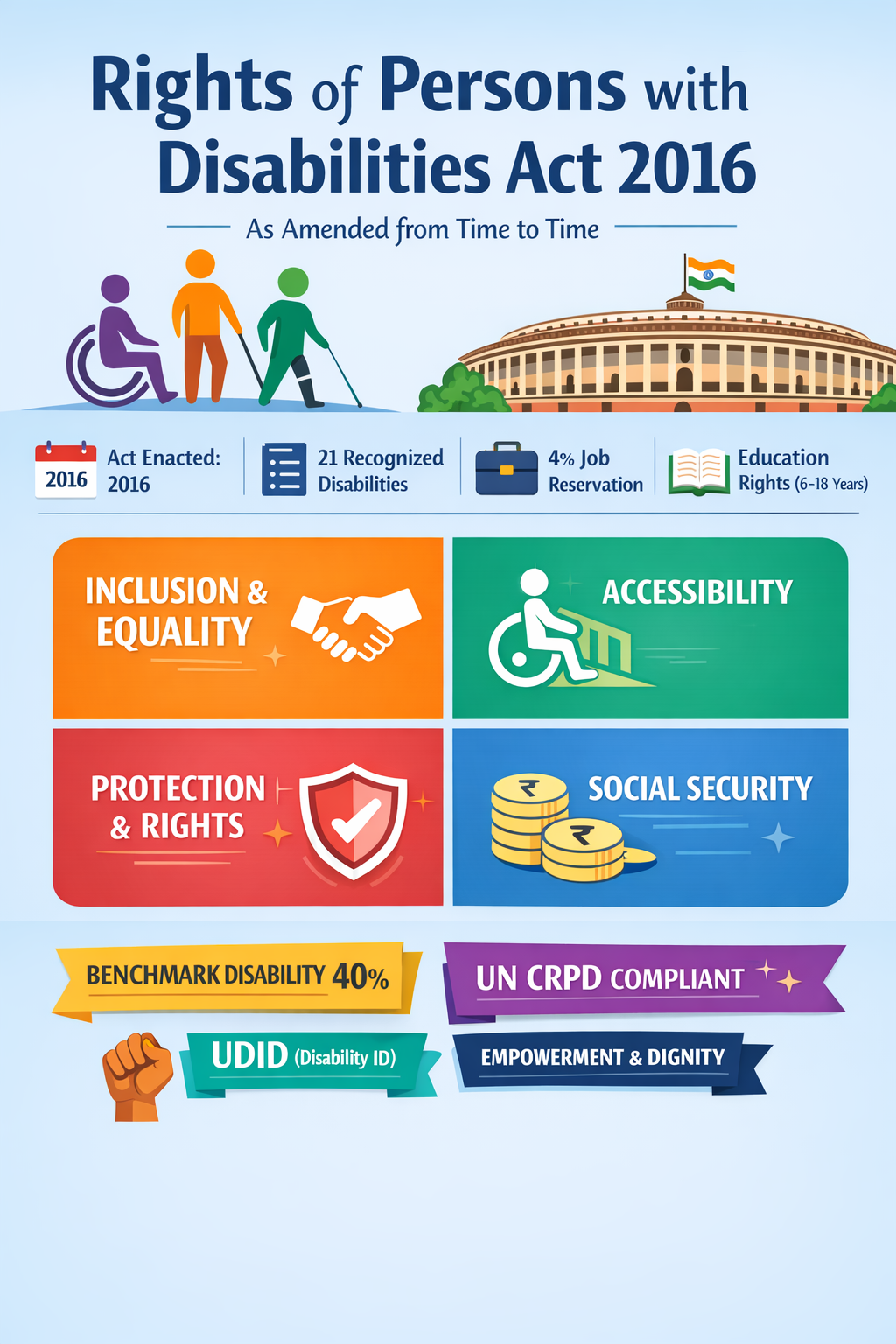
The Rights of Persons with Disabilities Act, 2016 (RPwD Act) is a landmark legislation in India aimed at protecting and promoting the rights of persons with disabilities. It replaced the earlier disability law and ensured equal opportunities, dignity, and inclusion for disabled persons in society. The Act focuses on accessibility, education, employment, social security, and protection against discrimination.
दिव्यांगजन अधिकार अधिनियम, 2016 भारत का एक महत्वपूर्ण कानून है जिसका उद्देश्य दिव्यांग व्यक्तियों के अधिकारों की रक्षा करना और उन्हें समाज में समान अवसर प्रदान करना है। इस अधिनियम ने पहले के कानून को प्रतिस्थापित किया और दिव्यांगजनों के लिए शिक्षा, रोजगार, सामाजिक सुरक्षा और समानता सुनिश्चित की।
The Act was enacted to comply with the United Nations Convention on the Rights of Persons with Disabilities (UNCRPD), which India ratified in 2007.
2. Meaning of Person with Disability
दिव्यांग व्यक्ति का अर्थ
According to the RPwD Act, a person with disability is someone who has long-term physical, mental, intellectual, or sensory impairment which interacts with barriers and restricts full participation in society.
RPwD अधिनियम के अनुसार दिव्यांग व्यक्ति वह है जिसे दीर्घकालिक शारीरिक, मानसिक, बौद्धिक या संवेदी विकलांगता हो और सामाजिक बाधाओं के कारण वह समाज में पूर्ण रूप से भाग लेने में असमर्थ हो।
3. History of Disability Rights in the World
विश्व में दिव्यांग अधिकारों का इतिहास
The global movement for disability rights began in the 20th century. Key milestones include:
- 1948 – Universal Declaration of Human Rights
- 1981 – International Year of Disabled Persons
- 1993 – UN Standard Rules on Equalization of Opportunities
- 2006 – UN Convention on the Rights of Persons with Disabilities (UNCRPD)
The UNCRPD emphasized dignity, equality, accessibility, and non-discrimination for persons with disabilities.
दिव्यांग अधिकारों का वैश्विक आंदोलन 20वीं सदी में शुरू हुआ। प्रमुख घटनाएँ:
- 1948 – मानवाधिकारों की सार्वभौमिक घोषणा
- 1981 – अंतरराष्ट्रीय दिव्यांग वर्ष
- 1993 – समान अवसर नियम
- 2006 – संयुक्त राष्ट्र दिव्यांग अधिकार अभिसमय (UNCRPD)
इस अभिसमय का उद्देश्य दिव्यांग व्यक्तियों के लिए समान अवसर और सम्मान सुनिश्चित करना था।
4. History of Disability Laws in India
भारत में दिव्यांग अधिकारों का इतिहास
Important milestones in India:
- 1995 – Persons with Disabilities Act
- 1999 – National Trust Act
- 2006 – National Policy for Persons with Disabilities
- 2016 – Rights of Persons with Disabilities Act
The Right of Persons with Disability Act-2016 replaced the Persons with Disabilities Act, 1995 and expanded the number of recognised disabilities from 7 to 21.
भारत में दिव्यांग अधिकारों से संबंधित प्रमुख कानून:
- 1995 – दिव्यांग व्यक्तियों का अधिनियम
- 1999 – राष्ट्रीय ट्रस्ट अधिनियम
- 2006 – राष्ट्रीय दिव्यांग नीति
- 2016 – दिव्यांगजन अधिकार अधिनियम
2016 के अधिनियम ने पहले के कानून को प्रतिस्थापित किया और विकलांगताओं की संख्या 7 से बढ़ाकर 21 कर दी।
5. Objectives of RPwD Act 2016 / अधिनियम के उद्देश्य
- Ensure equality and dignity
- Promote inclusive education
- Prevent discrimination
- Provide employment opportunities
- Ensure accessibility
- Provide social security
- समानता और सम्मान सुनिश्चित करना
- समावेशी शिक्षा को बढ़ावा देना
- भेदभाव को रोकना
- रोजगार के अवसर प्रदान करना
- सुगम्यता सुनिश्चित करना
- सामाजिक सुरक्षा प्रदान करना
6. Types of Disabilities under the Right of Persons with Disability Act-2016 / अधिनियम के अंतर्गत विकलांगताओं के प्रकार
The Act recognizes 21 disabilities, including:
Blindness
Low vision
Leprosy cured
Hearing impairment
Locomotor disability
Intellectual disability
Autism spectrum disorder
Cerebral palsy
Dwarfism
Muscular dystrophy
Chronic neurological conditions
Speech and language disability
Specific learning disability
Multiple sclerosis
Parkinson’s disease
Hemophilia
Thalassemia
Sickle cell disease
Acid attack victims
Multiple disabilities
Mental illness
7. Key Features of the Right of Persons with Disability Act-2016 / अधिनियम की प्रमुख विशेषताएँ
- 4% reservation in government jobs
- 5% reservation in higher education institutions
- Free education for children with benchmark disability (6–18 years)
- Barrier-free environment
- Establishment of Central and State Advisory Boards
- Social security schemes
- Special courts for disability cases
- Protection of women and children with disabilities
- सरकारी नौकरियों में 4% आरक्षण
- उच्च शिक्षा में 5% सीट आरक्षित
- 6–18 वर्ष तक नि:शुल्क शिक्षा
- बाधा-मुक्त वातावरण
- केंद्रीय और राज्य सलाहकार बोर्ड
- सामाजिक सुरक्षा योजनाएँ
- विशेष न्यायालय
- दिव्यांग महिलाओं और बच्चों की सुरक्षा
8. Educational Provisions in Right of Persons with Disability Act-2016 / शिक्षा से संबंधित प्रावधान
The Act promotes inclusive education where students with disabilities study alongside others with necessary support services such as special educators, assistive devices, and accessible classrooms.
यह अधिनियम समावेशी शिक्षा को बढ़ावा देता है जिसमें दिव्यांग छात्र सामान्य विद्यार्थियों के साथ पढ़ते हैं और उन्हें विशेष शिक्षकों तथा सहायक उपकरणों की सुविधा दी जाती है।
9. Government Schemes for Persons with Disabilities / दिव्यांगजनों के लिए सरकारी योजनाएँ
Important schemes include:
- Accessible India Campaign
- Deendayal Disabled Rehabilitation Scheme
- Unique Disability ID (UDID) Scheme
- Scholarships for students with disabilities
- सुगम्य भारत अभियान
- दीनदयाल दिव्यांग पुनर्वास योजना
- यूनिक डिसेबिलिटी आईडी योजना
- दिव्यांग छात्रवृत्ति योजना
10. Importance for Teachers and Education System / शिक्षा व्यवस्था में महत्व
Teachers must create inclusive classrooms and respect the rights of students with disabilities.
शिक्षकों को समावेशी कक्षा बनानी चाहिए और दिव्यांग छात्रों के अधिकारों का सम्मान करना चाहिए।
11. Conclusion of Right of Persons with Disability Act-2016 / निष्कर्ष
The Rights of Persons with Disabilities Act, 2016 is a progressive step toward building an inclusive society where persons with disabilities enjoy equal rights and opportunities.
दिव्यांगजन अधिकार अधिनियम 2016 एक समावेशी समाज की दिशा में महत्वपूर्ण कदम है जो दिव्यांग व्यक्तियों को समान अधिकार और अवसर प्रदान करता है।
For more topics please visit :https://teacherszone.in/
Please follow us on Facebook: https://www.facebook.com/profile.php?id=61586013442564
12. Objective Questions of Right of Persons with Disability Act-2016
- Right of Persons with Disability Act-2016 was passed in
A 1995
B 2001
C 2016
D 2018
Answer: C - Right of Persons with Disability Act-2016 replaced which law?
A Mental Health Act
B PWD Act 1995
C RTE Act
D Juvenile Justice Act
Answer: B - Number of disabilities recognized in Right of Persons with Disability Act-2016
A 7
B 14
C 21
D 25
Answer: C - Reservation in government jobs in Right of Persons with Disability Act-2016
A 2%
B 3%
C 4%
D 5%
Answer: C - Reservation in higher education in Right of Persons with Disability Act-2016
A 3%
B 5%
C 6%
D 7%
Answer: B - UN convention related to disability rights
A UNCRC
B UNCRPD
C UNESCO
D UNICEF
Answer: B
7. The minimum disability required to be considered a “Benchmark Disability” is:( in Right of Persons with Disability Act-2016)
A 20%
B 30%
C 40%
D 50%
Answer: C
8. The RPwD Act was enacted to implement which international convention?
A UNCRC
B UNCRPD
C UNESCO Convention
D ILO Convention
Answer: B
9. India ratified the UN Convention on the Rights of Persons with Disabilities in:
A 2005
B 2006
C 2007
D 2008
Answer: C
10. Free education for children with benchmark disabilities is guaranteed for the age group:
A 3–14 years
B 6–14 years
C 6–18 years
D 5–18 years
Answer: C
11. Reservation for persons with disabilities in higher education institutions is: ( as per Right of Persons with Disability Act-2016)
A 3%
B 4%
C 5%
D 6%
Answer: C
12. Reservation in government jobs under the Right of Persons with Disability Act-2016 is:
A 3%
B 4%
C 5%
D 6%
Answer: B
13. The nodal ministry responsible for disability affairs in India is:
A Ministry of Education
B Ministry of Health
C Ministry of Social Justice and Empowerment
D Ministry of Labour
Answer: C
14. The RPwD Act increased the number of recognized disabilities from:
A 5 to 15
B 7 to 21
C 10 to 25
D 8 to 20
Answer: B
15. Which of the following is included as a disability under the Right of Persons with Disability Act-2016?
A Acid attack victim
B Thalassemia
C Autism
D All of the above
Answer: D
16. The Central Advisory Board on Disability is constituted by:
A President
B Prime Minister
C Central Government
D Supreme Court
Answer: C
17. The Chief Commissioner for Persons with Disabilities works at:
A District level
B State level
C National level
D Local level
Answer: C
18. State Commissioners for Persons with Disabilities work at:
A National level
B State level
C District level
D International level
Answer: B
19. The Right of Persons with Disability Act-2016 provides for special courts to:
A Conduct elections
B Handle disability-related offences
C Provide scholarships
D Train teachers
Answer: B
20. The Unique Disability ID (UDID) scheme aims to:
A Provide employment
B Create a national database of disabled persons
C Give pensions
D Provide insurance
Answer: B
21. The Accessible India Campaign is also known as:
A Sugamya Bharat Abhiyan
B Swachh Bharat Abhiyan
C Skill India
D Digital India
Answer: A
22. The Accessible India Campaign was launched in:
A 2014
B 2015
C 2016
D 2017
Answer: B
23. The Right of Persons with Disability Act-2016 emphasizes:
A Inclusive education
B Special education only
C Home schooling only
D Private education only
Answer: A
24. Inclusive education means:
A Separate schools for disabled students
B Disabled students study with others in regular schools
C No education for disabled students
D Only online education
Answer: B
25. The Right of Persons with Disability Act-2016 provides protection against:
A Discrimination
B Violence
C Abuse
D All of the above
Answer: D
26. Which disability is related to difficulty in reading and writing?
A Intellectual disability
B Specific learning disability
C Autism
D Hearing impairment
Answer: B
27. The Right of Persons with Disability Act-2016 was passed by Parliament in:
A 2014
B 2015
C 2016
D 2017
Answer: C
28. The Right of Persons with Disability Act-2016 came into force in:
A 2015
B 2016
C 2017
D 2018
Answer: C
29. The National Fund for persons with disabilities is created under:
A RPwD Act
B RTE Act
C Mental Health Act
D Labour Act
Answer: A
30. The Right of Persons with Disability Act-2016 promotes:
A Equal opportunity
B Non-discrimination
C Full participation
D All of the above
Answer: D
31. Which disability is related to loss of hearing?
A Hearing impairment
B Autism
C Cerebral palsy
D Dwarfism
Answer: A
32. The term “locomotor disability” refers to:
A Hearing problem
B Movement-related disability
C Speech problem
D Learning problem
Answer: B
33. Autism spectrum disorder mainly affects:
A Hearing
B Vision
C Social interaction and communication
D Bone growth
Answer: C
34. The Right of Persons with Disability Act-201, promotes accessibility in:
A Buildings
B Transport
C Information technology
D All of the above
Answer: D
35. Which scheme provides scholarships to students with disabilities?
A NSP Scholarship
B Disability Scholarship Scheme
C Both A and B
D None
Answer: C
36. The Right of Persons with Disability Act-2016, focuses on the empowerment of:
A Women with disabilities
B Children with disabilities
C Persons with disabilities
D All of the above
Answer: D
37. Acid attack victims are included as disability in:
A PWD Act 1995
B RPwD Act 2016
C RTE Act
D Mental Health Act
Answer: B
38. Multiple disabilities means:
A Two or more disabilities together
B Only physical disability
C Only mental disability
D Only learning disability
Answer: A
39. The main goal of disability legislation is:
A Charity
B Welfare
C Rights-based approach
D Punishment
Answer: C
40. The Right of Persons with Disability Act-2016 is based on the principle of:
A Equality and dignity
B Isolation
C Exclusion
D Charity only
Answer: A
Previous-Exam Type MCQs on Right of Persons with Disability Act-2016
1. The Rights of Persons with Disabilities Act was enacted in:
A 1995
B 2001
C 2016
D 2018
Answer: C
Asked in: CTET, State TET, B.Ed Entrance
2. The RPwD Act replaced which earlier law?
A National Trust Act
B Persons with Disabilities Act, 1995
C RTE Act
D Mental Health Act
Answer: B
Asked in: UGC-NET Education, CTET
3. India ratified the UN Convention on the Rights of Persons with Disabilities in:
A 2005
B 2006
C 2007
D 2008
Answer: C
Asked in: UGC-NET, DSSSB
4. The A featured blog infographic for the RPwD Act 2016. recognizes how many disabilities?
A 7
B 14
C 21
D 25
Answer: C
Asked in: CTET, KVS, State TET
5. Reservation in government jobs for persons with disabilities is:
A 3%
B 4%
C 5%
D 6%
Answer: B
Asked in: DSSSB, KVS, State TET
6. Reservation in higher education institutions under the RPwD Act is:
A 3%
B 4%
C 5%
D 6%
Answer: C
Asked in: UGC-NET Education, B.Ed Entrance
7. Benchmark disability means at least:
A 20% disability
B 30% disability
C 40% disability
D 50% disability
Answer: C
Asked in: CTET, DSSSB
8. The RPwD Act came into force in:
A 2016
B 2017
C 2018
D 2019
Answer: B ( 19th April 2017)
Asked in: UGC-NET Education
9. The nodal ministry responsible for disability affairs is:
A Ministry of Education
B Ministry of Social Justice and Empowerment
C Ministry of Health
D Ministry of Labour
Answer: B
Asked in: CTET, B.Ed Entrance
10. The Accessible India Campaign is also known as:
A Sugamya Bharat Abhiyan
B Swachh Bharat Abhiyan
C Skill India Mission
D Digital India Mission
Answer: A
Asked in: State TET, DSSSB
11. Accessible India Campaign was launched in:
A 2014
B 2015
C 2016
D 2017
Answer: B
Asked in: DSSSB, KVS
12. The Unique Disability ID scheme is abbreviated as:
A UID
B UDID
C UDIS
D UDDI
Answer: B
Asked in: CTET, State TET
13. Free education for children with benchmark disabilities is provided between:
A 3–14 years
B 6–14 years
C 6–18 years
D 5–18 years
Answer: C
Asked in: CTET, B.Ed Entrance
14. The Chief Commissioner for Persons with Disabilities functions at:
A District level
B State level
C National level
D Block level
Answer: C
Asked in: UGC-NET Education
15. The State Commissioner for Persons with Disabilities functions at:
A State level
B National level
C District level
D Block level
Answer: A
Asked in: DSSSB
16. The RPwD Act follows which approach?
A Charity approach
B Medical approach
C Rights-based approach
D Welfare approach
Answer: C
Asked in: UGC-NET Education
17. Inclusive education refers to:
A Separate schools for disabled children
B Home schooling
C Education of disabled children in regular schools
D Online schooling only
Answer: C
Asked in: CTET, KVS
18. Which of the following is included under the RPwD disability list?
A Autism
B Thalassemia
C Parkinson’s disease
D All of the above
Answer: D
Asked in: CTET, State TET
19. Acid attack victims were included as disability in:
A PWD Act 1995
B RPwD Act 2016
C RTE Act
D Mental Health Act
Answer: B
Asked in: DSSSB, State TET
20. The RPwD Act protects persons with disabilities from:
A Abuse
B Violence
C Exploitation
D All of the above
Answer: D
Asked in: CTET
21. The RPwD Act ensures accessibility in:
A Buildings
B Transport
C Information technology
D All of the above
Answer: D
Asked in: UGC-NET Education
22. The Central Advisory Board on Disability is constituted by:
A President
B Prime Minister
C Central Government
D Parliament
Answer: C
Asked in: DSSSB
23. Locomotor disability refers to:
A Hearing disability
B Movement disability
C Vision disability
D Speech disability
Answer: B
Asked in: CTET
24. Autism spectrum disorder mainly affects:
A Vision
B Social interaction and communication
C Hearing
D Bone growth
Answer: B
Asked in: CTET, State TET
25. Specific learning disability mainly affects:
A Vision
B Reading and writing
C Hearing
D Movement
Answer: B
Asked in: CTET, KVS
26. Which disorder affects muscles?
A Muscular dystrophy
B Autism
C Parkinson’s disease
D Thalassemia
Answer: A
Asked in: UGC-NET Education
27. Cerebral palsy mainly affects:
A Movement and posture
B Hearing
C Vision
D Skin
Answer: A
Asked in: CTET
28. Which of the following is a blood disorder?
A Thalassemia
B Hemophilia
C Sickle cell disease
D All of the above
Answer: D
Asked in: DSSSB
29. Intellectual disability affects:
A Learning and reasoning ability
B Hearing
C Vision
D Skin
Answer: A
Asked in: CTET
30. Hearing impairment refers to:
A Loss of hearing ability
B Loss of sight
C Loss of movement
D Loss of memory
Answer: A
Asked in: CTET
31. Parkinson’s disease mainly affects:
A Movement control
B Hearing
C Vision
D Skin
Answer: A
Asked in: UGC-NET Education
32. Dwarfism refers to:
A Short stature condition
B Hearing loss
C Vision loss
D Mental illness
Answer: A
Asked in: DSSSB
33. Multiple disabilities mean:
A Two or more disabilities together
B Only physical disability
C Only mental disability
D Only hearing disability
Answer: A
Asked in: CTET
34. Speech and language disability affects:
A Communication ability
B Movement ability
C Vision ability
D Hearing ability
Answer: A
Asked in: CTET
35. RPwD Act promotes:
A Equality
B Participation
C Non-discrimination
D All of the above
Answer: D
Asked in: UGC-NET
36. The RPwD Act provides special courts for:
A Education disputes
B Disability-related offences
C Property disputes
D Family disputes
Answer: B
Asked in: DSSSB
37. The Right of Persons with Disability Act-2016 focuses on empowerment of:
A Women with disabilities
B Children with disabilities
C Persons with disabilities
D All of the above
Answer: D
Asked in: CTET
38. Rehabilitation services aim to:
A Improve independence
B Develop skills
C Provide employment support
D All of the above
Answer: D
Asked in: UGC-NET
39. The National Fund for persons with disabilities is created under:
A RPwD Act
B RTE Act
C Labour Act
D Education Act
Answer: A
Asked in: DSSSB
40. Disability rights are based on the principle of:
A Charity
B Equality and dignity
C Isolation
D Dependence
Answer: B
Asked in: UGC-NET
Rights of Persons with Disabilities Act, 2016
41. The Right of Persons with Disability Act-2016 aims to create a:
A Competitive society
B Inclusive society
C Isolated society
D Restricted society
Answer: B
Asked in: CTET, State TET
42. The Right of Persons with Disability Act-2016 ensures equal opportunity in:
A Education
B Employment
C Public services
D All of the above
Answer: D
Asked in: UGC-NET Education
43. Disability certificates are issued by:
A School principal
B Medical authority
C District collector
D Police officer
Answer: B
Asked in: DSSSB, State TET
44. The Right of Persons with Disability Act-2016 encourages development of:
A Assistive devices
B Rehabilitation services
C Accessible technology
D All of the above
Answer: D
Asked in: UGC-NET Education
45. Social security for persons with disabilities includes:
A Pension schemes
B Insurance schemes
C Rehabilitation programs
D All of the above
Answer: D
Asked in: CTET, State TET
46. The Right of Persons with Disability Act-2016 promotes accessibility in:
A Schools
B Government offices
C Public transport
D All of the above
Answer: D
Asked in: DSSSB, KVS
47. Mental illness under the Right of Persons with Disability Act-2016 refers to:
A Disorder affecting thinking and behaviour
B Physical disability
C Vision disability
D Hearing disability
Answer: A
Asked in: UGC-NET Education
48. Which disability affects the nervous system?
A Multiple sclerosis
B Hearing impairment
C Dwarfism
D Thalassemia
Answer: A
Asked in: UGC-NET Education
49. The Right of Persons with Disability Act-2016 recognizes disability as a:
A Medical issue only
B Charity issue
C Human rights issue
D Economic issue
Answer: C
Asked in: UGC-NET Education
50. Inclusive policies under the Right of Persons with Disability Act-2016 apply to:
A Education
B Employment
C Infrastructure
D All of the above
Answer: D
Asked in: CTET, DSSSB
51. Which disorder mainly affects communication ability?
A Speech and language disability
B Hearing impairment
C Vision impairment
D Locomotor disability
Answer: A
Asked in: CTET
52. The RPwD Act protects persons with disabilities from discrimination in:
A Employment
B Education
C Public services
D All of the above
Answer: D
Asked in: UGC-NET Education
53. Which organization monitors disability rights at the national level?
A Election Commission
B Chief Commissioner for Persons with Disabilities
C Finance Commission
D UPSC
Answer: B
Asked in: DSSSB
54. State advisory boards for disability are formed by:
A Parliament
B Central Government
C State Government
D Judiciary
Answer: C
Asked in: State TET
55. The Right of Persons with Disability Act-2016 promotes participation of persons with disabilities in:
A Social life
B Economic activities
C Political life
D All of the above
Answer: D
Asked in: UGC-NET Education
56. The main objective of disability legislation is:
A Charity
B Welfare
C Rights and equality
D Isolation
Answer: C
Asked in: UGC-NET
57. Which disability mainly affects learning and reasoning ability?
A Intellectual disability
B Hearing impairment
C Dwarfism
D Vision impairment
Answer: A
Asked in: CTET
58. Which of the following is a developmental disorder?
A Autism spectrum disorder
B Parkinson’s disease
C Hemophilia
D Dwarfism
Answer: A
Asked in: CTET, State TET
59. The Right of Persons with Disability Act-2016 encourages awareness about:
A Disability rights
B Inclusive education
C Accessibility
D All of the above
Answer: D
Asked in: UGC-NET Education
60. The ultimate goal of the Right of Persons with Disability Act-2016 is to ensure:
A Isolation of persons with disabilities
B Equal rights and dignity
C Charity-based support
D Dependence on others
Answer: B
Asked in: UGC-NET, CTET