
Learn about the National Curriculum Framework for School Education (NCF-SE) 2023, its key features, objectives, curriculum structure, and reforms in India.
Table of Contents
1. Introduction
The National Curriculum Framework for School Education (NCF-SE) 2023 represents one of the most important reforms in India’s education system. It provides a comprehensive framework to guide the development of school curriculum, teaching practices, assessment methods, textbooks, and overall learning experiences in schools across India.
The framework has been developed following the vision and recommendations of the National Education Policy 2020, which aims to transform the Indian education system into a holistic, flexible, multidisciplinary, and learner-centered system.
NCF-SE 2023 replaces earlier curriculum frameworks and builds upon previous educational reforms such as the National Curriculum Framework 2005. However, unlike previous frameworks, NCF-SE 2023 introduces structural changes, competency-based learning, flexible subject choices, and experiential pedagogy aligned with global educational practices.
The primary goal of the framework is to ensure that every child develops knowledge, skills, values, and competencies necessary for lifelong learning and responsible citizenship.
2. Historical Background of Curriculum Frameworks in India
India has developed several curriculum frameworks since independence to guide school education.
This framework focused on national integration, science education, and value education.
1. National Curriculum Framework 1975
This was the first national curriculum framework that attempted to standardize school education across India.
2. National Curriculum Framework 1988
3. National Curriculum Framework 2005
The NCF 2005 introduced important reforms such as:
- Child-centered learning
- Constructivist pedagogy
- Reduction of curriculum load
- Emphasis on critical thinking
4. National Curriculum Framework for School Education 2023
The new framework expands the vision of NCF 2005 and aligns with the transformative goals of the National Education Policy 2020.
Key differences include:
- Introduction of the 5+3+3+4 structure
- Competency-based learning
- Multidisciplinary education
- Integration of vocational education
- Flexibility in subject selection
- Holistic assessment reforms
3. Vision and Objectives of NCF-SE 2023
The vision of NCF-SE 2023 is to create an education system that nurtures holistic development, critical thinking, creativity, and ethical values among learners.
Major Objectives
- Promote holistic and integrated development of learners
- Encourage experiential and activity-based learning
- Develop 21st-century skills
- Strengthen foundational literacy and numeracy
- Integrate vocational and skill education
- Promote multilingual education
- Ensure equity and inclusion
- Reform assessment practices
The framework recognizes that education should not merely focus on academic achievement, but also on social, emotional, ethical, and physical development.
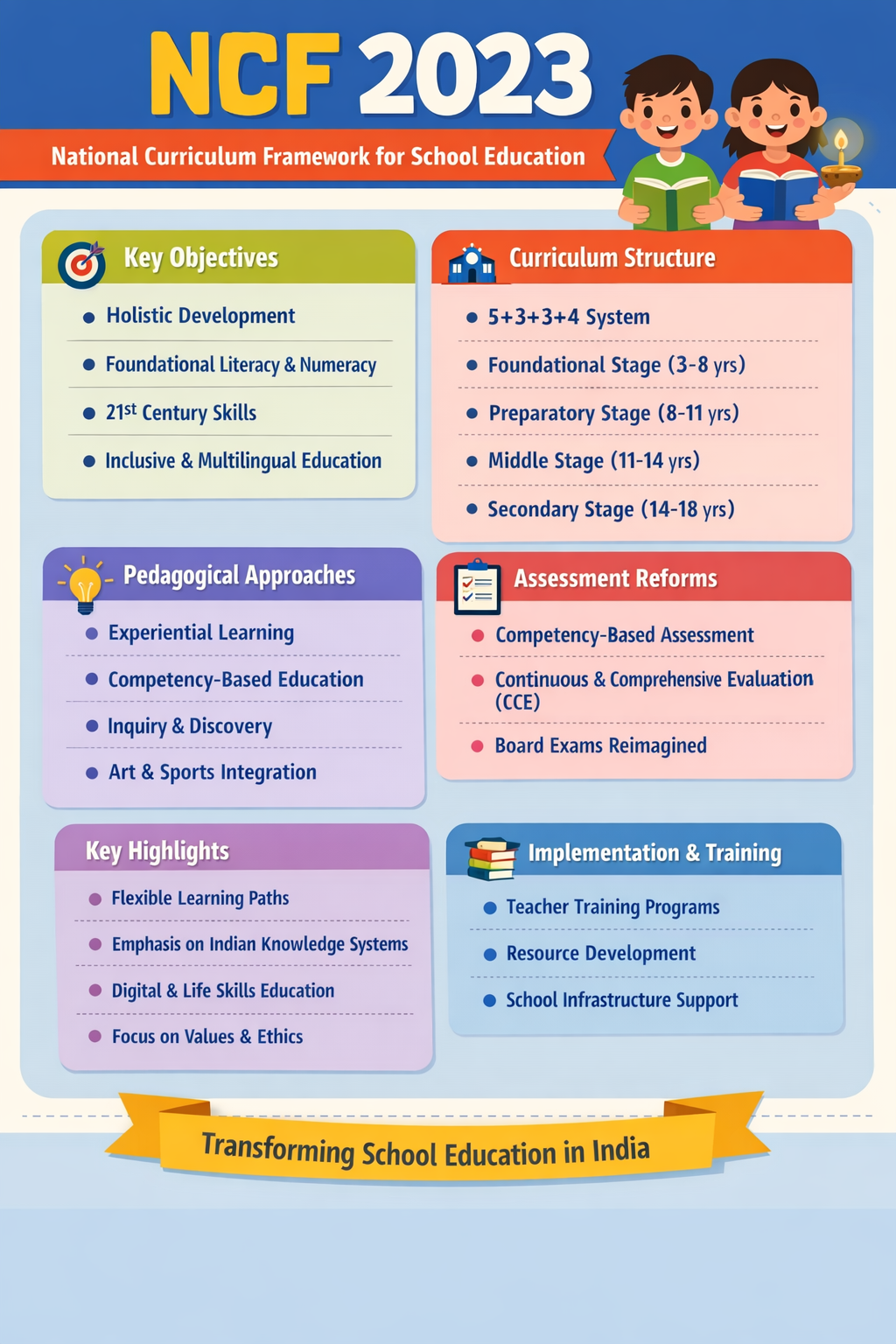
4.Structure of School Education under NCF-SE 2023
One of the most important structural changes introduced by the framework is the 5+3+3+4 curricular structure, replacing the traditional 10+2 system.
1. Foundational Stage (5 Years)
Age group: 3–8 years
Includes:
- 3 years of preschool or Anganwadi
- Grades 1 and 2
This stage focuses on:
- Play-based learning
- Language development
- Early literacy and numeracy
- Socio-emotional development
This stage is guided by the National Curriculum Framework for Foundational Stage 2022.
2. Preparatory Stage (3 Years)
Age group: 8–11 years
Includes:
- Grades 3–5
Focus areas:
- Discovery-based learning
- Language development
- Introduction to subjects such as mathematics, science, arts, and social sciences
3. Middle Stage (3 Years)
Age group: 11–14 years
Includes:
- Grades 6–8
Focus areas:
- Conceptual understanding
- Experiential learning
- Introduction of vocational education
- Coding and computational thinking
4. Secondary Stage (4 Years)
Age group: 14–18 years
Includes:
- Grades 9–12
This stage is divided into:
- Stage 1: Grades 9–10
- Stage 2: Grades 11–12
Key features include:
- Multidisciplinary subject choice
- Flexibility in curriculum
- Deeper conceptual learning
- Career exploration
5.Key Principles of NCF-SE 2023
1. Holistic Development
Education should focus on the overall development of learners, including:
- Intellectual development
- Physical development
- Emotional development
- Ethical development
- Social development
2. Experiential Learning
The framework strongly promotes learning by doing.
Students learn through:
- Projects
- Experiments
- Field visits
- Group activities
- Real-life problem solving
3. Competency-Based Education
The focus shifts from memorization to competency development.
Competencies include:
- Critical thinking
- Problem solving
- Communication skills
- Creativity
- Collaboration
4. Multilingual Education
NCF-SE 2023 promotes the three-language formula.
Key recommendations:
- Early education in mother tongue or home language
- Promotion of regional languages
- Development of multilingual proficiency
Research shows that children learn best in their home language during early years.
6.Curriculum and Subject Areas
The curriculum under NCF-SE 2023 is designed to ensure interdisciplinary learning.
Major subject areas include:
Languages
Language learning includes:
- Reading
- Writing
- Speaking
- Listening
The framework encourages literary appreciation and communication skills.
Mathematics
The focus of mathematics education is on:
- Conceptual understanding
- Problem solving
- Logical reasoning
- Real-life applications
Science
Science education aims to develop:
- Scientific temper
- Inquiry skills
- Observation
- Experimentation
Social Science
Social science includes:
- History
- Geography
- Political science
- Economics
The objective is to help students understand society, culture, and democratic values.
Arts Education
Arts education includes:
- Visual arts
- Music
- Dance
- Theatre
Arts help develop:
- Creativity
- Cultural awareness
- Emotional expression
Physical Education
Physical education focuses on:
- Health and fitness
- Sports participation
- Mental well-being
7.Vocational Education
A major reform introduced by NCF-SE 2023 is the integration of vocational education starting from Grade 6.
Students are exposed to:
- Carpentry
- Gardening
- Electrical work
- Coding
- Design
The aim is to reduce the gap between academic learning and practical skills.
8.Pedagogical Approaches
NCF-SE 2023 recommends several innovative teaching methods.
1. Activity-Based Learning
Students learn through hands-on activities.
2. Project-Based Learning
Students complete projects related to real-world problems.
3. Collaborative Learning
Students work in groups and develop teamwork skills.
4. Inquiry-Based Learning
Students learn by asking questions and exploring answers.
9.Assessment Reforms
Assessment is one of the most important areas of reform in NCF-SE 2023.
Traditional exam systems often focus only on memorization and rote learning. The new framework promotes holistic assessment.
Types of Assessment
- Formative assessment
- Continuous assessment
- Competency-based assessment
- Portfolio assessment
The goal is to evaluate students’ understanding, skills, and overall development.
10.Role of Teachers
Teachers play a crucial role in implementing the curriculum framework.
NCF-SE 2023 emphasizes:
- Teacher autonomy
- Professional development
- Innovative teaching practices
- Reflective teaching
Teachers should act as facilitators and mentors rather than mere instructors.
11.Inclusive Education
The framework strongly promotes inclusive education, ensuring that all children receive equal learning opportunities.
It supports:
- Children with disabilities
- Children from marginalized communities
- Gender equality
- Socio-economic inclusion
Inclusive classrooms promote respect for diversity and equal participation.
12.Integration of Technology
Technology plays an important role in modern education.
NCF-SE 2023 encourages the use of:
- Digital learning platforms
- Online educational resources
- Interactive tools
- Virtual laboratories
However, technology should support learning rather than replace teachers.
13.Environmental and Value Education
The framework emphasizes the importance of environmental awareness and ethical values.
Students are encouraged to develop:
- Environmental responsibility
- Social values
- Democratic citizenship
- Respect for diversity
14.Importance of NCF-SE 2023
The framework is important because it:
- Modernizes the Indian curriculum
- Promotes competency-based education
- Supports flexible learning pathways
- Encourages innovation in teaching
- Improves assessment practices
- Strengthens foundational learning
15.Challenges in Implementation
Despite its advantages, the implementation of NCF-SE 2023 may face certain challenges.
1. Teacher Training
Teachers need extensive training to adopt new pedagogical approaches.
2. Infrastructure
Schools require improved infrastructure for experiential learning.
3. Curriculum Alignment
State boards must align their curricula with the national framework.
4. Resource Availability
Learning materials and digital resources must be developed.
16.Future Impact of NCF-SE 2023
If implemented effectively, NCF-SE 2023 can transform Indian education by:
- Making learning more meaningful
- Reducing rote learning
- Developing critical thinking
- Preparing students for the future workforce
The framework also aligns with global educational trends emphasizing competency-based learning and holistic development.
17.Conclusion of NCF-SE 2023
The National Curriculum Framework for School Education 2023 is a major step toward transforming the Indian education system. By focusing on holistic development, competency-based learning, multilingual education, vocational skills, and assessment reforms, the framework aims to prepare students for the challenges of the 21st century.
Aligned with the vision of the National Education Policy 2020, NCF-SE 2023 seeks to create an education system that is flexible, inclusive, learner-centered, and future-ready.
Its successful implementation will require collaboration among teachers, policymakers, parents, and communities, but its potential to reshape Indian education is immense.
Please visit for more similar topics: https://teacherszone.in/
Please follow us on Facebook: https://www.facebook.com/profile.php?id=61586013442564
18. MCQs on NCF-SE 2023 (NET/JRF Level)
1. The National Curriculum Framework for School Education (NCF-SE) was released in:
A. 2021
B. 2022
C. 2023
D. 2024
Answer: C
2. NCF-SE 2023 has been developed in accordance with which policy?
A. National Policy on Education 1986
B. National Education Policy 2020
C. Right to Education Act 2009
D. National Knowledge Commission
Answer: B
3. The new school structure recommended under NEP and NCF-SE is:
A. 10+2
B. 5+3+3+4
C. 8+4
D. 6+3+3+4
Answer: B
4. The Foundational Stage covers which age group?
A. 2–6 years
B. 3–8 years
C. 6–10 years
D. 5–9 years
Answer: B
5. The Foundational Stage includes:
A. Preschool + Grades 1–2
B. Grades 1–3
C. Preschool only
D. Grades 1–5
Answer: A
6. Which stage follows the Foundational Stage?
A. Preparatory Stage
B. Middle Stage
C. Secondary Stage
D. Higher Stage
Answer: A
7. The Preparatory Stage includes which grades?
A. Grades 3–5
B. Grades 4–6
C. Grades 5–7
D. Grades 2–4
Answer: A
8. The Middle Stage includes which grades?
A. Grades 5–7
B. Grades 6–8
C. Grades 7–9
D. Grades 8–10
Answer: B
9. The Secondary Stage includes:
A. Grades 9–12
B. Grades 8–10
C. Grades 10–12
D. Grades 7–12
Answer: A
10. NCF-SE 2023 emphasizes:
A. Memorization
B. Rote learning
C. Competency-based education
D. Examination-based learning
Answer: C
11. The framework focuses on:
A. Teacher-centered learning
B. Child-centered learning
C. Curriculum-centered learning
D. Exam-centered learning
Answer: B
12. NCF-SE 2023 promotes learning through:
A. Lectures
B. Activity-based learning
C. Dictation
D. Drill practice
Answer: B
13. The framework encourages:
A. Rigid subject boundaries
B. Multidisciplinary learning
C. Single discipline learning
D. Textbook-only learning
Answer: B
14. The goal of NCF-SE is to promote:
A. Holistic development
B. Memorization
C. Competitive exams
D. Homework
Answer: A
15. Vocational education is introduced from:
A. Grade 4
B. Grade 5
C. Grade 6
D. Grade 8
Answer: C
16. The framework promotes:
A. Flexibility in subject choices
B. Fixed subject streams
C. Science-only focus
D. Commerce-only focus
Answer: A
17. NCF-SE encourages integration of:
A. Arts and sciences
B. Vocational and academic education
C. Theory and practice
D. All of the above
Answer: D
18. The new curriculum aims to reduce:
A. Creativity
B. Curriculum overload
C. Understanding
D. Skills
Answer: B
19. NCF-SE emphasizes development of:
A. 21st-century skills
B. Only academic knowledge
C. Only exam preparation
D. Only memorization
Answer: A
20. The framework supports:
A. Inclusive education
B. Exclusive education
C. Segregated learning
D. Elite education
Answer: A
21. Experiential learning means:
A. Learning through experience
B. Memorization
C. Lecture method
D. Dictation
Answer: A
22. Inquiry-based learning focuses on:
A. Asking questions
B. Memorizing facts
C. Teacher lectures
D. Exams
Answer: A
23. Collaborative learning involves:
A. Individual study
B. Group learning
C. Homework
D. Lectures
Answer: B
24. Project-based learning emphasizes:
A. Practical problem solving
B. Rote learning
C. Exams
D. Homework
Answer: A
25. Teachers in NCF-SE should act as:
A. Facilitators
B. Controllers
C. Examiners
D. Administrators
Answer: A
26. Learning environments should be:
A. Fearful
B. Rigid
C. Flexible and engaging
D. Punitive
Answer: C
27. Activity-based learning improves:
A. Engagement
B. Understanding
C. Creativity
D. All of the above
Answer: D
28. Multilingual education promotes:
A. Cognitive development
B. Cultural identity
C. Language skills
D. All of the above
Answer: D
29. Students learn best when learning is:
A. Passive
B. Active
C. Forced
D. Rigid
Answer: B
30. Real-life problem solving develops:
A. Critical thinking
B. Memorization
C. Dictation
D. Discipline
Answer: A
41. Language education emphasizes:
A. Reading
B. Writing
C. Speaking and listening
D. All of the above
Answer: D
42. Mathematics education focuses on:
A. Conceptual understanding
B. Rote learning
C. Memorization
D. Drill practice
Answer: A
43. Science education promotes:
A. Scientific temper
B. Observation
C. Experimentation
D. All of the above
Answer: D
44. Social sciences help students understand:
A. Society
B. Culture
C. Economy
D. All of the above
Answer: D
45. Arts education supports:
A. Creativity
B. Cultural awareness
C. Emotional expression
D. All of the above
Answer: D
46. Physical education promotes:
A. Health
B. Fitness
C. Well-being
D. All of the above
Answer: D
47. Vocational education helps in:
A. Skill development
B. Career awareness
C. Practical knowledge
D. All of the above
Answer: D
48. Coding and computational thinking are introduced in:
A. Foundational stage
B. Preparatory stage
C. Middle stage
D. Secondary stage
Answer: C
49. Interdisciplinary learning means:
A. Integration of subjects
B. Separate subjects
C. Exam preparation
D. Memorization
Answer: A
50. Curriculum should relate to:
A. Real-life experiences
B. Textbooks only
C. Exams only
D. Homework
Answer: A
61. Assessment in NCF-SE focuses on:
A. Competency evaluation
B. Memorization
C. Grades only
D. Exams only
Answer: A
62. Continuous assessment helps track:
A. Student progress
B. Exams
C. Homework
D. Attendance
Answer: A
63. Portfolio assessment includes:
A. Student work samples
B. Exam papers
C. Attendance records
D. Homework only
Answer: A
64. Formative assessment occurs:
A. During learning
B. After learning
C. Only in exams
D. Only annually
Answer: A
65. Summative assessment occurs:
A. At the end of learning
B. During learning
C. Daily
D. Weekly
Answer: A
66. Holistic assessment evaluates:
A. Knowledge
B. Skills
C. Attitudes
D. All of the above
Answer: D
67. Assessment should reduce:
A. Fear and stress
B. Learning
C. Skills
D. Creativity
Answer: A
68. Board exams are proposed to be:
A. Flexible
B. Competency-based
C. Less stressful
D. All of the above
Answer: D
69. Assessment should promote:
A. Deep learning
B. Rote learning
C. Memorization
D. Homework
Answer: A
70. Feedback in assessment helps:
A. Improve learning
B. Punish students
C. Increase fear
D. Conduct exams
Answer: A
81. Teacher autonomy helps in:
A. Innovation
B. Flexible teaching
C. Better pedagogy
D. All of the above
Answer: D
82. Inclusive education ensures:
A. Equal opportunities
B. Exclusion
C. Segregation
D. Elite education
Answer: A
83. Technology in education supports:
A. Digital learning
B. Online resources
C. Interactive tools
D. All of the above
Answer: D
84. Environmental education promotes:
A. Sustainability
B. Responsibility
C. Awareness
D. All of the above
Answer: D
85. Value education develops:
A. Ethics
B. Citizenship
C. Social responsibility
D. All of the above
Answer: D
86. Teacher professional development improves:
A. Teaching quality
B. Student learning
C. Classroom practices
D. All of the above
Answer: D
87. Community participation strengthens:
A. Schools
B. Learning environment
C. Student development
D. All of the above
Answer: D
88. School curriculum should promote:
A. Creativity
B. Critical thinking
C. Collaboration
D. All of the above
Answer: D
89. The ultimate aim of NCF-SE is:
A. Holistic development
B. Exams
C. Memorization
D. Competition
Answer: A
90. Students should develop:
A. Knowledge
B. Skills
C. Values
D. All of the above
Answer: D
91. The framework promotes:
A. Stress-free learning
B. Joyful education
C. Student participation
D. All of the above
Answer: D
92. Curriculum flexibility allows:
A. Subject choice
B. Interdisciplinary learning
C. Personalized education
D. All of the above
Answer: D
93. Schools should nurture:
A. Curiosity
B. Creativity
C. Inquiry
D. All of the above
Answer: D
94. Learning should connect with:
A. Life experiences
B. Society
C. Environment
D. All of the above
Answer: D
95. Teachers should encourage:
A. Discussion
B. Questioning
C. Exploration
D. All of the above
Answer: D
96. Education should prepare students for:
A. Life
B. Work
C. Citizenship
D. All of the above
Answer: D
97. School education should develop:
A. Responsible citizens
B. Skilled individuals
C. Ethical personalities
D. All of the above
Answer: D
98. NCF-SE 2023 aims to transform:
A. Curriculum
B. Pedagogy
C. Assessment
D. All of the above
Answer: D
99. The framework supports:
A. Equity
B. Inclusion
C. Access
D. All of the above
Answer: D
100. The success of NCF-SE 2023 depends on:
A. Teachers
B. Schools
C. Policy implementation
D. All of the above
Answer: D