
Comprehensive bilingual guide on Theoretical Perspectives on Learning – Behaviorism, Cognitivism, and Constructivism with detailed implications for Principal, Vice-Principal, Teacher, Learner, classroom environment, discipline, and innovative pedagogical practices. Ideal for B.Ed, M.Ed, UGC NET, KVS, and educational leadership exams. Theoretical Perspectives on Learning is avergreen topic for the prospects of the teacher exam.
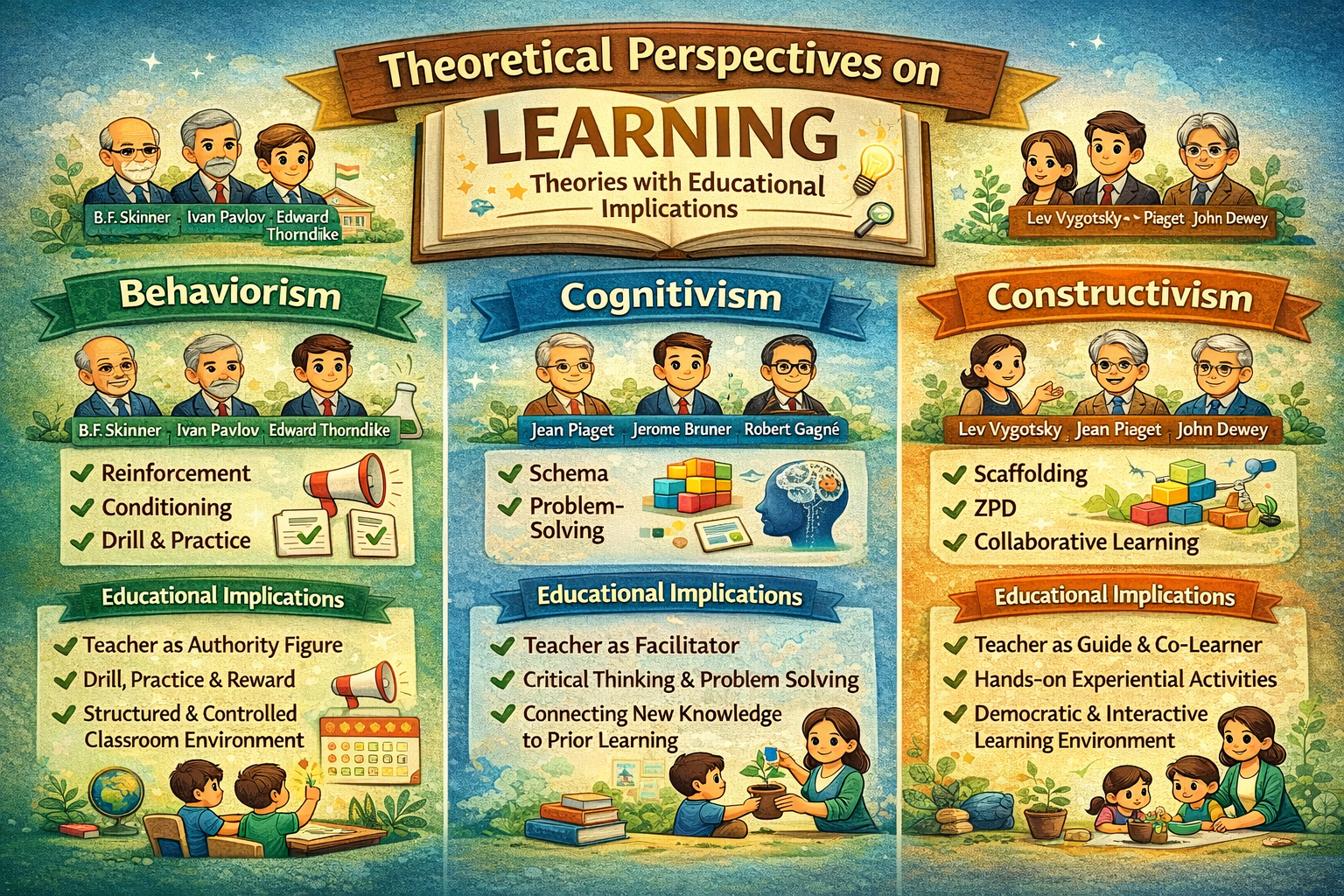
Table of Contents
1. Introduction / परिचय
Learning theories form the philosophical and psychological foundation of education. They explain how learning occurs, what influences it, and how teaching should be organized.
अधिगम के सिद्धांत शिक्षा की दार्शनिक एवं मनोवैज्ञानिक आधारशिला हैं। वे बताते हैं कि अधिगम कैसे होता है, उसे कौन-से कारक प्रभावित करते हैं और शिक्षण की संरचना कैसी होनी चाहिए।
The three major theoretical perspectives are:
अधिगम के तीन प्रमुख सिद्धांत हैं:
- Behaviorism / व्यवहारवाद
- Cognitivism / संज्ञानवाद
- Constructivism / निर्माणवाद
These theories influence school leadership, discipline, classroom climate and teacher-student relationships.
ये सिद्धांत विद्यालयी नेतृत्व, अनुशासन, कक्षा वातावरण और शिक्षक-छात्र संबंधों को प्रभावित करते हैं।
2. Behaviorism / व्यवहारवाद
Theoretical Perspectives on Learning-Learning Theories with Educational Implications:-
Behaviorism views learning as a change in observable behavior due to stimulus-response associations.
व्यवहारवाद के अनुसार अधिगम उद्दीपन-प्रतिक्रिया के माध्यम से व्यवहार में परिवर्तन है।
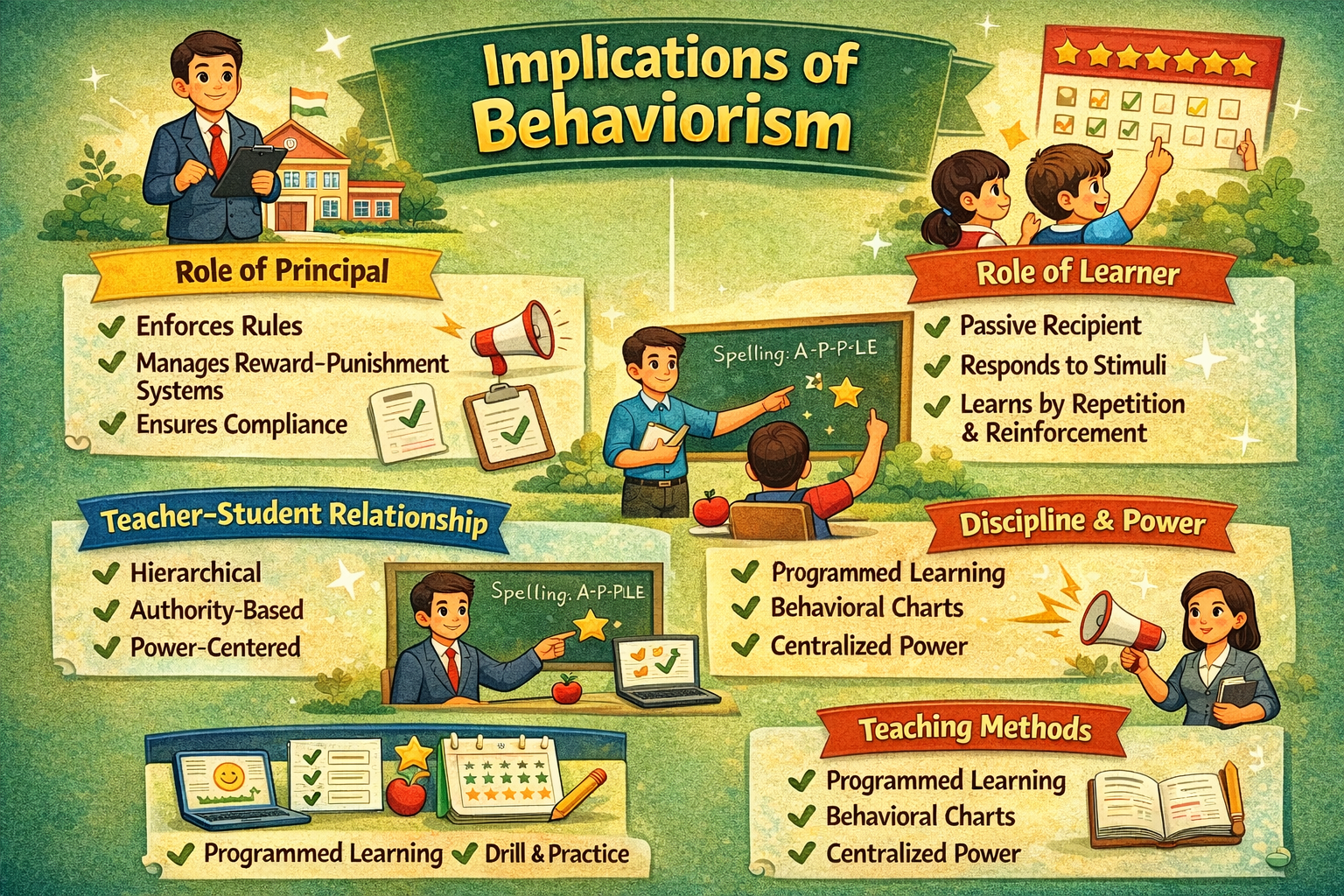
Major contributors:
- John B. Watson
- Ivan Pavlov
- Edward Thorndike
- B.F. Skinner
Key Concepts / मुख्य अवधारणाएँ
- Reinforcement / प्रबलन
- Punishment / दंड
- Conditioning / अनुबंधन
- Drill & Practice / अभ्यास
Learning is habit formation.
अधिगम आदत निर्माण है।
Implications (Theoretical Perspectives on Learning)
🔹 Role of Principal / प्रधानाचार्य की भूमिका
- Maintain discipline through clear rules.
- Reward performance.
- Focus on measurable outcomes.
प्रधानाचार्य अनुशासन और परिणाम आधारित व्यवस्था स्थापित करते हैं।
🔹 Role of Vice-Principal & HM
- Monitor compliance.
- Ensure rule enforcement.
नियमों का पालन सुनिश्चित करना।
🔹 Role of Teacher
- Authority figure.
- Reinforces correct responses.
शिक्षक नियंत्रणकर्ता होता है।
🔹 Role of Learner
- Passive recipient.
- Responds to stimuli.
विद्यार्थी निष्क्रिय प्रतिक्रिया देने वाला।
🔹 Teacher-Student Relationship
- Hierarchical / पदानुक्रम आधारित
🔹 Discipline & Power
- External control / बाहरी नियंत्रण
- Power centralized / शक्ति केंद्रीकृत
3. Cognitivism / संज्ञानवाद
Theoretical Perspectives on Learning-Learning Theories with Educational Implications:-
Cognitivism emphasizes mental processes such as thinking, memory, and problem-solving.
संज्ञानवाद मानसिक प्रक्रियाओं जैसे सोच, स्मृति और समस्या समाधान पर बल देता है।
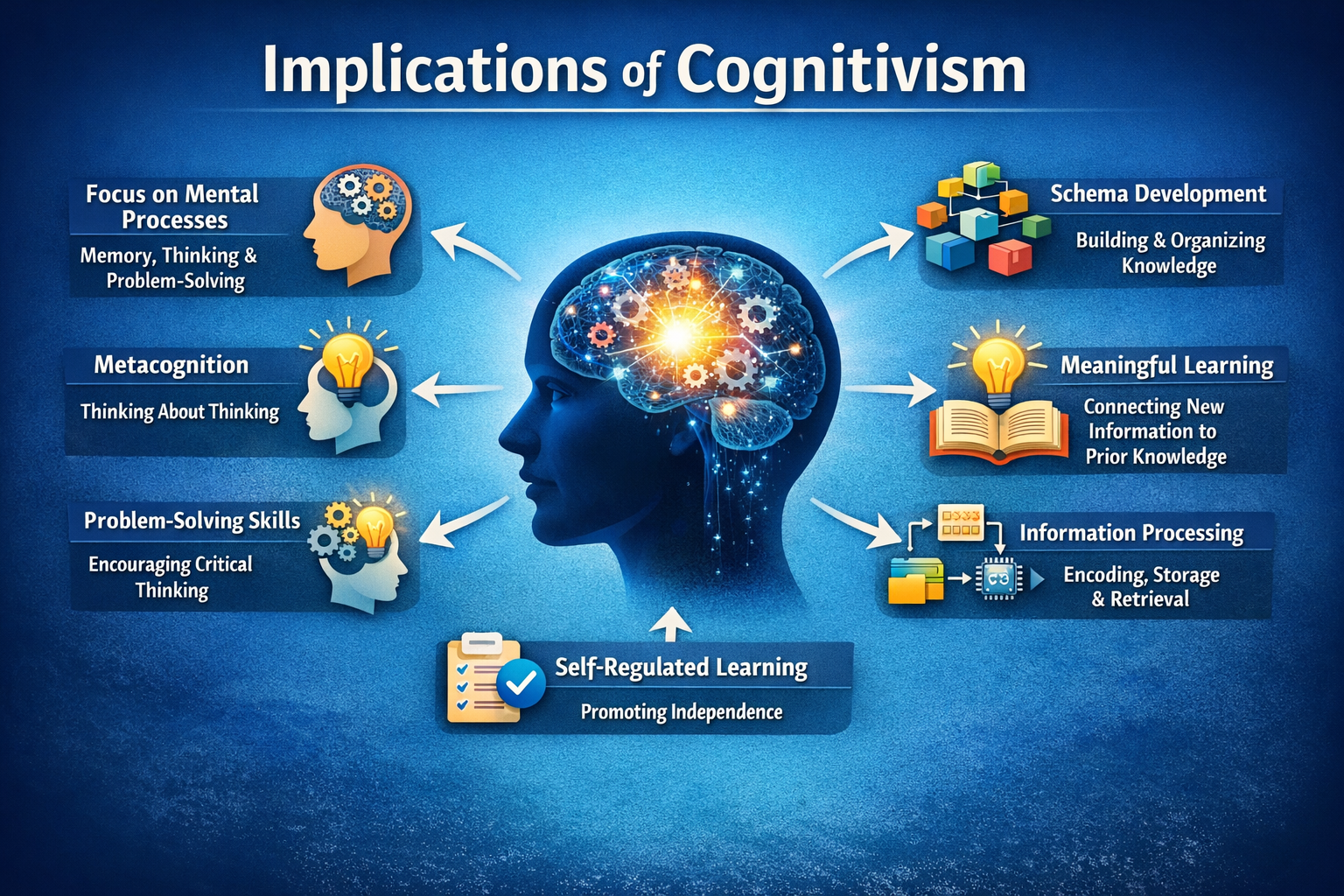
Major contributors:
- Jean Piaget
- Jerome Bruner
- David Ausubel
- Robert Gagne
Learning is internal mental structuring.
अधिगम मानसिक संरचना निर्माण है।
🎓 Implications ( Theoretical Perspectives on Learning)
🔹 Role of Principal
- Academic leader.
- Encourage curriculum planning.
प्रधानाचार्य शैक्षणिक नेतृत्व प्रदान करते हैं।
🔹 Role of VP & HM
- Supervise instructional quality.
शिक्षण गुणवत्ता की निगरानी।
🔹 Role of Teacher
- Facilitator of thinking.
- Connect prior knowledge.
शिक्षक चिंतन का मार्गदर्शक।
🔹 Role of Learner
- Active thinker.
- Processes information.
विद्यार्थी सक्रिय विचारक।
🔹 Teacher-Student Relationship
- Cooperative / सहयोगात्मक
🔹 Discipline & Power
- Self-regulation / आत्म-नियंत्रण
4. Constructivism / निर्माणवाद
Theoretical Perspectives on Learning-Learning Theories with Educational Implications:-
Constructivism states that learners construct knowledge through experience and social interaction.
निर्माणवाद के अनुसार विद्यार्थी अनुभव और सामाजिक अंतःक्रिया के माध्यम से ज्ञान का निर्माण करता है।
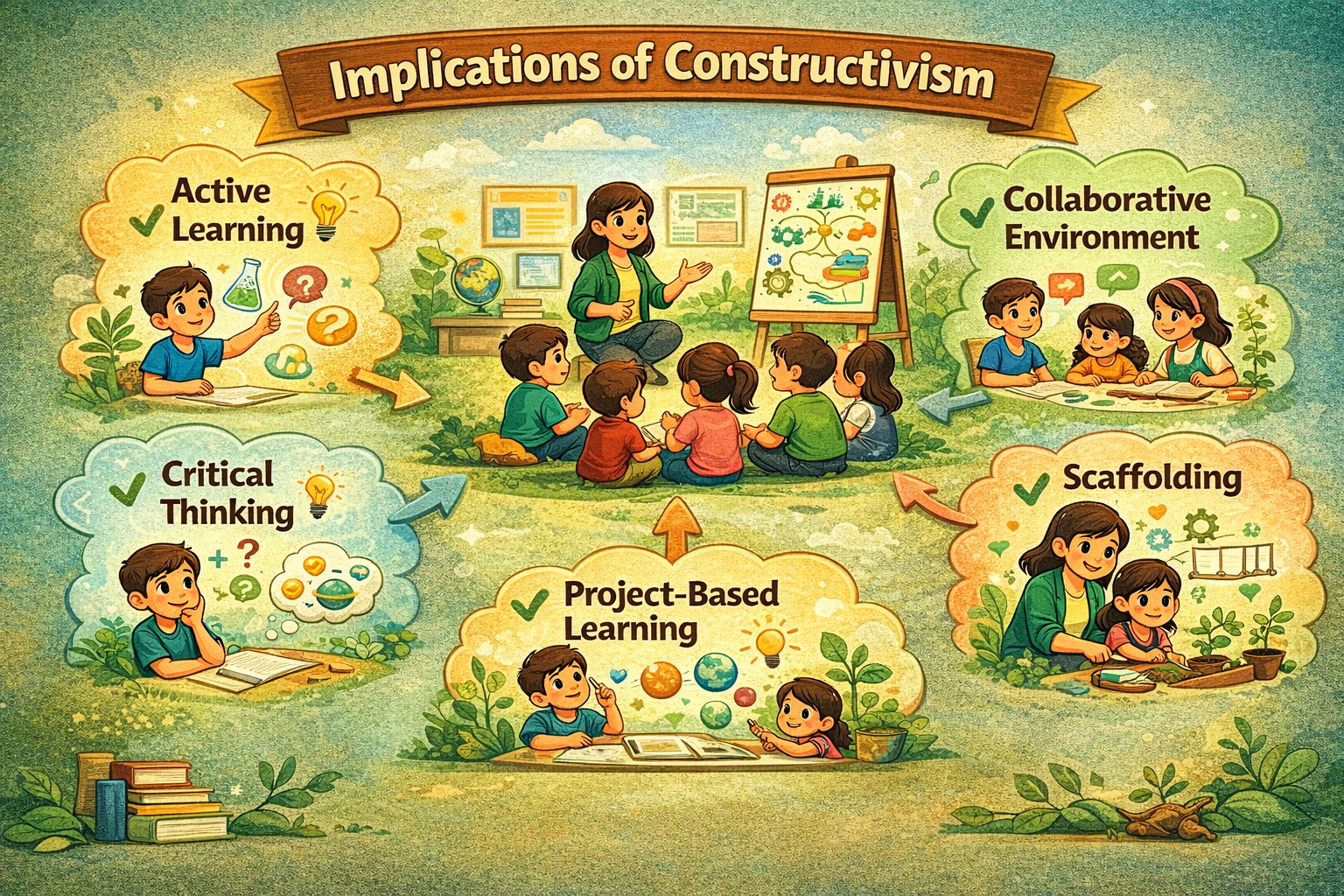
Major contributors:
- Lev Vygotsky
- Jean Piaget
- John Dewey
Learning is active, social and contextual.
अधिगम सक्रिय, सामाजिक और संदर्भ आधारित है।
🎓 Implications (Theoretical Perspectives on Learning)
🔹 Role of Principal
- Transformational leader.
- Promote collaborative culture.
प्रधानाचार्य परिवर्तनकारी नेता।
🔹 Role of VP & HM
- Mentor teachers.
- Encourage innovation.
नवाचार को प्रोत्साहित करना।
🔹 Role of Teacher
- Facilitator and co-learner.
- Use scaffolding.
शिक्षक सह-अधिगामी।
🔹 Role of Learner
- Knowledge constructor.
- Collaborative participant.
विद्यार्थी ज्ञान निर्माता।
🔹 Teacher-Student Relationship
- Democratic / लोकतांत्रिक
🔹 Discipline & Power
- Shared authority / साझा शक्ति
Theoretical Perspectives on Learning-Learning Theories with Educational Implications:-
Comparative Understanding / तुलनात्मक दृष्टि
| Aspect | Behaviorism | Cognitivism | Constructivism |
|---|---|---|---|
| Learning | Behavior change | Mental processing | Knowledge construction |
| Teacher | Authority | Facilitator | Co-learner |
| Learner | Passive | Active thinker | Knowledge builder |
| Discipline | External | Internal | Self-discipline |
Productive Classroom Environment / उत्पादक कक्षा वातावरण
Behaviorism → Structured & rule-based
संगठित एवं नियम आधारित
Cognitivism → Organized & intellectually stimulating
बौद्धिक रूप से प्रेरक
Constructivism → Interactive & collaborative
संवादात्मक एवं सहयोगात्मक
Understanding Discipline & Power / अनुशासन एवं शक्ति की समझ
Behaviorism: Control & compliance
Cognitivism: Guided autonomy
Constructivism: Democratic empowerment
आधुनिक शिक्षा निर्माणवादी दृष्टिकोण की ओर बढ़ रही है।
Conclusion / निष्कर्ष (Theoretical Perspectives on Learning
An effective school integrates all three theories.
एक प्रभावी विद्यालय तीनों सिद्धांतों का संतुलित उपयोग करता है।
- Structure from Behaviorism
- Intellectual depth from Cognitivism
- Creativity from Constructivism
40 Exam-Oriented MCQs baes on Theoretical Perspectives on Learning-Learning Theories with Educational Implications
- Behaviorism focuses on:
A) Internal thought
B) Observable behavior
C) Emotions
D) Values
Ans: B - Classical conditioning was proposed by:
A) Skinner
B) Piaget
C) Pavlov
D) Bruner
Ans: C - Operant conditioning was given by:
A) Thorndike
B) Skinner
C) Dewey
D) Ausubel
Ans: B - Law of Effect is associated with:
A) Pavlov
B) Thorndike
C) Watson
D) Gagne
Ans: B - Cognitivism emphasizes:
A) Habit formation
B) Mental processing
C) Punishment
D) Drill
Ans: B - Meaningful learning theory was given by:
A) Ausubel
B) Watson
C) Skinner
D) Thorndike
Ans: A - Discovery learning is linked to:
A) Skinner
B) Bruner
C) Pavlov
D) Watson
Ans: B - Constructivism stresses:
A) Teacher control
B) Knowledge construction
C) Drill
D) Punishment
Ans: B - ZPD concept was given by:
A) Piaget
B) Dewey
C) Vygotsky
D) Skinner
Ans: C - Scaffolding is related to:
A) Behaviorism
B) Cognitivism
C) Constructivism
D) Drill method
Ans: C
11. Operant Conditioning was proposed by:
A) Pavlov
B) Watson
C) Skinner
D) Piaget
Answer: C
12. Cognitive theory emphasizes:
A) Punishment
B) Mental processes
C) Imitation
D) Drill
Answer: B
13. ZPD concept is given by:
A) Piaget
B) Vygotsky
C) Tolman
D) Bruner
Answer: B
14. Constructivism supports:
A) Lecture method
B) Memorization
C) Collaborative learning
D) Punishment
Answer: C
15. Reinforcement increases:
A) Forgetting
B) Motivation
C) Behavior repetition
D) Anxiety
Answer: C
16. Discovery learning is related to:
A) Skinner
B) Bruner
C) Watson
D) Pavlov
Answer: B
17. Behaviorism focuses on:
A) Emotions
B) Observed behavior
C) Intuition
D) Creativity
Answer: B
18. Constructivist classroom is:
A) Teacher centered
B) Democratic
C) Rigid
D) Competitive
Answer: B
19. Self-regulation belongs to:
A) Behaviorism
B) Cognitivism
C) Drill theory
D) Classical conditioning
Answer: B
20. Principal as visionary leader relates to:
A) Behaviorism
B) Cognitivism
C) Constructivism
D) Drill theory
Answer: C
21. Classical conditioning involves:
A) Voluntary response
B) Reflex action
C) Insight
D) Cognition
Answer: B
22. Mental maps concept is given by:
A) Tolman
B) Watson
C) Skinner
D) Thorndike
Answer: A
23. Constructivism emphasizes:
A) Memorization
B) Social interaction
C) Drill
D) Authority
Answer: B
24. Learning by doing is related to:
A) Behaviorism
B) Constructivism
C) Punishment
D) Drill
Answer: B
25. Reinforcement schedule is part of:
A) Cognitivism
B) Constructivism
C) Behaviorism
D) Insight learning
Answer: C
26. Schema theory belongs to:
A) Cognitivism
B) Behaviorism
C) Drill theory
D) Conditioning
Answer: A
27. Inquiry-based learning is related to:
A) Constructivism
B) Behaviorism
C) Drill
D) Punishment
Answer: A
28. Teacher as facilitator belongs to:
A) Behaviorism
B) Constructivism
C) Conditioning
D) Memorization
Answer: B
29. Learner as passive recipient is view of:
A) Behaviorism
B) Constructivism
C) Cognitivism
D) Insight
Answer: A
30. Internal processing is core of:
A) Behaviorism
B) Cognitivism
C) Drill
D) Authority
Answer: B
31. Scaffolding is associated with:
A) Pavlov
B) Skinner
C) Vygotsky
D) Watson
Answer: C
32. Drill and practice method supports:
A) Constructivism
B) Behaviorism
C) Cognitivism
D) Insight
Answer: B
33. Democratic classroom is feature of:
A) Behaviorism
B) Cognitivism
C) Constructivism
D) Drill
Answer: C
34. Memory and encoding are part of:
A) Behaviorism
B) Cognitivism
C) Drill
D) Punishment
Answer: B
35. Reinforcement can be:
A) Positive
B) Negative
C) Both A and B
D) None
Answer: C
36. Child constructs knowledge through:
A) Punishment
B) Experience
C) Drill
D) Authority
Answer: B
37. Insight learning is related to:
A) Behaviorism
B) Cognitivism
C) Drill
D) Conditioning
Answer: B
38. Productive classroom requires:
A) Fear
B) Trust
C) Punishment
D) Silence
Answer: B
39. Power sharing is emphasized in:
A) Behaviorism
B) Constructivism
C) Drill
D) Conditioning
Answer: B
40. Modern education integrates:
A) Only Behaviorism
B) Only Cognitivism
C) Only Constructivism
D) All three theories
Answer: D
Previous Year MCQs with Answers based on Theoretical Perspectives on Learning-Learning Theories with Educational Implications (Behaviorism, Cognitivism & Constructivism)
1. (CTET 2015)
Who is considered the founder of Behaviorism?
A. Jean Piaget
B. Ivan Pavlov
C. John B. Watson
D. Jerome Bruner
✅ Answer: C
2. (UGC NET Education 2018)
Classical conditioning theory was propounded by:
A. B.F. Skinner
B. Ivan Pavlov
C. Edward Tolman
D. Thorndike
✅ Answer: B
3. (KVS PRT 2017)
Operant conditioning is associated with:
A. Piaget
B. Skinner
C. Bandura
D. Vygotsky
✅ Answer: B
4. (CTET 2019)
Learning through reinforcement is emphasized in:
A. Constructivism
B. Behaviorism
C. Humanism
D. Cognitivism
✅ Answer: B
5. (B.Ed Entrance DU 2016)
Law of Effect was given by:
A. Thorndike
B. Pavlov
C. Watson
D. Kohler
✅ Answer: A
6. (UGC NET 2020)
Cognitive development theory was proposed by:
A. Skinner
B. Piaget
C. Bruner
D. Tolman
✅ Answer: B
7. (CTET 2014)
Assimilation and accommodation are concepts of:
A. Skinner
B. Piaget
C. Bandura
D. Watson
✅ Answer: B
8. (STET Bihar 2019)
Discovery learning is associated with:
A. Skinner
B. Bruner
C. Pavlov
D. Thorndike
✅ Answer: B
9. (KVS TGT 2018)
Zone of Proximal Development (ZPD) was proposed by:
A. Piaget
B. Vygotsky
C. Skinner
D. Watson
✅ Answer: B
10. (CTET 2021)
Scaffolding is related to:
A. Behaviorism
B. Cognitivism
C. Social Constructivism
D. Humanism
✅ Answer: C
11. (UGC NET 2017)
Insight learning theory was given by:
A. Kohler
B. Skinner
C. Pavlov
D. Thorndike
✅ Answer: A
12. (B.Ed Entrance BHU 2018)
Reinforcement increases the probability of:
A. Forgetting
B. Punishment
C. Behavior repetition
D. Cognitive growth
✅ Answer: C
13. (CTET 2016)
Constructivism emphasizes:
A. Teacher control
B. Passive learning
C. Active knowledge construction
D. Rote learning
✅ Answer: C
14. (NVS TGT 2019)
Spiral curriculum was proposed by:
A. Piaget
B. Vygotsky
C. Bruner
D. Skinner
✅ Answer: C
15. (STET UP 2020)
Learning by doing is emphasized in:
A. Behaviorism
B. Constructivism
C. Cognitivism
D. Psychoanalysis
✅ Answer: B
16. (CTET 2018)
Punishment in classroom is related to:
A. Constructivism
B. Behaviorism
C. Humanism
D. Cognitivism
✅ Answer: B
17. (UGC NET 2019)
Information Processing Theory belongs to:
A. Behaviorism
B. Cognitivism
C. Humanism
D. Psychoanalysis
✅ Answer: B
18. (B.Ed Entrance 2017)
Trial and Error learning was given by:
A. Pavlov
B. Thorndike
C. Piaget
D. Bruner
✅ Answer: B
19. (KVS 2022)
Modeling is related to:
A. Bandura
B. Piaget
C. Skinner
D. Thorndike
✅ Answer: A
20. (CTET 2015)
Constructivist classroom is:
A. Teacher centered
B. Lecture based
C. Learner centered
D. Authoritative
✅ Answer: C
21. (UGC NET 2021)
Cognitive maps were proposed by:
A. Tolman
B. Skinner
C. Watson
D. Pavlov
✅ Answer: A
22. (STET 2018)
Immediate reinforcement is important in:
A. Behaviorism
B. Constructivism
C. Humanism
D. Cognitivism
✅ Answer: A
23. (CTET 2019)
Social interaction plays central role in:
A. Behaviorism
B. Constructivism
C. Cognitivism
D. Psychoanalysis
✅ Answer: B
24. (KVS 2016)
Readiness is emphasized by:
A. Thorndike
B. Skinner
C. Piaget
D. Watson
✅ Answer: A
25. (UGC NET 2018)
Discovery learning supports:
A. Passive learning
B. Memorization
C. Active exploration
D. Drill method
✅ Answer: C
26. (B.Ed Entrance 2019)
Learning is observable behavior change in:
A. Behaviorism
B. Cognitivism
C. Humanism
D. Constructivism
✅ Answer: A
27. (CTET 2017)
Metacognition is related to:
A. Behaviorism
B. Cognitivism
C. Psychoanalysis
D. Conditioning
✅ Answer: B
28. (STET 2020)
Child constructs knowledge through experience in:
A. Behaviorism
B. Constructivism
C. Humanism
D. Psychoanalysis
✅ Answer: B
29. (UGC NET 2022)
Meaningful learning was proposed by:
A. Ausubel
B. Skinner
C. Watson
D. Pavlov
✅ Answer: A
30. (CTET 2014)
Reinforcement is strongest when it is:
A. Delayed
B. Immediate
C. Rare
D. Avoided
✅ Answer: B
31–50 (Exam Pattern Based Mixed Questions) based on Theoretical Perspectives on Learning-Learning Theories with Educational Implications
- ZPD stands for —
A. Zone of Proximal Development
B. Zone of Primary Discipline
C. Zero Performance Domain
D. Zone of Psychological Drive
✅ Answer: A - Schema concept is related to —
A. Piaget
B. Skinner
C. Pavlov
D. Watson
✅ Answer: A - Insight learning experiment was conducted on —
A. Dogs
B. Rats
C. Chimpanzees
D. Cats
✅ Answer: C - Operant conditioning focuses on —
A. Stimulus
B. Consequence
C. Memory
D. Insight
✅ Answer: B - Constructivism rejects —
A. Learner participation
B. Active learning
C. Rote memorization
D. Group work
✅ Answer: C - Cognitive development stages are —
A. 3
B. 4
C. 5
D. 2
✅ Answer: B - Positive reinforcement means —
A. Adding pleasant stimulus
B. Removing pleasant stimulus
C. Punishment
D. Ignoring
✅ Answer: A - Social Constructivism was developed by —
A. Vygotsky
B. Piaget
C. Skinner
D. Watson
✅ Answer: A - Drill method is based on —
A. Behaviorism
B. Constructivism
C. Cognitivism
D. Humanism
✅ Answer: A - Learning by insight rejects —
A. Trial and Error
B. Understanding
C. Perception
D. Problem solving
✅ Answer: A
For more, you may download from here : https://drive.google.com/drive/folders/1GyP_i7cfNWRuyrodJ7MSx2LVc3odOm8K?usp=drive_link
You may follow us on Facebook also:https://www.facebook.com/profile.php?id=61586013442564
fro other topics you may visit this:-https://teacherszone.in/