
Learn about the NIPUN Bharat Mission in India: Complete Guide for KVS,NVS,EMRS,CTET, B.Ed, and Education Exams, its objectives, key features, and strategies to achieve foundational literacy and numeracy for all children by Grade 3 in India.
Table of Contents
1. Introduction NIPUN Bharat Mission
The NIPUN Bharat Mission is one of the most important educational initiatives launched by the Ministry of Education to strengthen foundational learning in India. The mission focuses on ensuring that every child acquires Foundational Literacy and Numeracy (FLN) skills by the end of Grade 3.
भारत सरकार द्वारा शुरू किया गया निपुण भारत मिशन भारत की शिक्षा प्रणाली में एक महत्वपूर्ण सुधार है। इसका उद्देश्य यह सुनिश्चित करना है कि प्रत्येक बच्चा कक्षा 3 तक पढ़ने, लिखने और गणित की मूलभूत क्षमताएँ प्राप्त कर सके।
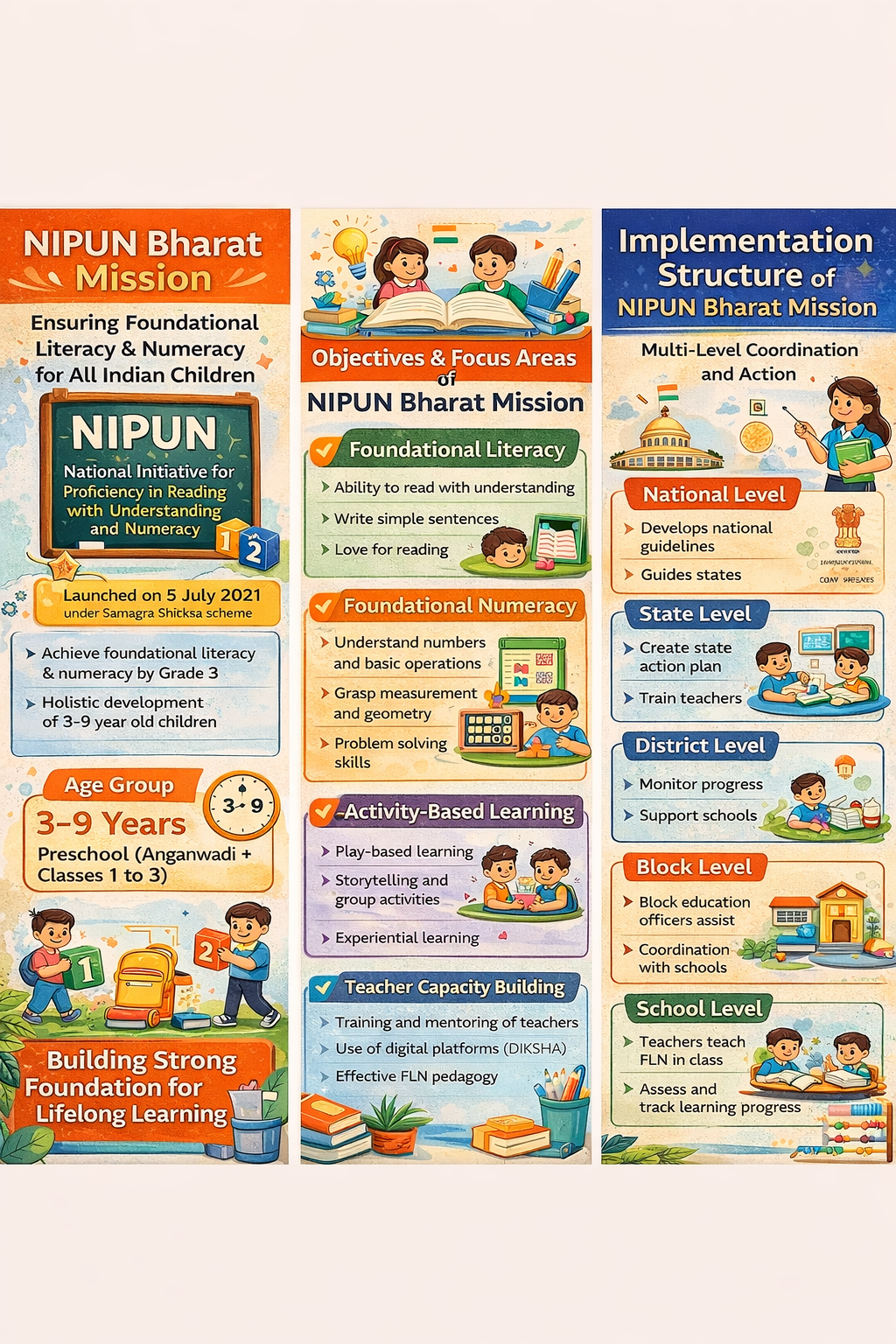
The mission was officially launched on 5 July 2021 under the Samagra Shiksha scheme to implement the vision of National Education Policy 2020.
यह मिशन राष्ट्रीय शिक्षा नीति 2020 के लक्ष्यों को प्राप्त करने के लिए शुरू किया गया है, जिसमें प्राथमिक स्तर पर Foundational Literacy and Numeracy को शिक्षा प्रणाली की सर्वोच्च प्राथमिकता माना गया है।
2. Background of NIPUN Bharat Mission
Before understanding the mission, it is important to know the context of foundational learning in India.
Research studies showed that many children in elementary schools were promoted to higher classes without acquiring basic reading and numeracy skills. This problem created learning gaps that affected their future education.
इसी समस्या को देखते हुए राष्ट्रीय शिक्षा नीति 2020 ने कहा कि यदि बच्चों में प्राथमिक स्तर पर पढ़ने और गणित की क्षमता विकसित नहीं होती है तो आगे की शिक्षा प्रभावी नहीं हो सकती।
Therefore, the Government of India launched NIPUN Bharat as a national mission to ensure universal foundational literacy and numeracy by Grade 3 by 2026-27.
3. Meaning of NIPUN Bharat Mission
NIPUN stands for:
National Initiative for Proficiency in Reading with Understanding and Numeracy
इसका अर्थ है:
समझ के साथ पढ़ने और संख्यात्मक क्षमता विकसित करने के लिए राष्ट्रीय पहल।
This mission aims to create an enabling learning environment where children develop strong literacy and numeracy skills during the foundational years of schooling.
4. Objectives of NIPUN Bharat Mission
The mission focuses on achieving several important goals.
1. Universal Foundational Literacy
Children should be able to:
- Read with understanding
- Write simple sentences
- Develop a love for reading
बच्चों को पढ़ने की समझ विकसित करनी चाहिए और उन्हें पढ़ने की आदत डालनी चाहिए।
2. Foundational Numeracy Skills
Children should understand basic mathematical concepts such as:
- Numbers
- Measurement
- Shapes
- Problem solving
इसका उद्देश्य बच्चों को गणितीय तर्क और समस्या समाधान की क्षमता विकसित करना है।
3. Early Childhood Education Integration
The mission ensures a smooth transition between:
- Anganwadi
- Pre-primary education
- Grade 1
इससे बच्चों के सीखने की प्रक्रिया सहज और निरंतर बनती है।
4. Child-Centred Learning
NIPUN Bharat promotes:
- Activity-based learning
- Play-based pedagogy
- Experiential learning
इससे बच्चों में सीखने के प्रति रुचि और जिज्ञासा विकसित होती है।
5.Target Group of NIPUN Bharat Mission
The mission mainly focuses on children aged 3 to 9 years.
It includes:
- Preschool / Anganwadi children
- Students of Grade 1, 2 and 3
इस मिशन का मुख्य लक्ष्य कक्षा 3 तक के बच्चों में बुनियादी साक्षरता और संख्यात्मक कौशल विकसित करना है।

6.Key Features of NIPUN Bharat Mission
1. Focus on Foundational Learning
The mission prioritizes the development of:
- Reading skills
- Writing skills
- Numeracy skills
यह बच्चों के संज्ञानात्मक विकास की नींव रखता है।
2. Activity-Based Learning
The mission encourages:
- storytelling
- games
- group activities
- experiential learning
इससे बच्चों को सीखने का आनंद मिलता है।
3. Teacher Capacity Building
Teachers receive training through programs such as:
- FLN training
- NISHTHA training
- DIKSHA digital platform
इससे शिक्षक नई शिक्षण विधियों को अपनाने में सक्षम बनते हैं।
4. Learning Materials
Special learning resources are developed, including:
- Workbooks
- Activity books
- Literacy kits
- Numeracy kits
ये सामग्री बच्चों को व्यावहारिक तरीके से सीखने में मदद करती हैं।
7.Implementation Structure of NIPUN Bharat Mission
The mission follows a five-tier implementation system.
1. National Level
Managed by the Ministry of Education.
2. State Level
State governments prepare action plans.
3. District Level
District education authorities monitor progress.
4. Block Level
Education officers support schools.
5. School Level
Teachers implement FLN activities in classrooms.
8.Role of Teachers in NIPUN Bharat Mission
Teachers are the most important stakeholders in the mission.
Their responsibilities include:
- Identifying learning gaps
- Providing remedial teaching
- Using activity-based pedagogy
- Assessing student progress
शिक्षक बच्चों की सीखने की गति को समझकर उन्हें व्यक्तिगत सहायता प्रदान करते हैं।
9.Role of Parents and Community in NIPUN Bharat Mission
The mission also encourages parental involvement.
Parents can support children by:
- Encouraging reading at home
- Helping with homework
- Creating a learning environment
समुदाय की भागीदारी से बच्चों की शिक्षा को मजबूत बनाया जा सकता है।
10.Teaching Strategies under NIPUN Bharat Mission
The mission promotes innovative teaching strategies.
Play-Based Learning
Children learn through games and activities.
Storytelling
Stories improve language skills.
Peer Learning
Students learn from each other.
Experiential Learning
Learning through real-life experiences.
11.Assessment under NIPUN Bharat Mission
Assessment focuses on continuous evaluation.
Instead of traditional exams, teachers use:
- classroom observation
- oral assessments
- activity-based evaluation
- learning portfolios
इससे बच्चों की वास्तविक सीखने की क्षमता का पता चलता है।
12.Importance of Foundational Literacy and Numeracy
Foundational learning is important because it forms the base for all future education.
Class 3 is considered the stage where children transition from “learning to read” to “reading to learn.”
यदि बच्चे इस स्तर तक पढ़ना और गणित समझना नहीं सीखते, तो आगे की शिक्षा में कठिनाई होती है।
13.Role of Technology in NIPUN Bharat Mission
Technology plays an important role in the mission.
Digital platforms include:
- DIKSHA portal
- digital learning resources
- online teacher training
इससे शिक्षा प्रणाली अधिक प्रभावी और आधुनिक बनती है।
14.NIPUN Bharat Mission and State Initiatives
Many states have launched programs aligned with NIPUN Bharat.
Examples include:
- Mission Buniyaad in Delhi
- NIPUN Haryana
- Foundational Learning programs in Andhra Pradesh
These initiatives aim to strengthen FLN outcomes at the local level.
15.Challenges in Implementing NIPUN Bharat Mission
Despite its importance, the mission faces several challenges.
Teacher Shortage
Many schools lack trained teachers.
Learning Gaps
Children from disadvantaged backgrounds often have learning gaps.
Infrastructure Issues
Some schools lack basic facilities.
Please follow us on facebook : https://www.facebook.com/profile.php?id=61586013442564
Please visit for similar topics: https://teacherszone.in/
16. MCQs on NIPUN Bharat Mission
(NET / CTET / B.Ed Level)
1. NIPUN Bharat Mission was launched in:
A. 2019
B. 2020
C. 2021
D. 2022
Answer: C
2. NIPUN stands for:
A. National Initiative for Primary Understanding and Numeracy
B. National Initiative for Proficiency in Reading with Understanding and Numeracy
C. National Institute for Primary Universal Numeracy
D. National Integrated Programme for Universal Numeracy
Answer: B
3. NIPUN Bharat Mission was launched under which scheme?
A. Mid-Day Meal
B. Samagra Shiksha
C. Rashtriya Madhyamik Shiksha Abhiyan
D. Sarva Shiksha Abhiyan
Answer: B
4. The mission aims to achieve universal FLN by:
A. 2024
B. 2025
C. 2026–27
D. 2030
Answer: C
5. NIPUN Bharat focuses on children up to which grade?
A. Grade 2
B. Grade 3
C. Grade 4
D. Grade 5
Answer: B
6. Foundational Literacy and Numeracy (FLN) refers to:
A. Advanced mathematics skills
B. Basic reading, writing and arithmetic skills
C. Computer literacy
D. Science knowledge
Answer: B
7. NIPUN Bharat Mission was launched by the:
A. Ministry of Education
B. Ministry of Women and Child Development
C. NCERT
D. NITI Aayog
Answer: A
8. The mission is aligned with which national policy?
A. National Curriculum Framework 2005
B. National Education Policy 2020
C. National Policy on Education 1986
D. Right to Education Act
Answer: B
9. The main aim of NIPUN Bharat is:
A. Improve higher education
B. Achieve foundational literacy and numeracy
C. Promote digital learning
D. Improve vocational education
Answer: B
10. The mission primarily targets children aged:
A. 3–9 years
B. 6–10 years
C. 5–12 years
D. 8–14 years
Answer: A
11. NIPUN Bharat was launched on:
A. 5 July 2021
B. 15 August 2020
C. 26 January 2021
D. 2 October 2021
Answer: A
12. Foundational literacy means:
A. Ability to read with understanding
B. Memorizing textbooks
C. Writing essays only
D. Learning grammar
Answer: A
13. Foundational numeracy includes:
A. Algebra
B. Geometry
C. Basic number sense
D. Calculus
Answer: C
14. FLN skills are expected to be achieved by the end of:
A. Grade 1
B. Grade 2
C. Grade 3
D. Grade 4
Answer: C
15. The mission emphasizes:
A. Exam-based learning
B. Rote memorization
C. Conceptual understanding
D. Homework
Answer: C
16. The NIPUN Bharat Mission is implemented through:
A. Central government only
B. State governments only
C. A collaborative federal structure
D. Private schools only
Answer: C
17. Which stage of schooling is most relevant for NIPUN Bharat Mission?
A. Secondary stage
B. Middle stage
C. Foundational stage
D. Higher education
Answer: C
18. The mission promotes:
A. Child-centred pedagogy
B. Teacher-centred learning
C. Exam-centred education
D. Memorization
Answer: A
19. FLN is considered the foundation for:
A. Future learning
B. Sports
C. Vocational education
D. Government exams
Answer: A
20. The mission aims to reduce:
A. Curriculum
B. Learning poverty
C. School holidays
D. Exams
Answer: B
21. NIPUN Bharat Mission promotes:
A. Activity-based learning
B. Lecture method
C. Dictation
D. Drill practice
Answer: A
22. Play-based learning is mainly used in:
A. Secondary stage
B. Foundational stage
C. Higher education
D. Vocational education
Answer: B
23. Experiential learning means:
A. Learning through experience
B. Learning through memorization
C. Lecture method
D. Homework
Answer: A
24. Storytelling improves:
A. Language skills
B. Mathematical skills
C. Physical skills
D. Technical skills
Answer: A
25. Teachers under NIPUN Bharat Mission should act as:
A. Controllers
B. Facilitators
C. Inspectors
D. Examiners
Answer: B
26. Peer learning means:
A. Teacher teaching students
B. Students learning from each other
C. Self-learning
D. Online learning
Answer: B
27. Group activities help develop:
A. Collaboration skills
B. Competition
C. Memorization
D. Isolation
Answer: A
28. Multilingual education supports:
A. Cognitive development
B. Cultural identity
C. Language learning
D. All of the above
Answer: D
29. Teaching should connect with:
A. Real life experiences
B. Textbooks only
C. Exams only
D. Homework
Answer: A
30. Activity-based pedagogy improves:
A. Engagement
B. Creativity
C. Understanding
D. All of the above
Answer: D
31. NIPUN Bharat Mission implementation involves:
A. National level
B. State level
C. District level
D. All of the above
Answer: D
32. The nodal ministry for the mission is:
A. Ministry of Education
B. Ministry of Finance
C. Ministry of Health
D. Ministry of Labour
Answer: A
33. Teacher training is provided through:
A. NISHTHA program
B. Mid-Day Meal Scheme
C. RTE Act
D. KVS
Answer: A
34. Digital learning resources are provided through:
A. DIKSHA platform
B. SWAYAM
C. e-Pathshala
D. All of the above
Answer: D
35. Anganwadi centres support:
A. Early childhood learning
B. Secondary education
C. Higher education
D. Vocational education
Answer: A
36. The mission promotes convergence between:
A. School education
B. Early childhood education
C. Community participation
D. All of the above
Answer: D
37. School readiness programs are designed for:
A. Grade 5 students
B. Preschool children
C. College students
D. Teachers
Answer: B
38. District-level monitoring ensures:
A. Implementation effectiveness
B. Curriculum design
C. Teacher recruitment
D. Examination
Answer: A
39. State governments prepare:
A. Action plans
B. Budget plans
C. Curriculum plans
D. All of the above
Answer: D
40. Teachers track progress through:
A. Classroom assessment
B. Observation
C. Learning outcomes
D. All of the above
Answer: D
61. Assessment under NIPUN Bharat is mainly:
A. Continuous
B. Annual
C. Semester-based
D. Exam-based
Answer: A
62. Formative assessment occurs:
A. During learning
B. After learning
C. At the end of the year
D. During exams
Answer: A
63. Summative assessment occurs:
A. At the end of learning
B. During learning
C. Daily
D. Weekly
Answer: A
64. Portfolio assessment includes:
A. Student work samples
B. Attendance records
C. Homework
D. Exams
Answer: A
65. Assessment should focus on:
A. Competencies
B. Memorization
C. Exams
D. Homework
Answer: A
66. Continuous assessment helps in:
A. Monitoring learning progress
B. Punishing students
C. Conducting exams
D. Ranking students
Answer: A
67. Feedback helps:
A. Improve learning
B. Increase stress
C. Reduce learning
D. Punish students
Answer: A
68. Holistic assessment evaluates:
A. Knowledge
B. Skills
C. Attitudes
D. All of the above
Answer: D
69. Assessment should reduce:
A. Fear and anxiety
B. Learning
C. Creativity
D. Curiosity
Answer: A
70. Teachers assess through:
A. Observation
B. Interaction
C. Activities
D. All of the above
Answer: D
81. FLN skills are essential for:
A. Future academic success
B. Social development
C. Lifelong learning
D. All of the above
Answer: D
82. NIPUN Bharat supports:
A. Inclusive education
B. Exclusive education
C. Elite education
D. Segregated education
Answer: A
83. Community participation improves:
A. Learning environment
B. School support
C. Student motivation
D. All of the above
Answer: D
84. Parents can support FLN by:
A. Encouraging reading
B. Helping with homework
C. Creating learning environment
D. All of the above
Answer: D
85. Technology helps in:
A. Teacher training
B. Learning resources
C. Monitoring progress
D. All of the above
Answer: D
86. The mission promotes:
A. Equity in education
B. Exclusion
C. Segregation
D. Elite learning
Answer: A
87. NIPUN Bharat contributes to:
A. Quality education
B. Sustainable development
C. Learning outcomes
D. All of the above
Answer: D
88. The mission strengthens:
A. Early learning
B. Primary education
C. Foundational skills
D. All of the above
Answer: D
89. The success of NIPUN Bharat depends on:
A. Teachers
B. Schools
C. Community
D. All of the above
Answer: D
90. NIPUN Bharat aims to improve:
A. Reading ability
B. Writing ability
C. Numeracy ability
D. All of the above
Answer: D
91. The mission supports:
A. Holistic development
B. Memorization
C. Exams
D. Homework
Answer: A
92. Teachers should encourage:
A. Curiosity
B. Questioning
C. Exploration
D. All of the above
Answer: D
93. Students should develop:
A. Critical thinking
B. Problem solving
C. Creativity
D. All of the above
Answer: D
94. The mission aligns with:
A. SDG 4 (Quality Education)
B. SDG 1
C. SDG 5
D. SDG 8
Answer: A
95. Learning should be:
A. Joyful
B. Stress-free
C. Meaningful
D. All of the above
Answer: D
96. Schools should promote:
A. Reading culture
B. Numeracy culture
C. Learning environment
D. All of the above
Answer: D
97. Early learning influences:
A. Brain development
B. Cognitive growth
C. Academic success
D. All of the above
Answer: D
98. Teachers should use:
A. Innovative methods
B. Activity-based teaching
C. Interactive learning
D. All of the above
Answer: D
99. The mission transforms:
A. Early education
B. Teaching practices
C. Learning outcomes
D. All of the above
Answer: D
100. NIPUN Bharat ultimately aims to create:
A. Literate citizens
B. Skilled learners
C. Empowered individuals
D. All of the above
Answer: D