
Comprehensive article on Instructional Material and Resources. Covers meaning, types, principles of selection, inclusive education, digital resources, teachers’ role, challenges, and 50 MCQs for competitive exams like CTET, UPTET, KVS, NVS and DSSSB. Ideal for B.Ed, M.Ed, and teaching exam preparation. Instructional Material and Resources are very useful in teaching and learning process.
Table of Contents
1. Introduction / परिचय of Instructional Material and Resources
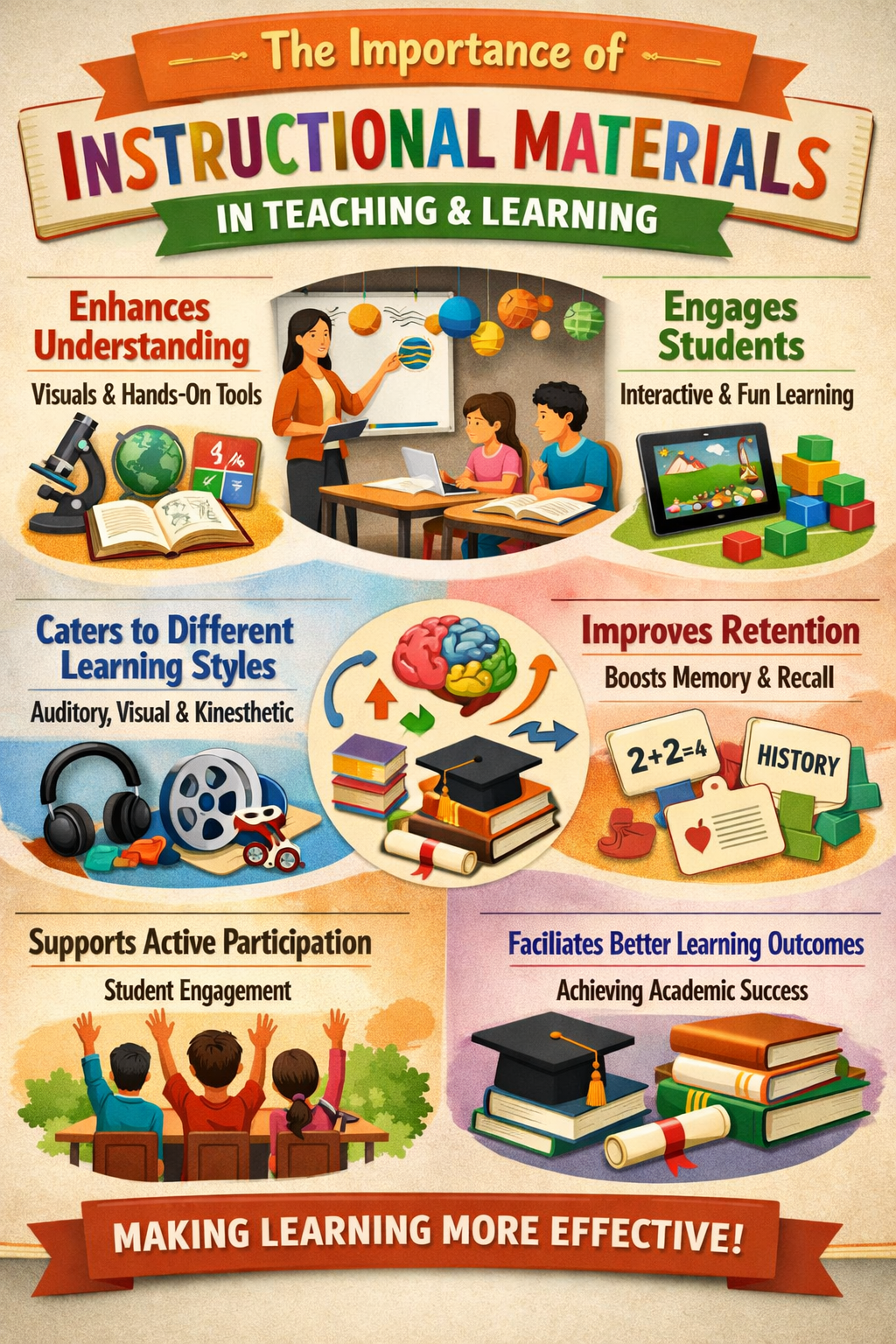
Instructional Material and Resources play a vital role in the teaching–learning process. According to NCERT and CBSE guidelines, effective learning occurs when teachers use suitable teaching aids, digital tools, textbooks, and community resources. IGNOU B.Ed and M.Ed study materials emphasize that instructional resources make learning child-centered, activity-based, and competency-oriented.
Hindi:
शिक्षण-अधिगम प्रक्रिया में Instructional Material and Resources की अत्यंत महत्वपूर्ण भूमिका होती है। NCERT तथा CBSE के दिशा-निर्देशों के अनुसार प्रभावी अधिगम तब होता है जब शिक्षक उपयुक्त शिक्षण सामग्री, डिजिटल साधनों, पाठ्यपुस्तकों एवं सामुदायिक संसाधनों का उपयोग करते हैं। IGNOU B.Ed एवं M.Ed अध्ययन सामग्री में भी यह स्पष्ट किया गया है कि शिक्षण संसाधन अधिगम को बाल-केंद्रित एवं क्रियात्मक बनाते हैं।
2. Meaning of Instructional Material / शिक्षण सामग्री का अर्थ
Instructional materials refer to all tools, aids, and resources used by teachers to facilitate learning. According to IGNOU B.Ed notes, these materials help in achieving learning objectives effectively. They include textbooks, charts, models, audio-visual aids, ICT tools, laboratory equipment, and community resources.
Instructional Material से आशय उन सभी साधनों एवं उपकरणों से है जिनका उपयोग शिक्षक अधिगम को प्रभावी बनाने के लिए करते हैं। IGNOU B.Ed नोट्स के अनुसार ये शिक्षण उद्देश्यों की प्राप्ति में सहायक होते हैं। इसमें पाठ्यपुस्तक, चार्ट, मॉडल, ऑडियो-विजुअल साधन, ICT उपकरण तथा प्रयोगशाला सामग्री शामिल हैं।
🔹 Objectives of Using Instructional Resources / शिक्षण संसाधनों के उद्देश्य
As per Ministry of Education policies and NCERT curriculum framework, instructional resources aim to:
- Clarify abstract concepts
- Promote active learning
- Develop critical thinking
- Enhance retention and understanding
- Support inclusive education
Ministry of Education तथा NCERT के पाठ्यक्रम ढांचे के अनुसार शिक्षण संसाधनों के उद्देश्य हैं:
- अमूर्त अवधारणाओं को स्पष्ट करना
- सक्रिय अधिगम को बढ़ावा देना
- आलोचनात्मक चिंतन विकसित करना
- स्मरण शक्ति एवं समझ को सुदृढ़ करना
- समावेशी शिक्षा को समर्थन देना
3.Types of Instructional Materials / शिक्षण सामग्री के प्रकार
Print Materials / मुद्रित सामग्री
Print materials include textbooks, workbooks, reference books, and journals. NIOS study materials are examples of self-learning print resources.
मुद्रित सामग्री में पाठ्यपुस्तक, कार्यपुस्तिका, संदर्भ पुस्तकें एवं पत्रिकाएं शामिल हैं। NIOS की अध्ययन सामग्री स्व-अधिगम के लिए उपयुक्त उदाहरण है।
Audio-Visual Materials / श्रव्य-दृश्य सामग्री
Audio-visual aids like videos, radio programs, smart boards, and documentaries enhance learning experiences. CBSE promotes ICT-based learning under digital initiatives.
वीडियो, रेडियो कार्यक्रम, स्मार्ट बोर्ड और वृत्तचित्र जैसी श्रव्य-दृश्य सामग्री अधिगम को रोचक बनाती है। CBSE डिजिटल पहल के अंतर्गत ICT आधारित शिक्षण को बढ़ावा देता है।
Activity-Based Materials / क्रियात्मक सामग्री
Models, experiments, laboratory apparatus, and teaching kits support experiential learning. NCERT science kits are widely used in schools.
मॉडल, प्रयोग, प्रयोगशाला उपकरण एवं शिक्षण किट अनुभवात्मक अधिगम को प्रोत्साहित करते हैं। NCERT विज्ञान किट विद्यालयों में व्यापक रूप से उपयोग की जाती हैं।
Digital Resources / डिजिटल संसाधन
E-learning platforms, educational apps, online courses, and virtual labs are modern instructional resources. The Ministry of Education promotes digital education through national initiatives.
ई-लर्निंग प्लेटफॉर्म, शैक्षिक ऐप्स, ऑनलाइन पाठ्यक्रम एवं वर्चुअल लैब आधुनिक शिक्षण संसाधन हैं। शिक्षा मंत्रालय राष्ट्रीय पहलों के माध्यम से डिजिटल शिक्षा को प्रोत्साहित करता है।
Community Resources / सामुदायिक संसाधन
Museums, libraries, local experts, field visits, and community institutions enrich classroom learning.
संग्रहालय, पुस्तकालय, स्थानीय विशेषज्ञ, शैक्षिक भ्रमण एवं सामुदायिक संस्थाएं कक्षा अधिगम को समृद्ध बनाती हैं।
4. Principles of Selecting Instructional Materials / चयन के सिद्धांत
According to IGNOU M.Ed materials:
- Relevance to objectives
- Age appropriateness
- Cost-effectiveness
- Cultural suitability
- Accessibility
IGNOU M.Ed अध्ययन सामग्री के अनुसार:
- उद्देश्यों के अनुरूप
- आयु के अनुकूल
- लागत प्रभावी
- सांस्कृतिक उपयुक्तता
- सुलभता
4.Importance in Inclusive Education / समावेशी शिक्षा में महत्व
Instructional resources support learners with diverse needs. Braille books, audio recordings, and assistive technologies help children with disabilities as recommended in national education policies.
शिक्षण संसाधन विविध आवश्यकताओं वाले शिक्षार्थियों की सहायता करते हैं। ब्रेल पुस्तकें, ऑडियो रिकॉर्डिंग एवं सहायक तकनीक विशेष आवश्यकताओं वाले बच्चों के लिए उपयोगी हैं।
5.Role of Teacher in Using Instructional Material and Resources / शिक्षक की भूमिका
Teachers act as facilitators. They must creatively adapt resources to learners’ needs and encourage participatory learning.
शिक्षक एक मार्गदर्शक की भूमिका निभाते हैं। उन्हें शिक्षार्थियों की आवश्यकता के अनुसार संसाधनों का रचनात्मक उपयोग करना चाहिए।
6. Challenges in Utilization while using Instructional Material and Resources
/ उपयोग में चुनौतियां
- Lack of infrastructure
- Insufficient training
- Limited funds
- Digital divide
- अवसंरचना की कमी
- प्रशिक्षण का अभाव
- सीमित वित्तीय संसाधन
- डिजिटल विभाजन
7. Conclusion of the topic Instructional Material and Resources/ निष्कर्ष
Instructional Material and Resources are essential for quality education. As highlighted by NCERT, CBSE, IGNOU, and the Ministry of Education, effective use of resources leads to meaningful learning, competency development, and holistic growth of learners.
Instructional Material and Resources गुणवत्तापूर्ण शिक्षा के लिए अनिवार्य हैं। NCERT, CBSE, IGNOU एवं शिक्षा मंत्रालय के अनुसार संसाधनों का प्रभावी उपयोग सार्थक अधिगम एवं समग्र विकास सुनिश्चित करता है।
For more topic please visit: https://teacherszone.in/
Please follow us on Facebook : https://www.facebook.com/profile.php?id=61586013442564
8. 50 Objective Questions (MCQs) of Instructional Material and Resources
- Instructional material primarily helps in:
a) Discipline control
b) Achieving learning objectives
c) Exam conduction
d) Attendance management - NIOS is known for:
a) Banking
b) Self-learning materials
c) Sports
d) Judiciary - Audio-visual aids include:
a) Chalk
b) Video
c) Desk
d) Uniform - Community resources include:
a) Museum
b) Blackboard
c) Attendance register
d) Bell - ICT stands for:
a) Indian Cultural Tool
b) Information and Communication Technology
c) Internal Classroom Technique
d) None
- The main principle for selecting instructional material is:
a) Attractive color
b) Relevance to objectives
c) High price
d) Teacher preference only - Cost-effectiveness means:
a) Most expensive material
b) Low quality material
c) Economical and useful material
d) Imported material - Activity-based learning promotes:
a) Passive listening
b) Rote memorization
c) Active participation
d) Silence in class - Inclusive education requires:
a) Same method for all
b) Flexible teaching resources
c) No teaching aids
d) Only lecture method - Braille books are used for:
a) Gifted children
b) Visually impaired learners
c) Slow learners
d) Teachers - Audio aids include:
a) Charts
b) Models
c) Radio programs
d) Maps - Visual aids include:
a) Podcast
b) Chart
c) Microphone
d) Speaker - Digital resources mainly support:
a) Traditional punishment
b) E-learning
c) Manual attendance
d) Chalkboard writing only - A smart board is an example of:
a) Print resource
b) Audio resource
c) ICT tool
d) Community resource - Field trips are categorized under:
a) Laboratory tools
b) Community resources
c) Print materials
d) Examination tools - Self-learning material is a feature of:
a) Formal punishment
b) Open schooling
c) Military training
d) Sports academy - Instructional materials help in:
a) Confusing learners
b) Clarifying concepts
c) Increasing fear
d) Avoiding syllabus - Teacher’s role in using resources is:
a) Dictator
b) Facilitator
c) Silent observer
d) Examiner only - Laboratory apparatus is mostly used in:
a) Language teaching
b) Science teaching
c) Attendance marking
d) Assembly - Age-appropriateness refers to:
a) Teacher’s age
b) Student’s developmental level
c) Principal’s age
d) Building age - Cultural suitability means:
a) Ignoring local culture
b) Respecting learners’ background
c) Foreign examples only
d) No examples - Evaluation of instructional material ensures:
a) Waste of time
b) Effectiveness
c) Decoration
d) Strict discipline - ICT stands for:
a) Internal Class Test
b) Information and Communication Technology
c) Indian Cultural Teaching
d) None - Workbooks are:
a) Audio aids
b) Print materials
c) Digital apps
d) Toys - Models are useful for:
a) Abstract imagination only
b) Concrete understanding
c) Decoration
d) Storage - Digital divide refers to:
a) Language problem
b) Gap in access to technology
c) Exam fear
d) Attendance shortage - Teaching kits are examples of:
a) Activity-based materials
b) Punishment tools
c) Furniture
d) Registers - Reference books are mainly used for:
a) Entertainment
b) Deep understanding
c) Attendance
d) Discipline - Inclusive classroom materials should be:
a) Rigid
b) Flexible
c) Costly
d) Complicated - Audio-visual aids improve:
a) Boredom
b) Retention
c) Confusion
d) Noise - Instructional resources should be selected before:
a) Examination
b) Teaching
c) Result declaration
d) Admission - National education policies promote:
a) Only lecture method
b) Technology integration
c) No curriculum
d) No evaluation - Experiential learning emphasizes:
a) Reading only
b) Doing and experiencing
c) Memorizing
d) Writing punishment - Charts are mainly used to:
a) Entertain
b) Display information visually
c) Store books
d) Record marks - Online courses are part of:
a) Traditional tools
b) Digital resources
c) Community hall
d) Sports period - Teacher training helps in:
a) Ignoring aids
b) Effective utilization
c) Avoiding planning
d) Reducing syllabus - Community experts in class help in:
a) Real-life learning
b) Exam cheating
c) Attendance
d) Homework avoidance - Costly material is always:
a) Best
b) Effective
c) Not necessarily effective
d) Mandatory - Selection of material depends on:
a) Weather
b) Learning objectives
c) Wall color
d) School uniform - Instructional materials promote:
a) Passive learning
b) Meaningful learning
c) Fear
d) Punishment - Multimedia includes:
a) Only text
b) Text, audio, video
c) Chalk only
d) Bell - Worksheets mainly assess:
a) Understanding
b) Height
c) Attendance
d) Discipline - Library is considered a:
a) Community resource
b) Punishment room
c) Playground
d) Staff room - Printed textbooks are examples of:
a) Non-teaching aids
b) Primary instructional material
c) Furniture
d) Audio tools - Instructional planning requires:
a) No objectives
b) Clear objectives
c) Random content
d) No resources - Assistive technology supports:
a) Only teachers
b) Learners with special needs
c) Principals
d) Visitors - Flashcards are useful for:
a) Visual reinforcement
b) Noise making
c) Attendance
d) Decoration - Evaluation of resources should be:
a) Continuous
b) One-time
c) Avoided
d) Ignored - ICT-based teaching encourages:
a) Memorization only
b) Interactive learning
c) Punishment
d) Silence - Effective instructional material leads to:
a) Confusion
b) Holistic development
c) Fear of exams
d) Avoidance of learning
Answer Key: Instructional Material and Resources
- b
- c
- c
- b
- b
- c
- b
- b
- c
- b
- b
- b
- b
- b
- b
- b
- b
- b
- b
- b
- b
- a
- b
- b
- b
- b
- b
- b
- b
- b
- b
- a
- c
- b
- b
- b
- a
- a
- b
- b
- b
- a
- a
- b
- b
9. Previous Year Exam-Oriented MCQs of Instructional Material and Resources
- The most important criterion for selecting instructional material in a classroom is:
a) Teacher’s convenience
b) Alignment with learning objectives
c) Availability in market
d) Attractive design - According to constructivist approach, instructional materials should:
a) Promote rote learning
b) Encourage learner participation
c) Replace teacher completely
d) Focus only on exams - A teacher uses a globe to explain latitudes and longitudes. This is an example of:
a) Audio aid
b) Visual aid
c) Verbal method
d) Punishment method - In an inclusive classroom, instructional materials must be:
a) Uniform for all students
b) Flexible and adaptable
c) Only textbook-based
d) Teacher-centered - Which of the following is an example of experiential learning material?
a) Lecture notes
b) Laboratory apparatus
c) Attendance register
d) Mark sheet - The use of community resources in teaching mainly promotes:
a) Memorization
b) Real-life learning
c) Fear
d) Competition - Worksheets are primarily used for:
a) Decoration
b) Reinforcement and assessment
c) Punishment
d) Time-pass - Digital divide refers to:
a) Gap in syllabus
b) Gap in access to technology
c) Language barrier
d) Cultural barrier - Flashcards are most effective for:
a) Developing listening skills
b) Visual reinforcement
c) Punishment
d) Attendance marking - Instructional materials are considered effective when they:
a) Increase syllabus burden
b) Clarify abstract concepts
c) Replace textbooks
d) Eliminate teacher’s role - The main objective of using audio-visual aids is to:
a) Entertain students
b) Make learning permanent
c) Reduce teacher workload
d) Increase homework - In Bloom’s taxonomy, well-designed instructional materials help in achieving:
a) Only remembering
b) Higher-order thinking skills
c) Attendance goals
d) Discipline rules - Open Educational Resources (OER) are:
a) Paid materials
b) Freely accessible learning resources
c) Printed books only
d) Restricted content - A science kit provided in schools mainly supports:
a) Theoretical learning
b) Activity-based learning
c) Punishment
d) Examination control - Teaching-learning material (TLM) should be selected according to:
a) Classroom wall color
b) Learners’ age and level
c) Principal’s choice
d) Market trends - ICT integration in classroom promotes:
a) Passive learning
b) Interactive learning
c) Rigid teaching
d) Only homework - Which of the following is NOT a community resource?
a) Museum
b) Library
c) Smart board
d) Local expert - Self-learning material is especially useful in:
a) Open and distance learning
b) Nursery play
c) Physical education only
d) School assembly - Effective use of instructional resources improves:
a) Confusion
b) Retention and understanding
c) Fear
d) Competition only - Evaluation of instructional material should focus on:
a) Price only
b) Educational effectiveness
c) Size only
d) Color only - A teacher modifies content according to learner diversity. This shows:
a) Rigid teaching
b) Resource adaptation
c) Negligence
d) Exam bias - Assistive technologies are mainly used for:
a) Sports
b) Learners with special needs
c) Teachers only
d) Administrators - Project method requires instructional materials that are:
a) Passive
b) Resource-rich
c) Lecture-based
d) Rigid - Cost-effectiveness in TLM means:
a) Cheapest material only
b) Value for educational purpose
c) Imported items
d) High maintenance - In competency-based education, instructional material should:
a) Focus on memorization
b) Develop skills and competencies
c) Increase homework
d) Avoid activities - Multimedia teaching combines:
a) Only text
b) Text, audio, and video
c) Chalk and board only
d) Attendance and marks - Field visits are helpful in:
a) Theoretical memorization
b) Connecting classroom to real world
c) Avoiding syllabus
d) Increasing fear - Teaching aids are effective when they are:
a) Used frequently without purpose
b) Linked with lesson objectives
c) Used randomly
d) Ignored - NCERT recommended activity-based learning mainly aims at:
a) Passive listening
b) Child-centered learning
c) Teacher domination
d) Strict discipline - Which of the following promotes inclusive education?
a) Same worksheet for all
b) Differentiated instructional materials
c) No activities
d) One teaching method only
Answers with Explanation/Instructional Material and Resources
1. b) Alignment with learning objectives
Instructional materials must match the learning objectives to ensure meaningful and outcome-based teaching.
2. b) Encourage learner participation
Constructivist approach promotes active learning where students construct knowledge through participation.
3. b) Visual aid
A globe is a visual teaching aid used to clarify geographical concepts.
4. b) Flexible and adaptable
Inclusive classrooms require adaptable materials to meet diverse learner needs.
5. b) Laboratory apparatus
Experiential learning focuses on “learning by doing,” and lab tools support this.
6. b) Real-life learning
Community resources connect classroom knowledge with real-world experiences.
7. b) Reinforcement and assessment
Worksheets help in practice, reinforcement, and formative assessment.
8. b) Gap in access to technology
Digital divide refers to inequality in access to digital tools and internet.
9. b) Visual reinforcement
Flashcards help strengthen memory through visual cues.
10. b) Clarify abstract concepts
Instructional materials simplify complex and abstract ideas.
11. b) Make learning permanent
Audio-visual aids enhance retention through multi-sensory learning.
12. b) Higher-order thinking skills
Well-designed materials support analysis, evaluation, and creativity.
13. b) Freely accessible learning resources
OER are openly licensed educational materials available free of cost.
14. b) Activity-based learning
Science kits promote hands-on and practical learning.
15. b) Learners’ age and level
Materials must match the developmental stage of learners.
16. b) Interactive learning
ICT tools encourage engagement and two-way interaction.
17. c) Smart board
Smart board is an ICT tool, not a community resource.
18. a) Open and distance learning
Self-learning materials are mainly designed for independent learners.
19. b) Retention and understanding
Effective resources improve comprehension and long-term memory.
20. b) Educational effectiveness
Evaluation should focus on how well material achieves learning outcomes.
21. b) Resource adaptation
Modifying materials shows sensitivity to learner diversity.
22. b) Learners with special needs
Assistive technologies support inclusive education.
23. b) Resource-rich
Project method requires diverse materials for investigation and exploration.
24. b) Value for educational purpose
Cost-effectiveness means educational benefit relative to cost.
25. b) Develop skills and competencies
Competency-based education focuses on skills and application.
26. b) Text, audio, and video
Multimedia integrates multiple modes for effective learning.
27. b) Connecting classroom to real world
Field visits bridge theory with practical experiences.
28. b) Linked with lesson objectives
Teaching aids must align with objectives for effectiveness.
29. b) Child-centered learning
Activity-based learning promotes active student involvement.
30. b) Differentiated instructional materials
Inclusive education requires materials tailored to different learner needs.