
Learn about the Government Educational Policies, Decisions, and Recommendations of the Education Commission and their impact on India’s education system. Important topic for KVS, NVS, CTET, B.Ed, M.Ed, and other teaching exams.
Table of Contents
1.Introduction of Government Educational Policies / परिचय
Education plays a crucial role in shaping the social, economic, and cultural development of a nation. In India, the education system has undergone several reforms over the decades through various commissions and policies. One of the most significant reforms in recent times is the National Education Policy 2020, which aims to transform the Indian education system to meet the demands of the 21st century.
शिक्षा किसी भी राष्ट्र के सामाजिक, आर्थिक और सांस्कृतिक विकास का आधार होती है। भारत में शिक्षा व्यवस्था को समय-समय पर विभिन्न आयोगों और नीतियों के माध्यम से सुधारा गया है। हाल के वर्षों में सबसे महत्वपूर्ण सुधारों में से एक राष्ट्रीय शिक्षा नीति 2020 है, जिसका उद्देश्य 21वीं सदी की आवश्यकताओं के अनुरूप भारतीय शिक्षा प्रणाली को बदलना है।
This policy was approved by the Government of India in July 2020 after nearly 34 years since the previous policy of 1986. The policy reflects the recommendations of the Kasturirangan Committee, which was constituted to review and redesign the education system.
यह नीति जुलाई 2020 में भारत सरकार द्वारा लागू की गई, जो 1986 की शिक्षा नीति के लगभग 34 वर्षों बाद आई। इस नीति का मसौदा कस्तूरीरंगन समिति की सिफारिशों के आधार पर तैयार किया गया था।
The NEP 2020 aims to build an education system rooted in Indian values while preparing students for global challenges. It focuses on the principles of access, equity, quality, affordability, and accountability.
NEP 2020 का उद्देश्य भारतीय मूल्यों पर आधारित शिक्षा प्रणाली विकसित करना है, जो छात्रों को वैश्विक चुनौतियों के लिए तैयार करे। यह नीति सुलभता, समानता, गुणवत्ता, वहनीयता और जवाबदेही जैसे सिद्धांतों पर आधारित है।
2.Historical Background Government Educational Policies, Recommendations of the Education Commission / भारत में शिक्षा नीतियों का ऐतिहासिक परिप्रेक्ष्य
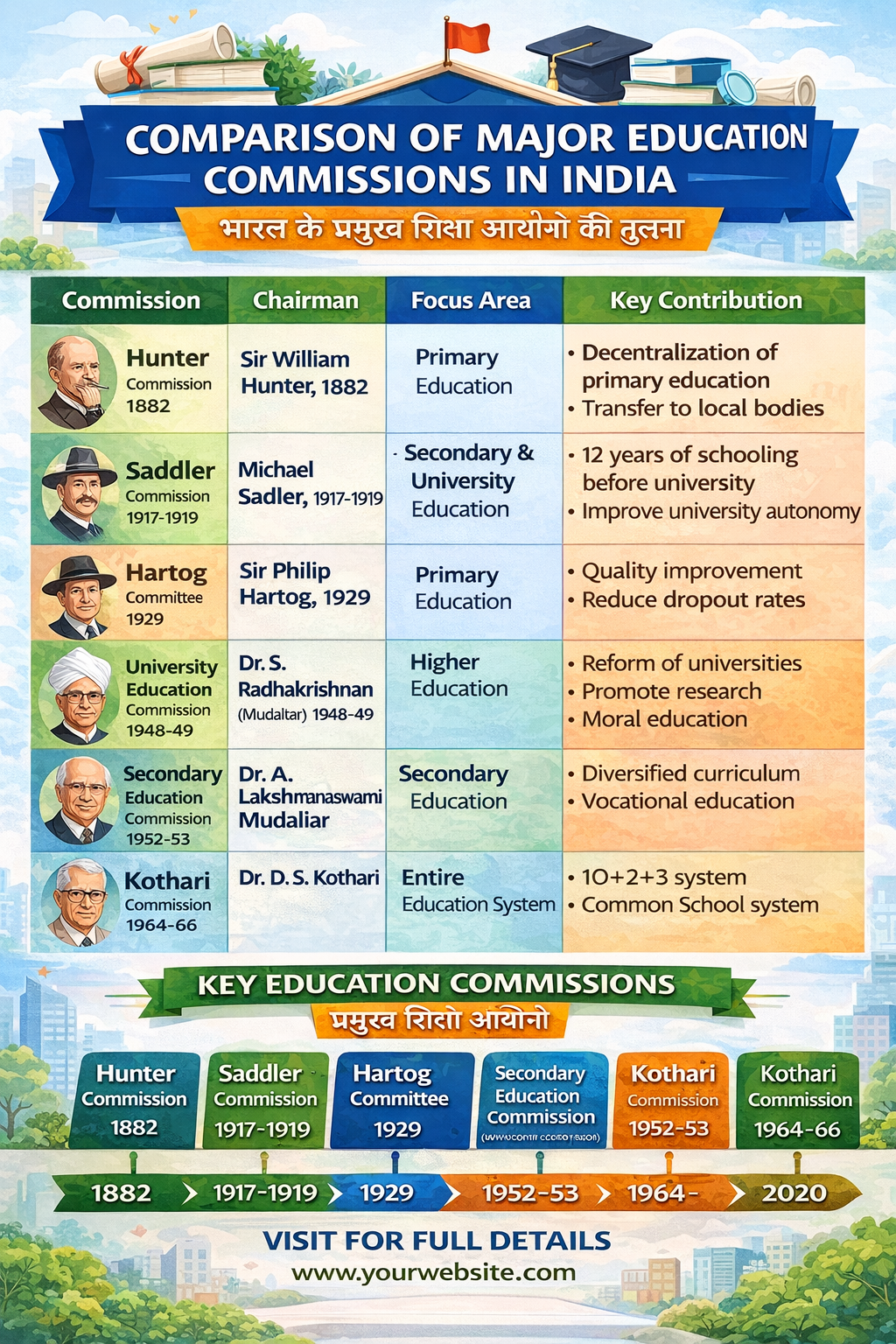
Before the implementation of NEP 2020, several education commissions and policies shaped India’s education system.
NEP 2020 के लागू होने से पहले भारत में कई शिक्षा आयोगों और नीतियों ने शिक्षा व्यवस्था को प्रभावित किया।
Major Education Commissions
- University Education Commission (1948–49) – Chaired by Dr. S. Radhakrishnan.
- Secondary Education Commission (1952–53) – Chaired by Dr. A. Lakshmanaswami Mudaliar.
- Education Commission (1964–66) – Known as the Kothari Commission.
- National Policy on Education (1968)
- National Policy on Education (1986) with revision in 1992.
These commissions recommended universal education, improvement in curriculum, teacher training, and equality in education.
इन आयोगों ने सार्वभौमिक शिक्षा, पाठ्यक्रम सुधार, शिक्षक प्रशिक्षण और शिक्षा में समानता पर जोर दिया।
However, due to globalization, digital transformation, and changing job markets, a new policy was required, which led to the formulation of NEP 2020.
लेकिन वैश्वीकरण, डिजिटल परिवर्तन और बदलते रोजगार के अवसरों के कारण नई शिक्षा नीति की आवश्यकता महसूस हुई, जिसके परिणामस्वरूप NEP 2020 लागू की गई।
3.Objectives of National Education Policy 2020 / राष्ट्रीय शिक्षा नीति 2020 के उद्देश्य
The National Education Policy 2020 aims to bring a holistic transformation in education.
राष्ट्रीय शिक्षा नीति 2020 का उद्देश्य शिक्षा प्रणाली में समग्र परिवर्तन लाना है।
Major Objectives
- Universal access to quality education.
- Development of critical thinking and creativity.
- Promotion of Indian culture and languages.
- Integration of technology in education.
- Increasing Gross Enrolment Ratio (GER) in higher education.
- Skill-based and vocational education.
- Inclusive education for disadvantaged groups.
इस नीति के मुख्य उद्देश्य हैं:
- गुणवत्तापूर्ण शिक्षा की सार्वभौमिक उपलब्धता
- रचनात्मकता और आलोचनात्मक सोच का विकास
- भारतीय संस्कृति और भाषाओं का संरक्षण
- शिक्षा में तकनीक का उपयोग
- उच्च शिक्षा में नामांकन दर बढ़ाना
- कौशल आधारित शिक्षा
- वंचित वर्गों के लिए समावेशी शिक्षा
4.Key Government Decisions in NEP 2020 / NEP 2020 में सरकार के प्रमुख निर्णय
The Government of India has taken several major decisions to transform the education system.
भारत सरकार ने शिक्षा प्रणाली में सुधार के लिए कई महत्वपूर्ण निर्णय लिए हैं।
1. New School Structure (5+3+3+4 System)
नई स्कूल संरचना (5+3+3+4 प्रणाली)
The NEP replaces the traditional 10+2 structure with a 5+3+3+4 system covering children from age 3 to 18.
NEP ने पारंपरिक 10+2 प्रणाली को हटाकर 5+3+3+4 संरचना लागू की है।
Stages include:
- Foundational Stage (3–8 years)
- Preparatory Stage (8–11 years)
- Middle Stage (11–14 years)
- Secondary Stage (14–18 years)
This structure emphasizes early childhood education and conceptual learning.
यह संरचना प्रारंभिक बाल्यावस्था शिक्षा और अवधारणात्मक सीखने पर जोर देती है।
2. Early Childhood Care and Education (ECCE)
प्रारंभिक बाल्यावस्था देखभाल और शिक्षा
NEP 2020 emphasizes the importance of early childhood education.
NEP 2020 में प्रारंभिक बाल शिक्षा को अत्यंत महत्वपूर्ण माना गया है।
Government initiatives such as Anganwadi learning kits are being implemented to strengthen early learning programs.
सरकार आंगनवाड़ी केंद्रों के माध्यम से बच्चों के लिए प्रारंभिक शिक्षा कार्यक्रमों को मजबूत कर रही है।
3. Mother Tongue as Medium of Instruction
मातृभाषा में शिक्षा
NEP recommends that the mother tongue or regional language should be the medium of instruction till at least Grade 5.
NEP में यह सिफारिश की गई है कि कम से कम कक्षा 5 तक शिक्षा मातृभाषा या स्थानीय भाषा में दी जाए।
This improves conceptual understanding and learning outcomes.
इससे बच्चों की समझ और सीखने की क्षमता बेहतर होती है।
4. Holistic and Multidisciplinary Education
बहुविषयक और समग्र शिक्षा
The policy promotes a multidisciplinary approach where students can choose subjects across streams.
NEP में छात्रों को विभिन्न विषयों का चयन करने की स्वतंत्रता दी गई है।
For example:
- Physics with Music
- Biology with Economics
इससे शिक्षा अधिक लचीली और रुचिकर बनती है
5. Integration of Vocational Education
व्यावसायिक शिक्षा का समावेशन
The policy aims that 50% of learners should receive vocational education by 2025.
NEP का लक्ष्य है कि 2025 तक कम से कम 50% विद्यार्थियों को व्यावसायिक शिक्षा प्रदान की जाए।
Students will learn practical skills such as:
- Coding
- Carpentry
- Entrepreneurship
- Agriculture
6. Reform in Assessment and Examination System
परीक्षा प्रणाली में सुधार
NEP aims to reduce exam pressure and promote competency-based assessments.
NEP में परीक्षा के दबाव को कम करने और कौशल आधारित मूल्यांकन को बढ़ावा देने पर जोर दिया गया है।
Boards and internal assessments are being redesigned to measure real understanding rather than rote learning.
7. Teacher Education Reforms
शिक्षक शिक्षा में सुधार
Teachers are the backbone of the education system.
शिक्षक शिक्षा व्यवस्था की रीढ़ होते हैं।
NEP introduces:
- Four-year integrated B.Ed degree
- Continuous professional development for teachers.
By 2030, a 4-year B.Ed degree will be mandatory for teachers.
2030 तक शिक्षकों के लिए 4 वर्षीय B.Ed डिग्री अनिवार्य होगी।
5.Recommendations of the Education Commission in NEP 2020 / NEP 2020 में शिक्षा आयोग की प्रमुख सिफारिशें
The Education Commission and expert committees recommended several reforms to modernize education.
शिक्षा आयोग और विशेषज्ञ समितियों ने शिक्षा को आधुनिक बनाने के लिए कई सिफारिशें दी हैं।
1. Academic Bank of Credits (ABC)
The Academic Bank of Credits allows students to store academic credits digitally and use them later to complete their degree.
Academic Bank of Credits छात्रों को अपने शैक्षणिक क्रेडिट को डिजिटल रूप में सुरक्षित रखने की सुविधा देता है।
2. Multiple Entry and Exit System
Students can exit and re-enter higher education programs.
छात्र उच्च शिक्षा में प्रवेश और निकास की सुविधा प्राप्त कर सकते हैं।
Example:
- 1 year – Certificate
- 2 years – Diploma
- 3 years – Degree
- 4 years – Degree with Research
3. National Research Foundation
The policy recommends the establishment of the National Research Foundation to promote research and innovation in universities.
इसका उद्देश्य उच्च शिक्षा में शोध और नवाचार को बढ़ावा देना है।
4. Digital and Online Education
NEP promotes digital platforms such as:
- SWAYAM
- DIKSHA
- National Digital Library
These platforms enhance access to quality education across the country.
6.Government Initiatives for Implementation of NEP 2020 / NEP 2020 के कार्यान्वयन के लिए सरकारी पहल
Several programs have been launched to implement the policy.
नीति के कार्यान्वयन के लिए सरकार ने कई कार्यक्रम शुरू किए हैं।
Examples include:
- National Curriculum Framework
- Skill India Mission
- Digital India in Education
- National Educational Technology Forum
These initiatives aim to modernize the education system and make learning accessible to all.
7.Challenges in Implementing NEP 2020
NEP 2020 के कार्यान्वयन की चुनौतियाँ
Despite its transformative vision, NEP 2020 faces several challenges.
हालांकि NEP 2020 एक परिवर्तनकारी नीति है, लेकिन इसके कार्यान्वयन में कई चुनौतियाँ हैं।
Major Challenges
- Lack of infrastructure in rural schools
- Shortage of trained teachers
- Digital divide
- Funding requirements
- Coordination between central and state governments
इन चुनौतियों को दूर करने के लिए सरकार और समाज दोनों को मिलकर प्रयास करने होंगे।
8.Impact of NEP 2020 on Indian Education /भारतीय शिक्षा पर NEP 2020 का प्रभाव
If implemented effectively, NEP 2020 can transform the Indian education system.
यदि इसे प्रभावी रूप से लागू किया गया तो NEP 2020 भारतीय शिक्षा प्रणाली को बदल सकती है।
Expected impacts include:
- Improved quality of education
- Increased global competitiveness
- Development of skilled workforce
- Promotion of research and innovation
- Better learning outcomes for students
9. Conclusion Government Educational Policies निष्कर्ष
The National Education Policy 2020 is one of the most comprehensive reforms in India’s education system. It reflects the recommendations of expert committees and aims to create an inclusive, flexible, and multidisciplinary education system.
राष्ट्रीय शिक्षा नीति 2020 भारत की शिक्षा प्रणाली में सबसे व्यापक सुधारों में से एक है। यह विशेषज्ञ समितियों की सिफारिशों पर आधारित है और एक समावेशी, लचीली और बहुविषयक शिक्षा प्रणाली विकसित करने का प्रयास करती है।
If implemented successfully, this policy can transform India into a global knowledge superpower and prepare students for the challenges of the future.
यदि इस नीति को सफलतापूर्वक लागू किया गया तो भारत एक वैश्विक ज्ञान महाशक्ति बन सकता है और छात्रों को भविष्य की चुनौतियों के लिए तैयार कर सकता है।
Please visit for similar topics: https://teacherszone.in/
Please follow us on Facebook: https://www.facebook.com/profile.php?id=61586013442564
10. MCQs on Government Educational Policies (NET / CTET / B.Ed Level)
1.
The Education Commission (1964–66) is popularly known as:
A. Hunter Commission
B. Mudaliar Commission
C. Kothari Commission
D. Sadler Commission
Answer: C
2.
Who was the Chairman of the Education Commission (1964–66)?
A. Dr. S. Radhakrishnan
B. Dr. D. S. Kothari
C. J. P. Naik
D. Zakir Husain
Answer: B
3.
The Education Commission (1964–66) was appointed by the:
A. Planning Commission
B. Ministry of Education, Government of India
C. University Grants Commission
D. UNESCO
Answer: B
4.
The report of the Education Commission was titled:
A. Education for All
B. Education and National Development
C. Education Reform in India
D. National Education Structure
Answer: B
5.
The Education Commission submitted its report in:
A. 1965
B. 1966
C. 1967
D. 1968
Answer: B
6.
Which education policy was mainly based on the recommendations of the Education Commission?
A. National Policy on Education 1968
B. National Policy on Education 1986
C. National Curriculum Framework 2005
D. NEP 2020
Answer: A
7.
The famous phrase associated with the Commission is:
A. Education for democracy
B. Education and national development
C. Education for employment
D. Education for modernization
Answer: B
8.
The Commission recommended the structure of education as:
A. 10+2+3
B. 5+3+3+4
C. 8+4+3
D. 7+3+2
Answer: A
9.
The Commission emphasized that education should promote:
A. National integration
B. Scientific outlook
C. Social justice
D. All of the above
Answer: D
10.
Which organization provided assistance to the Education Commission?
A. World Bank
B. UNESCO
C. IMF
D. UNICEF
Answer: B
11.
The Education Commission recommended that work experience in education should aim at:
A. Preparing students only for manual labor
B. Linking education with productivity and practical life
C. Reducing theoretical learning
D. Eliminating vocational education
Answer: B
12.
The Three Language Formula includes:
A. Regional language
B. Hindi
C. English
D. All of the above
Answer: D
13.
The Commission recommended free and compulsory education up to:
A. 12 years
B. 14 years
C. 16 years
D. 18 years
Answer: B
14.
The Commission recommended common school system to promote:
A. Equality in education
B. Privatization
C. Elite education
D. Technical education
Answer: A
15.
The Commission recommended spending on education should be:
A. 4% of GDP
B. 5% of GDP
C. 6% of GDP
D. 8% of GDP
Answer: C
16.
Which level of education was emphasized for vocationalization?
A. Primary education
B. Secondary education
C. Higher education
D. Pre-primary education
Answer: B
17.
The Commission recommended science education for:
A. Selected students
B. Only higher education
C. All students
D. Only science stream students
Answer: C
18.
The Commission recommended work experience as part of:
A. Curriculum
B. Administration
C. Finance
D. Examination system
Answer: A
19.
Which concept was emphasized to reduce inequality in education?
A. Private schooling
B. Common school system
C. Foreign education
D. Elite education
Answer: B
20.
According to the Education Commission, the Common School System was proposed mainly to:
A. Promote elite education
B. Ensure equal educational opportunities for all children
C. Encourage private schooling
D. Reduce government responsibility
Answer: B
21.
Which level of education did the Commission consider the most crucial for national development?
A. Elementary education
B. Secondary education
C. Higher education
D. Technical education
Answer: A
22.
The Commission recommended special attention to rural education mainly through:
A. Agricultural education and rural universities
B. Industrial training only
C. Private schooling
D. Urban education expansion
Answer: A
23.
The Education Commission emphasized science education because it:
A. Improves examination performance
B. Promotes scientific temper and national development
C. Eliminates arts subjects
D. Reduces curriculum load
Answer: B
24.
According to the Commission, guidance and counseling services should be provided in schools to:
A. Help students select suitable educational and career paths
B. Reduce teacher workload
C. Replace examinations
D. Eliminate vocational education
Answer: A
25.
Which subject was given special importance by the Commission?
A. Science
B. Mathematics
C. Agriculture
D. All of the above
Answer: D
26.
The Commission recommended strengthening school supervision and inspection mainly to:
A. Increase administrative control
B. Improve quality of education
C. Reduce teacher autonomy
D. Increase examination pressure
Answer: B
27.
The Commission emphasized educational opportunities for disadvantaged groups mainly to:
A. Reduce social inequalities
B. Promote elite education
C. Increase urban education
D. Reduce rural schools
Answer: A
28.
The National Literacy Mission was launched in:
A. 1985
B. 1986
C. 1988
D. 1990
Answer: C
29.
The National Policy on Education 1986 recommended strengthening:
A. Vocational education
B. Science education
C. Teacher education
D. All of the above
Answer: D
30.
NPE 1986 introduced the concept of Navodaya Vidyalayas to:
A. Promote rural talent
B. Promote urban education
C. Promote private schooling
D. Promote vocational education
Answer: A
31.
Which scheme under NPE 1986 aimed at adult literacy?
A. National Literacy Mission
B. SSA
C. RMSA
D. Kasturba Gandhi Balika Vidyalaya
Answer: A
32.
The National Policy on Education 1986 emphasized Universalization of:
A. Secondary education
B. Higher education
C. Elementary education
D. Technical education
Answer: C
33.
Operation Blackboard aimed to provide:
A. Computer education
B. Minimum essential facilities in primary schools
C. Teacher training only
D. Scholarships to students
Answer: B
34.
Which program was launched to improve primary education infrastructure under NPE 1986?
A. Operation Blackboard
B. Sarva Shiksha Abhiyan
C. RMSA
D. Mid-Day Meal Scheme
Answer: A
35.
The Commission recommended coordination between universities and industries.
A. True
B. False
Answer: A
36.
The National Policy on Education 1986 was modified in:
A. 1990
B. 1991
C. 1992
D. 1995
Answer: C
37.
The National Policy on Education 1986 was formulated during the Prime Ministership of:
A. Indira Gandhi
B. Rajiv Gandhi
C. Morarji Desai
D. P. V. Narasimha Rao
Answer: B
38.
The Commission recommended development of educational research institutions mainly to:
A. Improve policy decisions and teaching methods
B. Reduce curriculum changes
C. Replace universities
D. Increase administrative control
Answer: A
39.
Which institution was recommended to play an important role in educational planning and development?
A. NCERT
B. RBI
C. Election Commission
D. Planning Commission for industries
40.
The Commission recommended curriculum diversification mainly to:
A. Provide varied learning opportunities
B. Eliminate science subjects
C. Reduce student workload
D. Focus only on theoretical learning
Answer: A
41.
Which of the following was a major recommendation of the Education Commission regarding elementary education?
A. Privatization of elementary education
B. Universalization of elementary education
C. Only urban education development
D. Limiting elementary education to 10 years
Answer: B
42.
The Education Commission emphasized improvement in the quality of school education mainly through:
A. Increasing examinations
B. Improving teacher training and curriculum
C. Reducing teacher numbers
D. Increasing school fees
Answer: B
43.
Which service was recommended by the Commission to help students choose careers?
A. Placement service
B. Guidance and counseling service
C. Employment exchange
D. Scholarship board
Answer: B
44.
The concept of school complexes or clusters was suggested mainly to:
A. Close rural schools
B. Improve cooperation and resource sharing among schools
C. Increase school competition
D. Reduce teacher recruitment
Answer: B
45.
Which subjects were given special emphasis by the Education Commission?
A. Science and Mathematics
B. Agriculture and Technology
C. Work experience
D. All of the above
Answer: D
46.
The Commission recommended inclusion of value education in order to:
A. Promote moral and ethical development
B. Promote religious instruction only
C. Replace academic subjects
D. Increase examination scores
Answer: A
47.
The Education Commission recommended curriculum modernization mainly to:
A. Reduce learning levels
B. Make education relevant to national needs
C. Replace teachers with machines
D. Increase rote memorization
Answer: B
48.
The Commission emphasized community participation in education to:
A. Reduce government responsibility
B. Improve school management and support
C. Increase private funding only
D. Replace teachers
Answer: B
49.
The Education Commission recommended improvement in educational administration to:
A. Centralize all authority
B. Improve efficiency and coordination
C. Eliminate state governments’ role
D. Reduce school supervision
Answer: B
50.
Which group’s education received special attention in the recommendations of the Commission?
A. Women and disadvantaged groups
B. Only urban students
C. Only science students
D. Only university students
Answer: A
51.
The Commission recommended autonomy for universities in order to:
A. Reduce government funding
B. Improve academic freedom and quality
C. Eliminate regulation
D. Reduce admissions
Answer: B
52.
Which aspect of university education was emphasized by the Commission?
A. Research and innovation
B. Memorization
C. Only lecture method
D. Only examinations
Answer: A
53.
The Commission recommended expansion of higher education mainly to:
A. Increase literacy
B. Meet growing demand for skilled manpower
C. Reduce school enrollment
D. Promote foreign education
Answer: B
54.
The Education Commission recommended improving quality of higher education through:
A. Increased research and faculty development
B. Eliminating postgraduate courses
C. Reducing teaching hours
D. Closing small universities
Answer: A
55.
Which relationship was emphasized by the Commission for national development?
A. Universities and industries
B. Universities and courts
C. Universities and police
D. Universities and banks
Answer: A
56.
The Commission recommended strengthening professional education mainly in fields such as:
A. Engineering and medicine
B. Law only
C. Arts only
D. Agriculture only
Answer: A
57.
The Education Commission recommended promotion of interdisciplinary education to:
A. Restrict subject choice
B. Encourage integrated knowledge
C. Eliminate science subjects
D. Focus only on specialization
Answer: B
58.
The Commission recommended improvement in postgraduate education mainly through:
A. Research programs
B. Fewer teachers
C. Reduced laboratories
D. Limited enrollment
Answer: A
59.
International cooperation in education was recommended to:
A. Promote cultural and academic exchange
B. Reduce domestic education
C. Increase foreign dependency
D. Replace national curriculum
Answer: A
60.
The Commission emphasized development of science and technology education mainly to:
A. Increase theoretical learning
B. Promote national development
C. Reduce industrial growth
D. Eliminate arts subjects
Answer: B
61.
The recommendations of the Education Commission strongly influenced which policy?
A. National Policy on Education 1968
B. National Policy on Education 1986
C. National Curriculum Framework 2005
D. NEP 2020
Answer: A
62.
According to the Commission, education should function as:
A. A social service only
B. An instrument of national development
C. A private activity
D. A religious activity
Answer: B
63.
The Commission emphasized adult education programs mainly to:
A. Promote literacy among adults
B. Increase school enrollment
C. Replace school education
D. Reduce unemployment
Answer: A
64.
Education was seen as a means to promote:
A. Social justice
B. Economic growth
C. National unity
D. All of the above
Answer: D
65.
Which educational reform was recommended to increase employment opportunities?
A. Vocational education
B. Religious education
C. Classical education
D. Elite education
Answer: A
66.
The Commission emphasized teacher professionalism mainly through:
A. Better training and status
B. Reduced responsibilities
C. Lower salaries
D. Limited recruitment
Answer: A
67.
Educational reforms recommended by the Commission aimed at:
A. Modernization of education
B. Reducing scientific education
C. Eliminating traditional knowledge
D. Privatization only
Answer: A
68.
Education was recommended to contribute to productivity mainly through:
A. Work experience and vocational training
B. Religious education
C. Classical education
D. Memorization
Answer: A
69.
The Commission recommended special educational support for:
A. Economically and socially disadvantaged groups
B. Only urban students
C. Only rich students
D. Only science students
Answer: A
70.
Which area received strong emphasis in the Commission’s recommendations?
A. Scientific and technological education
B. Religious education only
C. Political education
D. Military education
Answer: A
71.
The Commission suggested that education should help in national integration by promoting:
A. Linguistic diversity only
B. Common cultural values
C. Religious division
D. Regionalism
Answer: B
72.
The Education Commission recommended strengthening secondary education mainly to:
A. Reduce dropouts
B. Prepare students for higher education and employment
C. Replace elementary education
D. Eliminate vocational courses
Answer: B
73.
Which important reform in school education was recommended?
A. Curriculum diversification
B. Elimination of science
C. Removal of languages
D. Reduction of subjects
Answer: A
74.
The Commission recommended agriculture education mainly for:
A. Rural development
B. Urban employment
C. Industrial training
D. Foreign trade
Answer: A
75.
The Commission emphasized educational planning mainly to:
A. Reduce government control
B. Ensure systematic development of education
C. Privatize schools
D. Increase fees
Answer: B
76.
The Commission recommended strengthening teacher education institutions such as:
A. Training colleges
B. Industrial schools
C. Research labs only
D. Agricultural institutes
Answer: A
77.
Educational reforms suggested by the Commission aimed at promoting:
A. Equality and excellence
B. Only elite education
C. Only vocational training
D. Only private education
Answer: A
78.
The Commission emphasized science laboratories in schools mainly to:
A. Promote practical learning
B. Reduce theoretical teaching
C. Replace textbooks
D. Increase examinations
Answer: A
79.
The Commission recommended scholarships and financial aid mainly for:
A. Talented and needy students
B. Only urban students
C. Only science students
D. Only university students
Answer: A
80.
The Commission recommended improvement of educational statistics and data collection mainly to:
A. Improve educational planning
B. Increase bureaucracy
C. Reduce school management
D. Privatize education
Answer: A
81.
The Commission recommended balanced development of education at all levels in order to:
A. Improve national productivity
B. Reduce literacy
C. Limit higher education
D. Privatize education
Answer: A
82.
The Commission emphasized equalization of educational opportunities mainly through:
A. Scholarships and common school system
B. Higher fees
C. Limited admissions
D. Private schools
Answer: A
83.
The Commission emphasized teacher recruitment based on merit to:
A. Improve teaching quality
B. Reduce training
C. Increase favoritism
D. Decrease teacher numbers
Answer: A
84.
The Commission recommended educational reforms mainly to:
A. Support national development goals
B. Replace school education
C. Reduce government role
D. Eliminate higher education
Answer: A
85.
Which level of education was emphasized for vocational training?
A. Secondary education
B. Nursery education
C. Primary education only
D. University only
Answer: A
86.
The Commission suggested strengthening educational research institutions mainly to:
A. Improve policy making
B. Reduce curriculum development
C. Replace teachers
D. Privatize education
Answer: A
87.
The Commission recommended educational innovation mainly to:
A. Improve teaching methods
B. Increase rote learning
C. Reduce curriculum
D. Replace classrooms
Answer: A
88.
The Commission emphasized educational planning at national level to:
A. Coordinate development across states
B. Reduce state role
C. Increase bureaucracy
D. Privatize education
Answer: A
89.
The Commission recommended expansion of technical education mainly to:
A. Support industrial development
B. Reduce science education
C. Promote classical education
D. Eliminate vocational training
Answer: A
90.
The Commission emphasized modern teaching methods such as:
A. Activity-based learning
B. Lecture method only
C. Dictation method
D. Memorization
Answer: A
91.
The Commission recommended strengthening school libraries mainly to:
A. Encourage reading habits
B. Reduce textbook use
C. Replace teachers
D. Eliminate examinations
Answer: A
92.
The Commission emphasized education for national unity mainly through:
A. Cultural understanding
B. Regional isolation
C. Religious division
D. Language barriers
Answer: A
93.
The Commission recommended improvement of examination systems mainly to:
A. Reduce rote learning
B. Increase memorization
C. Increase number of exams
D. Eliminate internal assessment
Answer: A
94.
The Commission recommended educational finance reforms mainly to:
A. Increase government investment
B. Reduce education spending
C. Privatize education
D. Reduce school infrastructure
Answer: A
95.
The Commission emphasized education for democracy mainly to:
A. Develop responsible citizens
B. Promote dictatorship
C. Limit education access
D. Promote elite education
Answer: A
96.
The Commission recommended teacher motivation mainly through:
A. Better salaries and working conditions
B. Increased workload
C. Reduced training
D. Limited promotions
Answer: A
97.
The Commission emphasized educational equality mainly to:
A. Reduce social inequality
B. Increase social divisions
C. Promote elite education
D. Limit access to schools
Answer: A
98.
The Commission recommended development of educational infrastructure mainly to:
A. Improve learning conditions
B. Increase bureaucracy
C. Reduce student enrollment
D. Privatize schools
Answer: A
99.
The Commission emphasized science education for all students mainly to:
A. Promote scientific temper
B. Reduce cultural education
C. Eliminate arts education
D. Increase memorization
Answer: A
100.
The Education Commission (1964–66) is considered significant because it:
A. Provided the most comprehensive review of Indian education
B. Focused only on higher education
C. Focused only on primary education
D. Focused only on vocational education
Answer: A