
Comprehensive guide on Foundational Literacy and Numeracy (FLN) based on NEP 2020, NIPUN Bharat, IGNOU, NCERT and CBSE for effective early education.
Table of Contents
1. Introduction: Why Foundational Literacy and Numeracy(FLN) is the Highest Priority/परिचय: आधारभूत साक्षरता और संख्यात्मकता सर्वोच्च प्राथमिकता क्यों है?
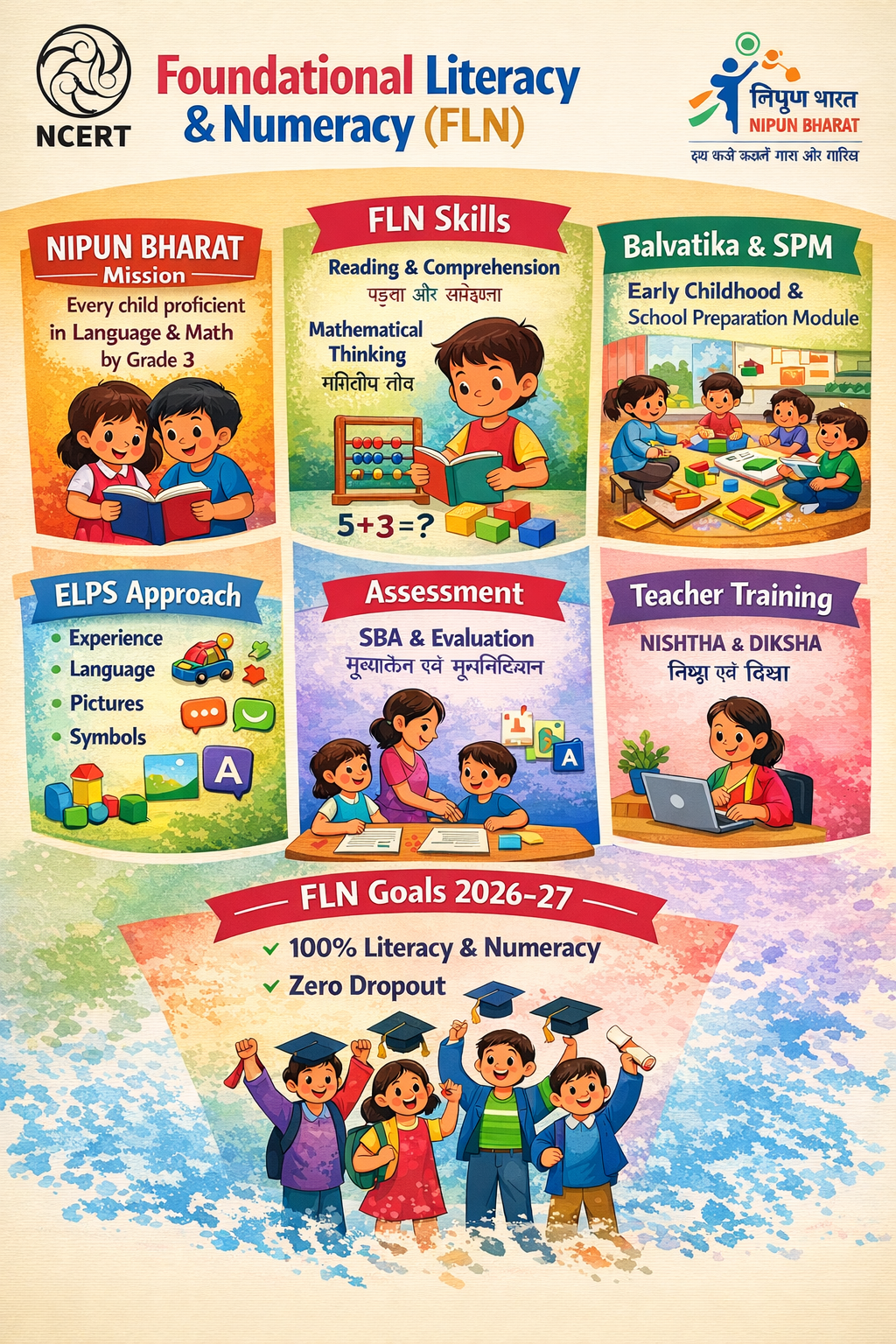
Foundational Literacy and Numeracy (FLN) is recognized as the most urgent and necessary prerequisite for learning. According to NEP 2020, universal FLN must be achieved by 2026-27; otherwise, higher education reforms will not be effective. Early education builds the base for lifelong learning.
Foundational Literacy and Numeracy (FLN) is the ability of children to read with understanding, write meaningfully, and perform basic mathematical operations by the end of Grade 3. FLN is the foundation for lifelong learning. It is also emphasised that without strong foundational skills, higher learning becomes difficult.
Foundational Literacy includes oral language development, phonemic awareness, vocabulary, reading fluency, comprehension, and writing skills. As highlighted in National Education Policy, early language exposure in mother tongue improves literacy outcomes.
आधारभूत साक्षरता और संख्यात्मकता (FLN) को सीखने की सबसे महत्वपूर्ण पूर्व-आवश्यकता माना गया है। नई शिक्षा नीति 2020 के अनुसार 2026-27 तक सार्वभौमिक FLN प्राप्त करना अनिवार्य है, अन्यथा उच्च शिक्षा सुधार प्रभावी नहीं होंगे। प्रारंभिक शिक्षा आजीवन अधिगम की नींव रखती है। Foundational Literacy and Numeracy (FLN)
आधारभूत साक्षरता और संख्यात्मकता (FLN) का अर्थ है कि कक्षा 3 तक के बच्चे समझ के साथ पढ़ सकें, अर्थपूर्ण लेखन कर सकें और गणित की मूलभूत क्रियाएँ कर सकें। FLN आजीवन सीखने की नींव है। मजबूत आधार के बिना उच्च शिक्षा कठिन हो जाती है।
आधारभूत साक्षरता में मौखिक भाषा विकास, ध्वन्यात्मक जागरूकता, शब्दावली, पढ़ने की प्रवाहिता, बोध और लेखन कौशल शामिल हैं। राष्ट्रीय शिक्षा नीति 2020 के अनुसार मातृभाषा में प्रारंभिक शिक्षा साक्षरता को बेहतर बनाती है।
2.What is NIPUN Bharat? निपुण भारत क्या है?
NIPUN Bharat stands for National Initiative for Proficiency in Reading with Understanding and Numeracy. Its vision is that every child should understand language and mathematics by Grade 3. The mission ensures that children “learn to read” so that they can later “read to learn.”
Foundational Numeracy means understanding numbers, counting, place value, addition, subtraction, multiplication, division, and problem-solving in daily life.
निपुण भारत का अर्थ है National Initiative for Proficiency in Reading with Understanding and Numeracy। इसका लक्ष्य है कि कक्षा 3 तक हर बच्चा भाषा और गणित को समझ सके। बच्चे पहले पढ़ना सीखें ताकि आगे चलकर पढ़कर सीख सकें।Foundational Literacy and Numeracy (FLN)
आधारभूत संख्यात्मकता का अर्थ है संख्याओं की समझ, गिनती, स्थानमान, जोड़, घटाव, गुणा, भाग और दैनिक जीवन की समस्याओं को हल करना। इग्नू एम.एड सामग्री के अनुसार संख्यात्मकता रटने की प्रक्रिया नहीं, बल्कि अवधारणात्मक स्पष्टता है।
3.Need for FLN in India/ भारत में FLN की आवश्यकता
Low learning levels in Classes 3 and 5, poor reading comprehension, weak mathematical skills, and increasing dropout rates highlight the urgent need for FLN reforms. Children who fall behind at the foundational stage often remain behind permanently.
FLN is critical for achieving universal education goals. Studies by NCERT and Ministry of Education indicate that children who lack FLN skills face dropout risks. It is the base for achieving Sustainable Development Goals (SDG-4).
कक्षा 3 और 5 में कम अधिगम स्तर, पढ़ने की कमजोर समझ, गणितीय कौशल की कमी और बढ़ती ड्रॉपआउट दर FLN की आवश्यकता को दर्शाती है। जो बच्चे प्रारंभिक स्तर पर पीछे रह जाते हैं, वे आगे भी पिछड़ जाते हैं। Foundational Literacy and Numeracy (FLN)
FLN सार्वभौमिक शिक्षा के लक्ष्यों को प्राप्त करने के लिए अत्यंत महत्वपूर्ण है। एनसीईआरटी और शिक्षा मंत्रालय के अध्ययन बताते हैं कि जिन बच्चों में FLN कौशल की कमी होती है, उनमें स्कूल छोड़ने की संभावना अधिक होती है। यह सतत विकास लक्ष्य-4 की प्राप्ति का आधार है।
4.Foundational Literacy: Key Components /आधारभूत साक्षरता के मुख्य घटक Foundational Literacy and Numeracy (FLN)
Foundational Literacy includes:
- Oral Language Development
- Decoding skills
- Reading Fluency
- Reading Comprehension
- Writing for expression
Reading is not merely recognizing letters; it is constructing meaning. Writing reflects children’s experiences and critical thinking.
आधारभूत साक्षरता में शामिल हैं:
- मौखिक भाषा विकास
- डिकोडिंग कौशल
- पठन प्रवाह
- पठन समझ
- अभिव्यक्ति हेतु लेखन
पढ़ना केवल अक्षर पहचानना नहीं, बल्कि अर्थ निर्माण करना है। लेखन बच्चे के अनुभव और सोच को दर्शाता है। Foundational Literacy and Numeracy (FLN)
5.Foundational Numeracy: Mathematical Thinking/आधारभूत संख्यात्मकता: गणितीय सोच
Foundational Numeracy means the ability to reason and apply numerical concepts in daily life. It includes:
- Pre-number concepts
- Number system understanding
- Operations (Addition, Subtraction, Multiplication, Division)
- Measurement
- Data handling
- Shapes and spatial understanding
Children should confidently perform basic operations up to three-digit numbers.
आधारभूत संख्यात्मकता का अर्थ है दैनिक जीवन में संख्यात्मक अवधारणाओं का प्रयोग करना। इसमें शामिल हैं:
- पूर्व-संख्या अवधारणाएँ
- संख्या प्रणाली की समझ
- जोड़, घटाव, गुणा, भाग
- मापन
- डेटा प्रबंधन
- आकृतियाँ और स्थानिक समझ
बच्चों को तीन अंकों तक की गणनाएँ आत्मविश्वास से करनी चाहिए।Foundational Literacy and Numeracy (FLN)
6.ELPS Approach in FLN/FLN में ELPS दृष्टिकोण . Foundational Literacy and Numeracy (FLN)
The ELPS model ensures conceptual clarity:
- E – Experience
- L – Language
- P – Pictures
- S – Symbols
This structured progression strengthens deep learning and conceptual understanding.
ELPS मॉडल अवधारणात्मक स्पष्टता सुनिश्चित करता है:
- E – अनुभव
- L – भाषा
- P – चित्र
- S – प्रतीक
यह क्रमबद्ध प्रक्रिया गहरी समझ विकसित करती है।
7.School Preparation Module (Balvatika)/ स्कूल तैयारी मॉड्यूल (बालवाटिका)
The School Preparation Module (SPM) is a 3-month play-based programme for Grade 1 students. Since 85% of brain development happens before age 6, this module strengthens pre-literacy and pre-numeracy skills through fun activities.
It includes learning of alphabets, sounds, colours, shapes, and numbers with peer and parental involvement.
स्कूल तैयारी मॉड्यूल (SPM) कक्षा 1 के लिए 3 माह का खेल-आधारित कार्यक्रम है। 6 वर्ष से पहले 85% मस्तिष्क विकास हो जाता है, इसलिए यह मॉड्यूल पूर्व-साक्षरता और पूर्व-संख्या कौशल को मजबूत करता है।
इसमें अक्षर, ध्वनियाँ, रंग, आकृतियाँ और संख्याओं का अधिगम साथियों और अभिभावकों की सहभागिता से कराया जाता है।
8.Learning Goals (Lakshya) of FLN Mission/ FLN मिशन के लक्ष्य (लक्ष्य)
The mission defines grade-wise targets:
- Balvatika: Recognize letters and numbers up to 10
- Grade 1: Read 45–60 words per minute; numbers up to 99
- Grade 2: Numbers up to 999; simple multiplication
- Grade 3: Numbers up to 9999; fluent reading with comprehension
मिशन ने कक्षा-वार लक्ष्य निर्धारित किए हैं:
- बालवाटिका: अक्षर और 10 तक की संख्याएँ पहचानना
- कक्षा 1: 45–60 शब्द प्रति मिनट पढ़ना; 99 तक की संख्या
- कक्षा 2: 999 तक की संख्या; सरल गुणा
- कक्षा 3: 9999 तक की संख्या; प्रवाहपूर्ण पठन
9.Assessment in FLN / FLN में मूल्यांकन
Assessment is continuous and stress-free. It includes:
- School Based Assessment (SBA)
- Large-scale standardized assessments
- Early identification of learning gaps
Assessment is done “as, of, and for” learning.
मूल्यांकन निरंतर और तनाव-मुक्त है। इसमें शामिल हैं
- स्कूल आधारित मूल्यांकन
- बड़े पैमाने पर मानकीकृत मूल्यांकन
- सीखने की कमियों की प्रारंभिक पहचान
मूल्यांकन “सीखने के रूप में, सीखने का और सीखने के लिए” किया जाता है।
10.Teacher Empowerment through NISHTHA & DIKSHA/NISHTHA और DIKSHA के माध्यम से शिक्षक सशक्तिकरण
English:
Teacher training modules under NISHTHA focus on FLN pedagogy, mother tongue instruction, and peer learning. DIKSHA platform provides e-books, videos, assessments, and interactive materials.
Hindi:
NISHTHA के अंतर्गत शिक्षक प्रशिक्षण FLN शिक्षण पद्धति, मातृभाषा में शिक्षण और सहपाठी अधिगम पर केंद्रित है। DIKSHA प्लेटफॉर्म ई-पुस्तकें, वीडियो और इंटरैक्टिव सामग्री प्रदान करता है।
11. Implementation Mechanism / क्रियान्वयन तंत्र
A five-tier system operates at National, State, District, Block, and School levels. Community participation, Panchayats, parents, and teachers play crucial roles in ensuring zero dropout and 100% enrollment.
राष्ट्रीय, राज्य, जिला, ब्लॉक और विद्यालय स्तर पर पाँच-स्तरीय व्यवस्था लागू है। पंचायत, अभिभावक और शिक्षक मिलकर शून्य ड्रॉपआउट और 100% नामांकन सुनिश्चित करते हैं।
12. Impact of FLN Mission / FLN मिशन का प्रभाव
FLN improves transition rates, reduces dropout, strengthens holistic child development, and enhances cognitive, socio-emotional, and life skills.
FLN संक्रमण दर में सुधार करता है, ड्रॉपआउट कम करता है और बच्चों के शारीरिक, सामाजिक-भावनात्मक तथा संज्ञानात्मक विकास को सुदृढ़ बनाता है।
13.Conclusion / निष्कर्ष
Foundational Literacy and Numeracy is the backbone of India’s education reform. Achieving universal FLN by 2026-27 will transform learning outcomes and secure the future of millions of children.
आधारभूत साक्षरता और संख्यात्मकता भारत के शिक्षा सुधार की रीढ़ है। 2026-27 तक सार्वभौमिक FLN प्राप्त करना लाखों बच्चों के भविष्य को सुरक्षित करेगा।
50 Objective Questions (MCQs). Foundational Literacy and Numeracy (FLN)
- FLN should be achieved by which grade?
A. Grade 5
B. Grade 3
C. Grade 8
D. Grade 10
Answer: B - NIPUN Bharat Mission was launched in which year?
A. 2018
B. 2019
C. 2021
D. 2022
Answer: C - NEP 2020 introduced which structure?
A. 10+2
B. 8+4
C. 5+3+3+4
D. 6+3+3
Answer: C - FLN stands for:
A. Fundamental Learning Number
B. Foundational Literacy and Numeracy
C. Formal Learning Norms
D. Functional Literacy Number
Answer: B - Which organization develops national curriculum?
A. CBSE
B. NCERT
C. NIOS
D. UGC
Answer: B - Foundational Numeracy includes:
A. Algebra
B. Trigonometry
C. Basic arithmetic
D. Calculus
Answer: C - Mother tongue instruction improves:
A. Dropout
B. Literacy
C. Confusion
D. Delay
Answer: B - NIPUN Bharat focuses on:
A. Higher Education
B. Technical Education
C. Grade 3 FLN
D. University Reform
Answer: C - FLN is linked with SDG:
A. 1
B. 2
C. 4
D. 8
Answer: C - Assessment in FLN should be:
A. Summative
B. Exam-based
C. Competency-based
D. Annual
Answer: C11. The main objective of FLN is to ensure:
A. High marks in board exams
B. Early childhood employment
C. Basic reading and arithmetic skills by Grade 3
D. Competitive exam preparation
Answer: C
12. Which mission focuses on achieving universal FLN in India?
A. Sarva Shiksha Abhiyan
B. NIPUN Bharat
C. RMSA
D. Skill India
Answer: B
13. Continuous and Comprehensive Evaluation (CCE) supports:
A. Annual exams only
B. Formative assessment
C. Only summative tests
D. No assessment
Answer: B
14. Foundational Literacy mainly develops:
A. Scientific research
B. Language and reading skills
C. Engineering skills
D. Business skills
Answer: B
15. Place value concept is part of:
A. Advanced mathematics
B. Foundational Numeracy
C. Higher algebra
D. Statistics
Answer: B
16. Which approach is recommended by NCERT for early grades?
A. Lecture method
B. Play-way method
C. Rote memorization
D. Drill method
Answer: B
17. Activity-based learning promotes:
A. Passive listening
B. Child-centered learning
C. Teacher dominance
D. Exam fear
Answer: B
18. FLN is a priority area in which policy?
A. NCF 2005
B. RTE Act
C. National Education Policy 2020
D. SSA 2001
Answer: C
19. Mother tongue as medium of instruction is recommended up to:
A. Grade 1
B. Grade 2
C. Grade 3 or 5
D. Grade 10
Answer: C
20. Numeracy skills help children in:
A. Solving daily life problems
B. Only classroom exams
C. Memorizing tables only
D. Writing essays
Answer: A
21. Portfolio assessment is encouraged by:
A. CBSE
B. RBI
C. AICTE
D. UPSC
Answer: A
22. FLN primarily targets children of age group:
A. 3–8 years
B. 10–15 years
C. 15–18 years
D. 18–21 years
Answer: A
23. The Foundational Stage in NEP 2020 includes:
A. Grades 6–8
B. Grades 9–12
C. 3 years pre-school + Grades 1–2
D. University level
Answer: C
24. Which of the following improves reading fluency?
A. Silent memorization
B. Storytelling and shared reading
C. Punishment
D. Long lectures
Answer: B
25. Teacher training for FLN is supported by:
A. IGNOU
B. ISRO
C. DRDO
D. SEBI
Answer: A
26. Learning outcomes for FLN are defined by:
A. NCERT
B. Railway Board
C. Finance Ministry
D. Election Commission
Answer: A
27. Competency-based education focuses on:
A. Marks
B. Syllabus completion
C. Skill mastery
D. Homework load
Answer: C
28. The full form of FLN is:
A. Functional Learning Network
B. Foundational Literacy and Numeracy
C. Formal Literacy Norm
D. Fundamental Logical Numbers
Answer: B
29. Which digital platform supports FLN resources?
A. SWAYAM
B. DIKSHA
C. UMANG
D. BHIM
Answer: B
30. Strong FLN leads to:
A. Increased dropout
B. Academic success
C. Learning gaps
D. Fear of mathematics
Answer: B
31. A Grade 2 child can read aloud fluently but cannot explain the meaning of the passage. According to FLN principles, the teacher should focus on:
A. Increasing reading speed
B. Memorization of text
C. Reading comprehension strategies
D. Giving homework daily
Answer: C
32. A teacher notices that students can perform addition using fingers but fail in word problems. This indicates lack of:
A. Counting skills
B. Conceptual understanding
C. Memory power
D. Practice
Answer: B
33. Under National Education Policy, achieving FLN by Grade 3 is important because:
A. It prepares students for board exams
B. It reduces teacher workload
C. It prevents future learning gaps
D. It increases school infrastructure
Answer: C
34. In a multilingual classroom, the best strategy for FLN development is:
A. Use only English
B. Ignore home language
C. Use mother tongue as bridge language
D. Avoid interaction
Answer: C
35. A child consistently reverses letters (b/d). According to NCERT guidelines, the teacher should:
A. Punish the child
B. Provide multisensory phonics activities
C. Reduce reading practice
D. Ignore the mistake
Answer: B
36. In competency-based assessment promoted by CBSE, evaluation should measure:
A. Rote memory
B. Syllabus coverage
C. Application of skills
D. Number of pages written
Answer: C
37. A teacher integrates number games during playtime. This approach reflects:
A. Traditional pedagogy
B. Constructivist approach
C. Lecture method
D. Drill method
Answer: B
38. According to NIPUN Bharat Mission, the expected learning outcome by Grade 3 in mathematics is:
A. Solving algebraic equations
B. Understanding fractions deeply
C. Performing basic operations with understanding
D. Learning calculus
Answer: C
39. If a child cannot identify numbers beyond 20 in Grade 3, the most appropriate intervention is:
A. Promote to next grade
B. Provide remedial and activity-based learning
C. Assign punishment
D. Ignore performance
Answer: B
40. Reading aloud together in class mainly develops:
A. Competition
B. Pronunciation and fluency
C. Fear
D. Silence
Answer: B
41. A teacher uses real-life examples like buying fruits to teach subtraction. This demonstrates:
A. Abstract teaching
B. Experiential learning
C. Memorization
D. Drill practice
Answer: B
42. Continuous assessment in FLN helps teachers to:
A. Rank students
B. Identify learning gaps early
C. Reduce teaching time
D. Increase exam pressure
Answer: B
43. The failure to achieve FLN by Grade 3 may result in:
A. Better higher learning
B. Dropout risk and poor academic performance
C. Fast syllabus completion
D. High confidence
Answer: B
44. Which of the following reflects child-centered pedagogy in FLN?
A. Teacher explains, students copy
B. Students explore and discuss
C. Only textbook reading
D. Silent classroom
Answer: B
45. According to NCERT learning outcomes, literacy includes:
A. Only reading speed
B. Writing without meaning
C. Reading with comprehension
D. Memorizing poems
Answer: C
46. When teaching place value using beads and sticks, the teacher is applying:
A. Concrete to abstract principle
B. Rote learning
C. Lecture method
D. Testing method
Answer: A
47. A portfolio assessment is useful because it:
A. Encourages comparison
B. Shows long-term progress
C. Focuses only on marks
D. Reduces teacher role
Answer: B
48. Which practice best supports early literacy at home?
A. Daily punishment
B. Watching TV silently
C. Storytelling and shared reading
D. Ignoring mistakes
Answer: C
49. In FLN framework, numeracy is connected to:
A. Only mathematics subject
B. Real-life problem solving
C. Board exams
D. Higher research
Answer: B
50. A school conducts baseline assessment at the beginning of the year. The purpose is to:
A. Fail weak students
B. Identify entry-level competencies
C. Complete syllabus
D. Increase competition
Previous Year Questions- Foundational Literacy and Numeracy (FLN)
1. Foundational Literacy primarily aims at developing:
A. Speed reading only
B. Reading with comprehension
C. Writing long essays
D. Memorization of poems
Answer: B
2. According to NEP 2020, the target for achieving FLN for all children is by:
A. 2022
B. 2025
C. 2030
D. 2027
Answer: B
3. In a Grade 1 classroom, the most appropriate method to develop phonemic awareness is:
A. Dictation daily
B. Storytelling and rhyming games
C. Long lectures
D. Copy-writing
Answer: B
4. A child reads correctly but slowly. The teacher should:
A. Force speed reading
B. Provide repeated reading practice
C. Punish for slow reading
D. Ignore the issue
Answer: B
5. Foundational Numeracy includes ability to:
A. Solve quadratic equations
B. Understand number sense and operations
C. Learn trigonometry
D. Memorize formulas only
Answer: B
6. The best way to teach subtraction in Grade 2 is:
A. Direct formula teaching
B. Using real objects like fruits or sticks
C. Giving 20 written sums
D. Explaining theory only
Answer: B
7. Which assessment method is most suitable for FLN?
A. Annual written exam
B. Continuous and formative assessment
C. Surprise tests only
D. Board pattern exam
Answer: B
8. A multilingual classroom should:
A. Ban home language
B. Use mother tongue as bridge language
C. Teach only English
D. Avoid discussion
Answer: B
9. Which of the following reflects constructivist pedagogy?
A. Teacher explains, students copy
B. Students explore and discover concepts
C. Memorization of textbook
D. Silent classroom
Answer: B
10. A teacher notices many children cannot identify numbers beyond 50. The best action is:
A. Move ahead with syllabus
B. Conduct remedial teaching
C. Give punishment
D. Inform parents only
Answer: B
11. The main objective of NIPUN Bharat Mission is to:
A. Improve higher education
B. Ensure FLN by Grade 3
C. Conduct board exams
D. Promote vocational training
Answer: B
12. Which of the following is NOT a component of foundational literacy?
A. Vocabulary
B. Comprehension
C. Algebra
D. Writing skills
Answer: C
13. When a child counts objects correctly but cannot write numbers, it shows need for improvement in:
A. Motor and symbol recognition skills
B. Listening skills
C. Moral values
D. Attendance
Answer: A
14. Peer learning in early grades helps in:
A. Competition only
B. Social and language development
C. Punishment
D. Reducing teacher role completely
Answer: B
15. Which strategy improves reading comprehension?
A. Asking inferential questions
B. Memorizing paragraphs
C. Silent copying
D. Only loud reading
Answer: A
16. According to NCERT learning outcomes, a Grade 3 child should be able to:
A. Solve algebra
B. Read simple texts with understanding
C. Write research papers
D. Learn coding
Answer: B
17. Diagnostic assessment helps teachers to:
A. Rank students
B. Identify specific learning gaps
C. Increase homework
D. Finish syllabus
Answer: B
18. Play-way method is effective because it:
A. Reduces syllabus
B. Makes learning joyful and meaningful
C. Avoids teaching
D. Promotes rote learning
Answer: B
19. Word problems in mathematics mainly assess:
A. Speed
B. Conceptual understanding
C. Memory
D. Handwriting
Answer: B
20. A child makes frequent spelling errors in early grades. The teacher should:
A. Discourage writing
B. Provide phonics-based practice
C. Reduce language exposure
D. Ignore mistakes
Answer: B
For More on Foundational Literacy and Numeracy (FLN) details please visit :https://teacherszone.in/
Please follow us on Facebook:https://www.facebook.com/profile.php?id=61586013442564