
Explore the major factors affecting learning and their educational implications for classroom instruction, student activities, and learning spaces. Understand key factors affecting learning, such as psychological, social, and environmental influences, and discover their practical implications for designing classrooms and improving student engagement. Comprehensive guide for teachers and school leaders. Ideal for B.Ed, M.Ed, CTET, KVS, and other teaching exams.
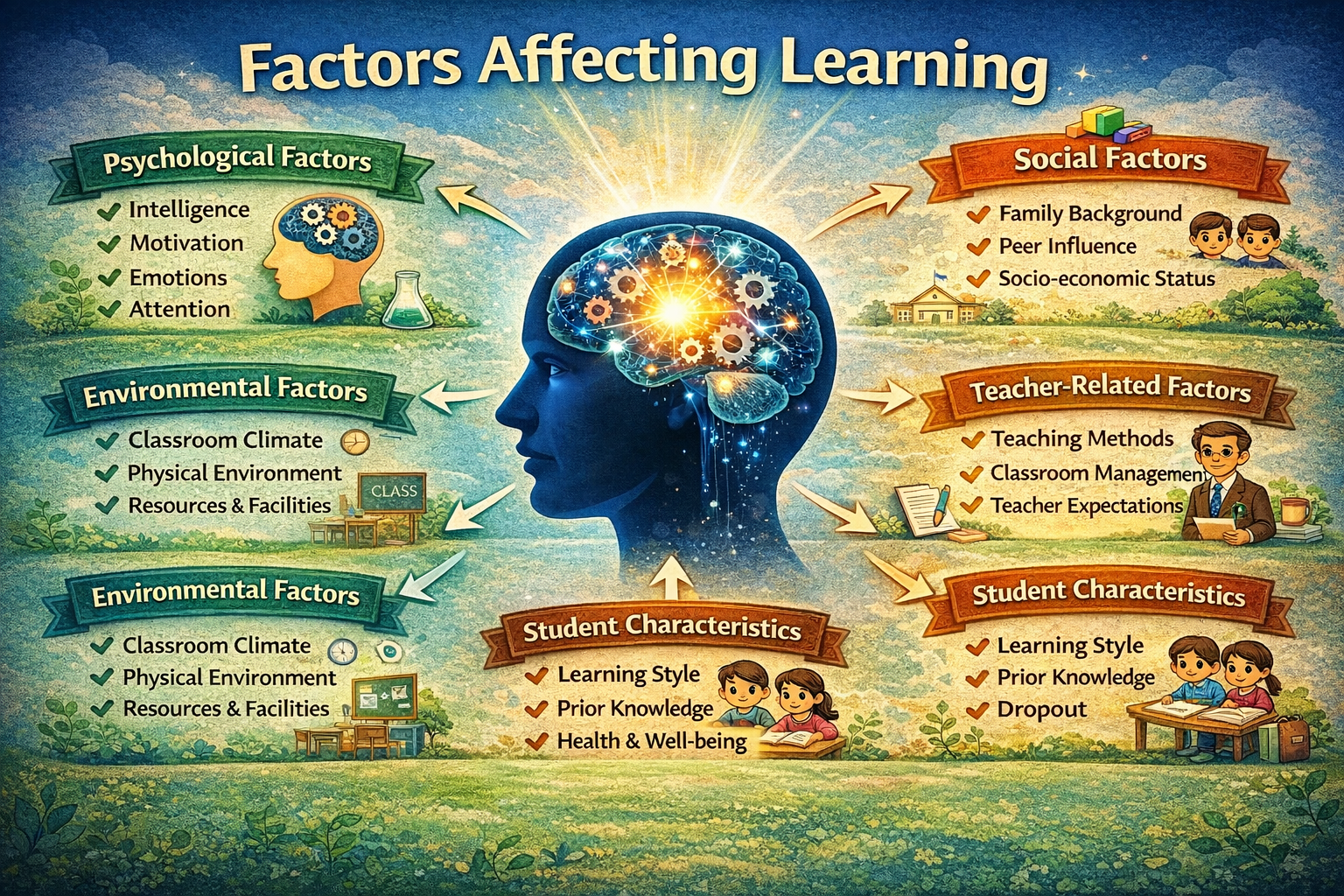
Table of Contents
Introduction
Learning is a continuous and dynamic process influenced by various psychological, social, environmental, and institutional factors. According to guidelines of the Ministry of Education (MoE), Government of India, NCERT Mental Well-being booklet, and IGNOU B.Ed/M.Ed study materials, effective learning occurs when the school environment addresses cognitive, emotional, social, and physical needs of learners.
सीखना एक सतत और गतिशील प्रक्रिया है, जो अनेक मनोवैज्ञानिक, सामाजिक, पर्यावरणीय एवं संस्थागत कारकों से प्रभावित होती है। IGNOU तथा शिक्षा मंत्रालय के दिशा-निर्देशों के अनुसार, प्रभावी अधिगम तब संभव है जब विद्यालय वातावरण शिक्षार्थी की बौद्धिक, भावनात्मक एवं सामाजिक आवश्यकताओं को संतुलित रूप से पूरा करे।
Major Factors Affecting Learning
In the learning process, the following factors affecting learning-
1️⃣ Psychological Factors (मनोवैज्ञानिक कारक)
✔ Intelligence & Cognitive Ability
Higher cognitive ability supports problem-solving and conceptual understanding.
उच्च बौद्धिक क्षमता समस्या समाधान और अवधारणात्मक समझ को बढ़ाती है।
✔ Motivation (प्रेरणा)
Intrinsic motivation enhances deep learning.
आंतरिक प्रेरणा गहन अधिगम को बढ़ावा देती है।
✔ Emotional Well-being
NCERT’s mental well-being guidelines emphasize safe and supportive classrooms.
भावनात्मक संतुलन सीखने की गुणवत्ता को प्रभावित करता है।
2️⃣ Social Factors (सामाजिक कारक)
Social factors are also important Factors affecting learning.
✔ Family Background
Parental involvement improves academic achievement.
अभिभावकों की भागीदारी से शैक्षिक उपलब्धि बढ़ती है।
✔ Peer Influence
Positive peer groups encourage collaborative learning.
सकारात्मक साथियों का प्रभाव सहकारी अधिगम को बढ़ाता है।
3️⃣ Environmental Factors (पर्यावरणीय कारक)
In the Factors affecting learning, environmental factors play a vital role.
✔ Classroom Climate
Safe, inclusive, and democratic classrooms foster participation.
लोकतांत्रिक और समावेशी कक्षा सहभागिता को बढ़ाती है।
✔ Physical Environment
Ventilation, lighting, seating arrangement influence concentration.
उचित रोशनी, वेंटिलेशन और बैठने की व्यवस्था ध्यान केंद्रित करने में सहायक है।
4️⃣ Teacher-Related Factors (शिक्षक संबंधी कारक)
Factors affecting learning, teachers, who are an important factor.
- Teaching methods
- Classroom management
- Teacher expectations
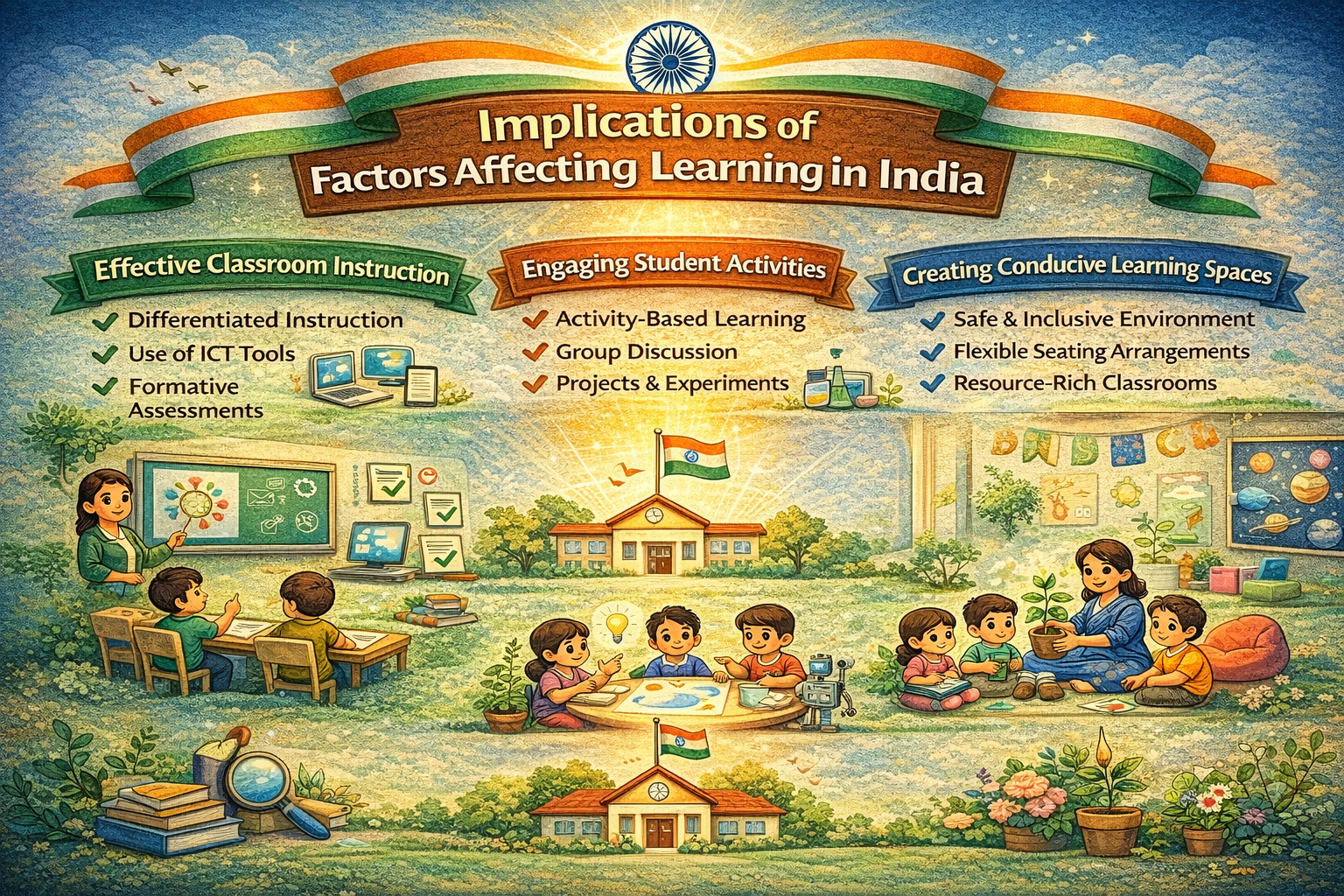
Educational Implications
1. Designing Classroom Instruction
✔ Use differentiated instruction
✔ Integrate ICT tools
✔ Adopt formative assessment
Implication: Lessons must consider individual differences.
निहितार्थ: शिक्षण योजना में व्यक्तिगत भिन्नताओं को शामिल करना आवश्यक है।
2. Planning Student Activities
✔ Activity-based learning
✔ Project-based learning
✔ Group discussion & peer tutoring
MoE recommends experiential and competency-based learning.
शिक्षा मंत्रालय अनुभवात्मक एवं दक्षता-आधारित अधिगम पर बल देता है।
3. Creating Learning Spaces in School
✔ Inclusive classrooms
✔ Safe emotional spaces
✔ Flexible seating arrangements
NCERT emphasizes mental health-friendly schools.
NCERT मानसिक स्वास्थ्य अनुकूल विद्यालयों की वकालत करता है।
Creating Productive Learning Spaces
A productive classroom environment should be:
- Emotionally secure
- Academically stimulating
- Socially inclusive
उत्पादक अधिगम वातावरण सुरक्षित, प्रेरक और समावेशी होना चाहिए।
Conclusion
Learning is influenced by multiple interrelated factors. Teachers and school leaders must adopt a holistic approach considering psychological, social, and environmental variables. Policy documents from IGNOU, NCERT, and MoE consistently emphasize inclusive, learner-centered, and well-being-oriented education.
सीखना बहुआयामी कारकों से प्रभावित होता है। इसलिए शिक्षकों और विद्यालय प्रशासन को समग्र दृष्टिकोण अपनाना चाहिए।
For PDF materials please click here: https://drive.google.com/drive/folders/1hYzqySXQ-gAXg71X-VO9shXEJJYpW5pe?usp=drive_link
30 Exam-Oriented MCQs with Answers based on- Factors affecting learning and their implications
1. Motivation primarily affects:
a) Physical growth
b) Learning readiness
c) Income
d) Climate
Ans: b
2. Emotional stability helps in:
a) Anxiety increase
b) Better concentration
c) Conflict
d) Dropout
Ans: b
3. Parental involvement leads to:
a) Poor attendance
b) High achievement
c) Indiscipline
d) Stress
Ans: b
4. Inclusive classroom means:
a) Only gifted students
b) Equal opportunity
c) Segregation
d) Competition
Ans: b
5. Formative assessment is used for:
a) Punishment
b) Improvement
c) Ranking
d) Certification
Ans: b
6. Peer tutoring promotes:
a) Isolation
b) Collaboration
c) Fear
d) Anxiety
Ans: b
7. Proper lighting affects:
a) Sleep
b) Attention
c) Nutrition
d) Memory loss
Ans: b
8. Socio-economic status influences:
a) Learning opportunities
b) Weather
c) Gender
d) None
Ans: a
9. Activity-based learning develops:
a) Passivity
b) Creativity
c) Silence
d) Fear
Ans: b
10. Safe school climate reduces:
a) Engagement
b) Stress
c) Attendance
d) Motivation
Ans: b
11. Intelligence mainly influences:
a) Emotional health
b) Cognitive performance
c) Physical strength
d) Social class
Ans: b
12. Democratic classroom promotes:
a) Fear
b) Participation
c) Authority
d) Silence
Ans: b
13. Individual differences require:
a) Same method
b) Differentiated teaching
c) Punishment
d) Ignoring
Ans: b
14. Mental well-being improves:
a) Dropout rate
b) Academic performance
c) Conflict
d) Anxiety
Ans: b
15. Constructive feedback helps in:
a) Confusion
b) Improvement
c) Withdrawal
d) Punishment
Ans: b
16. Group discussion develops:
a) Isolation
b) Communication skills
c) Fear
d) Laziness
Ans: b
17. Student-centered approach focuses on:
a) Teacher dominance
b) Learner needs
c) Memorization
d) Silence
Ans: b
18. Flexible seating encourages:
a) Rigidity
b) Collaboration
c) Passivity
d) Fear
Ans: b
19. Competency-based education emphasizes:
a) Rote learning
b) Skill mastery
c) Ranking
d) Punishment
Ans: b
20. Reflective teaching improves:
a) Teaching quality
b) Stress
c) Confusion
d) Dropout
Ans: a
21. Social support enhances:
a) Anxiety
b) Confidence
c) Isolation
d) Conflict
Ans: b
22. Peer influence can be:
a) Always negative
b) Positive or negative
c) Neutral
d) None
Ans: b
23. Experiential learning is recommended by:
a) MoE
b) Weather Dept
c) Banks
d) None
Ans: a
24. School climate impacts:
a) Learning outcomes
b) Rainfall
c) Income
d) Gender
Ans: a
25. Teacher expectations influence:
a) Student motivation
b) Climate
c) Economy
d) None
Ans: a
26. Activity-based teaching promotes:
a) Engagement
b) Fear
c) Silence
d) Dropout
Ans: a
27. Cognitive readiness affects:
a) Understanding
b) Income
c) Climate
d) Weather
Ans: a
28. Inclusive education ensures:
a) Exclusion
b) Equal participation
c) Segregation
d) Competition
Ans: b
29. Healthy learning space promotes:
a) Stress
b) Comfort
c) Anxiety
d) Conflict
Ans: b
30. Holistic development includes:
a) Only academics
b) Physical, emotional & social growth
c) Memorization
d) Competition
Ans: b
For updates,https://teacherszone.in/ please follow us:
50 Previous Year MCQs (Exam Oriented) based on Factors affecting learning and their implications
1. (CTET 2019)
Motivation affects learning by:
A. Reducing intelligence
B. Increasing engagement
C. Causing stress
D. Limiting participation
✅ Answer: B
2. (B.Ed Entrance 2018)
Intelligence mainly influences:
A. Physical growth
B. Cognitive achievement
C. Income
D. Climate
✅ Answer: B
3. (UGC NET 2020)
Socio-economic status primarily affects:
A. Weather
B. Learning opportunities
C. Gender
D. Climate
✅ Answer: B
4. (KVS 2017)
Inclusive education promotes:
A. Segregation
B. Equal opportunity
C. Competition only
D. Isolation
✅ Answer: B
5. (CTET 2016)
Emotional stability helps students in:
A. Anxiety
B. Better concentration
C. Conflict
D. Withdrawal
✅ Answer: B
6. (STET 2021)
Peer influence in school is:
A. Always negative
B. Always positive
C. Can be positive or negative
D. Irrelevant
✅ Answer: C
7. (B.Ed Entrance 2017)
Classroom climate affects:
A. Learning outcomes
B. Rainfall
C. Temperature
D. Income
✅ Answer: A
8. (UGC NET 2019)
Intrinsic motivation leads to:
A. Surface learning
B. Deep learning
C. Fear
D. Punishment
✅ Answer: B
9. (CTET 2018)
Formative assessment is used for:
A. Certification
B. Improvement
C. Ranking
D. Punishment
✅ Answer: B
10. (KVS 2022)
Flexible seating promotes:
A. Rigidity
B. Collaboration
C. Isolation
D. Silence
✅ Answer: B
11. (UGC NET 2017)
Learning readiness depends on:
A. Age only
B. Cognitive maturity
C. Weather
D. Income
✅ Answer: B
12. (CTET 2021)
Safe school environment reduces:
A. Motivation
B. Stress
C. Attendance
D. Interest
✅ Answer: B
13. (B.Ed 2019)
Teacher expectations influence:
A. Student performance
B. Climate
C. Economy
D. Policy
✅ Answer: A
14. (STET 2020)
Activity-based learning develops:
A. Passivity
B. Creativity
C. Fear
D. Silence
✅ Answer: B
15. (KVS 2018)
Parental involvement improves:
A. Dropout rate
B. Academic achievement
C. Conflict
D. Stress
✅ Answer: B
16.
Lighting in classroom affects:
A. Attention
B. Economy
C. Weather
D. Gender
✅ Answer: A
17.
Socio-emotional development supports:
A. Isolation
B. Confidence
C. Conflict
D. Fear
✅ Answer: B
18.
Constructive feedback helps in:
A. Improvement
B. Confusion
C. Punishment
D. Dropout
✅ Answer: A
19.
Democratic classroom encourages:
A. Authority
B. Participation
C. Fear
D. Silence
✅ Answer: B
20.
Competency-based learning focuses on:
A. Memorization
B. Skill mastery
C. Ranking
D. Punishment
✅ Answer: B
21.
Health problems may cause:
A. Better performance
B. Learning difficulty
C. Intelligence growth
D. Motivation
✅ Answer: B
22.
Group discussion improves:
A. Isolation
B. Communication skills
C. Fear
D. Laziness
✅ Answer: B
23.
Individual differences require:
A. Same teaching method
B. Differentiated instruction
C. Ignoring
D. Punishment
✅ Answer: B
24.
Learning space should be:
A. Rigid
B. Inclusive
C. Segregated
D. Competitive
✅ Answer: B
25.
Teacher’s positive attitude increases:
A. Anxiety
B. Motivation
C. Conflict
D. Dropout
✅ Answer: B
26.
Poor classroom management leads to:
A. Discipline
B. Learning disruption
C. Growth
D. Focus
✅ Answer: B
27.
Experiential learning emphasizes:
A. Rote learning
B. Learning by doing
C. Memorization
D. Silence
✅ Answer: B
28.
Emotional safety promotes:
A. Fear
B. Participation
C. Withdrawal
D. Isolation
✅ Answer: B
29.
School climate includes:
A. Only physical setting
B. Emotional & social environment
C. Weather
D. Temperature
✅ Answer: B
30.
ICT integration supports:
A. Passive learning
B. Interactive learning
C. Silence
D. Isolation
✅ Answer: B
31. Motivation is considered a:
A. External factor
B. Internal factor
C. Physical factor
D. Environmental factor
✅ Answer: B
32. Proper nutrition affects:
A. Only physical growth
B. Only emotional growth
C. Physical and mental growth
D. School management
✅ Answer: C
33. Good teacher-student rapport improves:
A. Learning outcomes
B. Weather conditions
C. School funding
D. Infrastructure
✅ Answer: A
34. Inclusive education ensures:
A. Segregation of learners
B. Equal participation of all learners
C. Competition among students
D. Isolation of special needs children
✅ Answer: B
35. Student anxiety negatively affects:
A. Attendance only
B. Uniform discipline
C. Academic performance
D. Classroom decoration
✅ Answer: C
36. Peer tutoring mainly develops:
A. Cooperation and collaboration
B. Fear
C. Isolation
D. Teacher dependency
✅ Answer: A
37. A clean and well-ventilated classroom enhances:
A. Conflict
B. Concentration
C. Dropout rate
D. Noise level
✅ Answer: B
38. Learning difficulties require:
A. Punishment
B. Ignoring the child
C. Competition
D. Remedial teaching
✅ Answer: D
39. Formative evaluation is:
A. One-time testing
B. Annual examination
C. Continuous and comprehensive
D. Punitive assessment
✅ Answer: C
40. Supportive school leadership promotes:
A. Positive school climate
B. Fear among students
C. Authoritarian control
D. Isolation
✅ Answer: A
41. Socio-cultural background influences student’s:
A. Height
B. Attitude towards learning
C. Weather
D. Uniform color
✅ Answer: B
42. Safe learning spaces help in reducing:
A. Attendance
B. Motivation
C. Participation
D. Bullying
✅ Answer: D
43. Emotional intelligence supports better:
A. Conflict
B. Punishment
C. Adjustment and relationships
D. Isolation
✅ Answer: C
44. Classroom discussion enhances:
A. Critical thinking
B. Silence
C. Fear
D. Memorization only
✅ Answer: A
45. While planning activities, teacher should consider:
A. Only syllabus
B. Individual differences
C. Competition only
D. Punishment
✅ Answer: B
46. Inclusive learning spaces promote:
A. Segregation
B. Uniformity
C. Diversity and equality
D. Isolation
✅ Answer: C
47. Democratic discipline builds:
A. Fear
B. Blind obedience
C. Responsibility
D. Punishment culture
✅ Answer: C
48. Student-centered classroom design increases:
A. Teacher dominance
B. Student engagement
C. Isolation
D. Anxiety
✅ Answer: B
49. Healthy school environment promotes:
A. Stress
B. Conflict
C. Well-being
D. Dropout
✅ Answer: C
50. Holistic development includes:
A. Only academic growth
B. Only physical growth
C. Only social growth
D. Physical, mental, and social growth
✅ Answer: D