
Comprehensive bilingual study material on Concept of Growth, Maturation, and Development, including principles and major debates like Nature vs Nurture, for KVS, NVS, EMRS, B.Ed, CTET, TET, and NET aspirants. Easy language, exam-oriented notes with examples.
Table of Contents
Introduction / परिचय
Human development is a continuous and systematic process. In educational psychology, understanding growth, maturation, and development is essential for teachers, parents, and researchers. These concepts help us understand how children change physically, mentally, socially, and emotionally over time.
मानव विकास एक सतत और क्रमबद्ध प्रक्रिया है। शैक्षिक मनोविज्ञान में वृद्धि (Growth), परिपक्वता (Maturation) और विकास (Development) को समझना शिक्षकों, अभिभावकों और शोधकर्ताओं के लिए अत्यंत आवश्यक है। ये अवधारणाएँ हमें यह समझने में सहायता करती हैं कि बच्चे समय के साथ शारीरिक, मानसिक, सामाजिक और भावनात्मक रूप से कैसे बदलते हैं।

1. Concept of Growth (वृद्धि की अवधारणा)
Meaning of Growth (Growth का अर्थ)
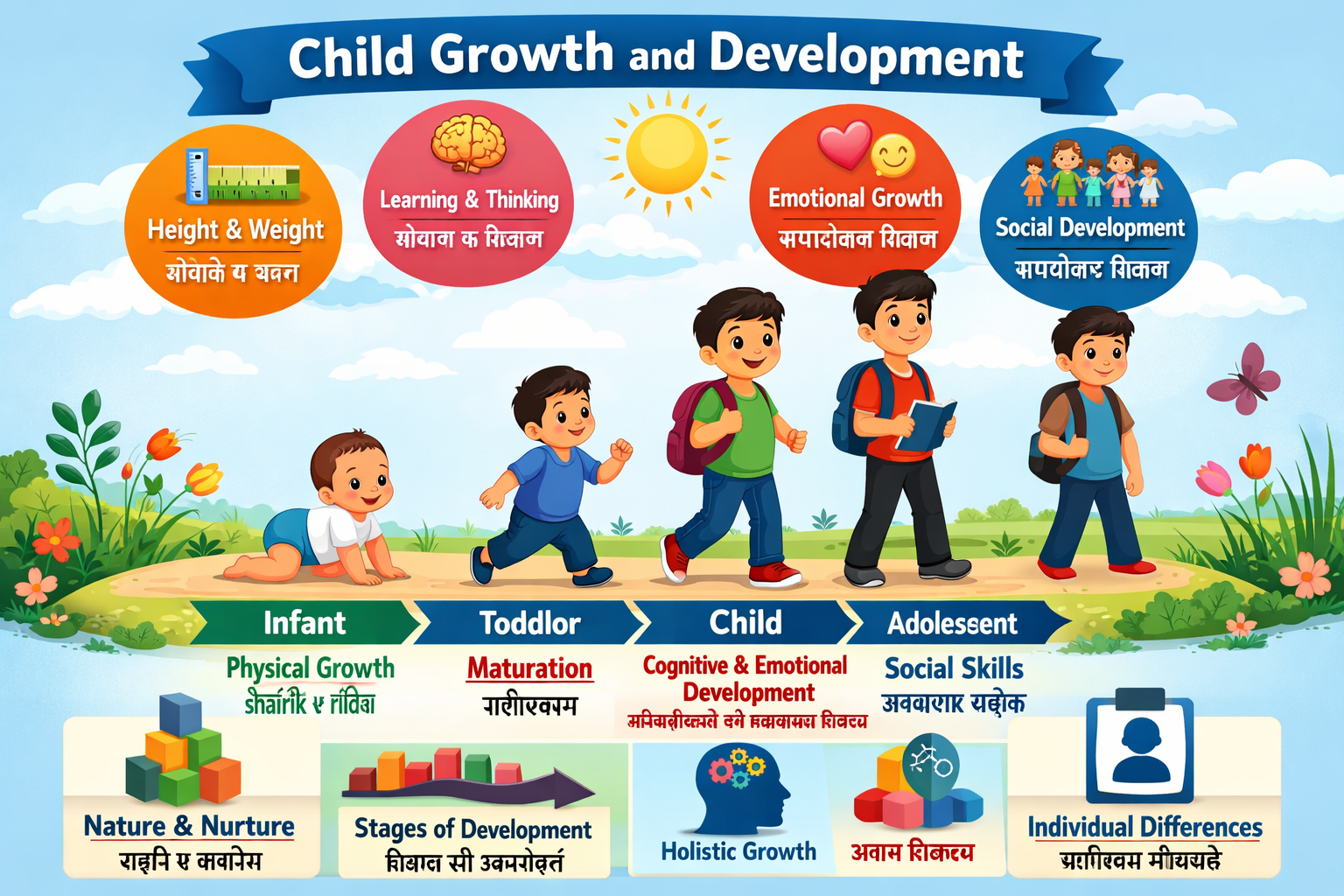
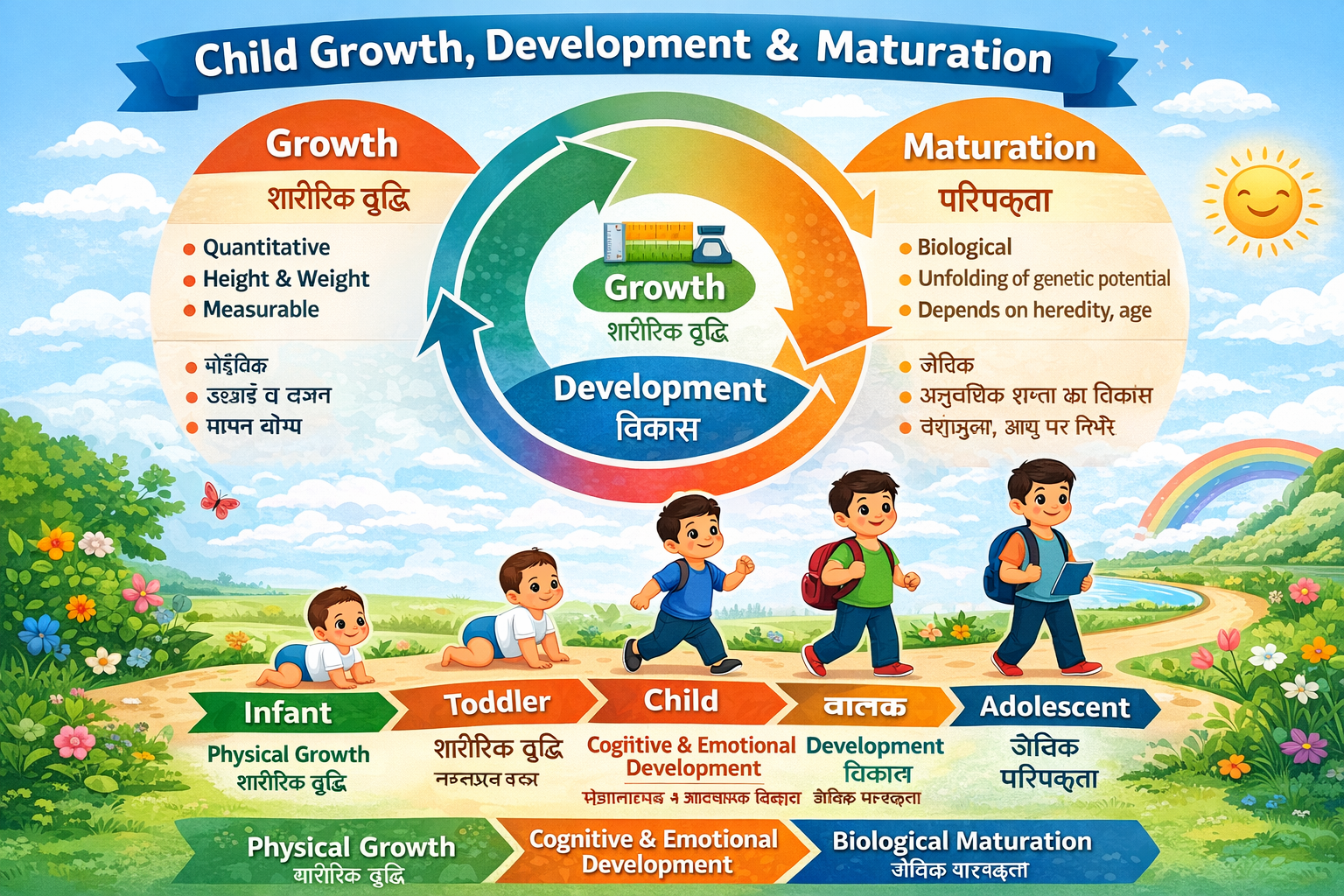
Growth refers to quantitative changes in the body. It includes increase in height, weight, size, and structure of the body.
वृद्धि से तात्पर्य शरीर में होने वाले मात्रात्मक (Quantitative) परिवर्तनों से है, जैसे – लंबाई, वजन, आकार और संरचना में वृद्धि।
Definitions (परिभाषाएँ)
- Growth is a change in size and structure of the body.
- It is measurable and observable.
Characteristics of Growth (वृद्धि की विशेषताएँ)
- It is quantitative.
- It can be measured (height, weight).
- It stops after a certain age.
- It mainly relates to physical changes.
- यह मात्रात्मक परिवर्तन है।
- इसे मापा जा सकता है।
- यह एक निश्चित आयु के बाद रुक जाती है।
- यह मुख्यतः शारीरिक परिवर्तन से संबंधित है।
Example (उदाहरण)
Increase in height from 120 cm to 140 cm is growth.
120 सेमी से 140 सेमी तक लंबाई बढ़ना वृद्धि है।
2. Concept of Maturation (परिपक्वता की अवधारणा)
Meaning of Maturation (परिपक्वता का अर्थ)
Maturation refers to the natural unfolding of genetic potential. It is the biological development that occurs automatically with age.
परिपक्वता का अर्थ है व्यक्ति की आनुवंशिक क्षमता का स्वाभाविक विकास। यह जैविक परिवर्तन है जो आयु के साथ स्वतः होता है।
Key Features (मुख्य विशेषताएँ)
- It is biological in nature.
- It depends on heredity.
- It does not require training.
- It follows a fixed pattern.
- यह जैविक प्रक्रिया है।
- यह वंशानुक्रम पर निर्भर करती है।
- इसके लिए प्रशिक्षण आवश्यक नहीं है।
- यह एक निश्चित क्रम का पालन करती है।
Example (उदाहरण)
A child learning to walk when muscles are mature.
मांसपेशियों के परिपक्व होने पर बच्चे का चलना सीखना।
3. Concept of Development (विकास की अवधारणा)
Meaning of Development (विकास का अर्थ)
Development refers to both quantitative and qualitative changes that occur in a person throughout life.
विकास से तात्पर्य व्यक्ति में होने वाले मात्रात्मक और गुणात्मक दोनों प्रकार के परिवर्तनों से है जो जीवनभर चलते रहते हैं।
Definitions (परिभाषाएँ)
According to Elizabeth Hurlock, development is a progressive series of orderly changes.
एलिज़ाबेथ हर्लॉक के अनुसार विकास एक क्रमबद्ध और प्रगतिशील परिवर्तन है।
Characteristics of Development (विकास की विशेषताएँ)
- It is continuous.
- It is holistic.
- It includes physical, mental, emotional, and social aspects.
- It continues throughout life.
- यह निरंतर चलने वाली प्रक्रिया है।
- यह समग्र (Holistic) है।
- इसमें शारीरिक, मानसिक, भावनात्मक और सामाजिक पहलू शामिल हैं।
- यह जीवनभर चलता है।
Difference Between Growth, Maturation & Development
वृद्धि, परिपक्वता और विकास में अंतर
| Basis | Growth | Maturation | Development |
|---|---|---|---|
| Nature | Quantitative | Biological | Quantitative + Qualitative |
| Measurement | Measurable | Not directly measurable | Measurable & Observable |
| Duration | Stops after maturity | Related to age | Lifelong |
| Example | Increase in height | Muscle readiness | Learning language |
Principles of Development
विकास के सिद्धांत
Understanding principles helps teachers in classroom teaching.
1️⃣ Principle of Continuity
Development is a continuous process.
विकास निरंतर चलने वाली प्रक्रिया है।
2️⃣ Principle of Sequentiality
Development follows a definite sequence.
विकास एक निश्चित क्रम का पालन करता है।
3️⃣ Principle of General to Specific
Children move from general responses to specific responses.
बच्चे सामान्य प्रतिक्रिया से विशिष्ट प्रतिक्रिया की ओर बढ़ते हैं।
4️⃣ Principle of Individual Differences
Each child develops at his/her own pace.
हर बच्चा अपनी गति से विकसित होता है।
5️⃣ Principle of Integration
Development involves integration of different aspects.
विकास में विभिन्न पक्षों का समन्वय होता है।
6️⃣ Cephalocaudal Principle
Development proceeds from head to toe.
विकास सिर से पाँव की ओर होता है।
7️⃣ Proximodistal Principle
Development moves from center to outward.
विकास केंद्र से बाहरी भागों की ओर होता है।
Major Debates in Development
विकास से जुड़े प्रमुख वाद-विवाद
Child development has several important debates in psychology.
बाल विकास के क्षेत्र में कई महत्वपूर्ण बहसें हैं।
1. Nature vs Nurture Debate ( Environment)
(वंशानुक्रम बनाम वातावरण)
This debate discusses whether development is influenced more by heredity (nature) or environment (nurture).
यह बहस इस बात पर केंद्रित है कि विकास पर अधिक प्रभाव वंशानुक्रम का है या वातावरण का।
Nature Supporters:
- Jean-Jacques Rousseau – believed development is natural.
Nurture Supporters:
- John Locke – Tabula Rasa theory.
Modern psychology believes both are important.
आधुनिक मनोविज्ञान मानता है कि दोनों महत्वपूर्ण हैं।
2. Continuity vs Discontinuity Debate
(सतत बनाम चरणबद्ध विकास)
Is development gradual or stage-wise?
क्या विकास धीरे-धीरे होता है या चरणों में?
Stage Theory Supporter:
- Jean Piaget
Piaget believed children move through fixed stages.
पियाजे का मानना था कि बच्चे निश्चित चरणों से गुजरते हैं।
3. Stability vs Change Debate
(स्थिरता बनाम परिवर्तन)
Do early traits remain stable?
क्या प्रारंभिक गुण जीवनभर स्थिर रहते हैं?
Modern research says both stability and change occur.
4. Critical Period Debate
(संवेदनशील काल)
Certain abilities develop during specific time periods.
कुछ क्षमताएँ विशेष समयावधि में विकसित होती हैं।
Educational Implications
शैक्षिक निहितार्थ
- Teachers should understand individual differences.
- Teaching should match developmental stage.
- Environment should be supportive.
- Emotional development is as important as intellectual development.
- शिक्षक को व्यक्तिगत भिन्नताओं को समझना चाहिए।
- शिक्षण विकासात्मक स्तर के अनुसार होना चाहिए।
- वातावरण सहायक होना चाहिए।
- भावनात्मक विकास भी बौद्धिक विकास जितना महत्वपूर्ण है।
Conclusion / निष्कर्ष
Growth, maturation, and development are interconnected but different concepts. Growth is quantitative, maturation is biological readiness, and development is a lifelong holistic process.
वृद्धि, परिपक्वता और विकास आपस में जुड़े हुए लेकिन भिन्न अवधारणाएँ हैं। वृद्धि मात्रात्मक है, परिपक्वता जैविक तैयारी है और विकास एक समग्र एवं आजीवन प्रक्रिया है।
Understanding these concepts helps teachers design effective teaching strategies and promote holistic child development.
इन अवधारणाओं की समझ शिक्षकों को प्रभावी शिक्षण रणनीति बनाने और समग्र बाल विकास को बढ़ावा देने में सहायता करती है।
For more similar topics, please visit: https://teacherszone.in/
Please follow us: https://www.facebook.com/profile.php?id=61586013442564
Growth, Maturation & Development – 50 MCQs
(With 4 Options & Answer Key)
🔹 Part – 1: Concept of Growth (वृद्धि)
1. Growth refers to:
A. Qualitative change
B. Quantitative change
C. Emotional change
D. Social change
Answer: B
2. Which of the following is an example of growth?
A. Learning language
B. Increase in weight
C. Moral reasoning
D. Problem solving
Answer: B
3. Growth mainly relates to:
A. Physical changes
B. Social changes
C. Emotional changes
D. Cognitive changes
Answer: A
4. Growth can be measured by:
A. Intelligence test
B. Observation
C. Height and weight
D. Interview
Answer: C
5. Growth usually stops after:
A. Childhood
B. Adolescence
C. Infancy
D. Old age
Answer: B
🔹 Part – 2: Concept of Maturation (परिपक्वता)
6. Maturation is primarily related to:
A. Environment
B. Training
C. Heredity
D. Culture
Answer: C
7. Maturation is a process which is:
A. Learned
B. Taught
C. Biological
D. Social
Answer: C
8. Maturation depends mainly upon:
A. School
B. Parents
C. Genetic factors
D. Society
Answer: C
9. A child starts walking when his muscles are ready. This is an example of:
A. Growth
B. Learning
C. Maturation
D. Conditioning
Answer: C
10. Maturation follows a:
A. Random pattern
B. Fixed pattern
C. Backward pattern
D. Cultural pattern
Answer: B
🔹 Part – 3: Concept of Development (विकास)
11. Development includes:
A. Only physical change
B. Only mental change
C. Quantitative and qualitative changes
D. Only emotional change
Answer: C
12. Development is:
A. Discontinuous
B. Lifelong
C. Temporary
D. Sudden
Answer: B
13. According to Elizabeth Hurlock, development is:
A. Random change
B. Progressive change
C. Physical change only
D. Environmental change
Answer: B
14. Development is:
A. Narrow concept
B. Limited to childhood
C. Holistic process
D. Only biological
Answer: C
15. Which of the following is not a domain of development?
A. Physical
B. Cognitive
C. Emotional
D. Financial
Answer: D
🔹 Part – 4: Principles of Development
16. Development proceeds from head to toe. This principle is called:
A. Proximodistal
B. Cephalocaudal
C. Sequential
D. Integration
Answer: B
17. Development proceeds from center to outward. This is:
A. Cephalocaudal
B. Sequential
C. Proximodistal
D. General principle
Answer: C
18. Development is continuous means:
A. It stops at adolescence
B. It occurs suddenly
C. It goes on throughout life
D. It is temporary
Answer: C
19. Principle of individual differences means:
A. All children develop equally
B. Each child develops at own pace
C. Development is same for all
D. No differences exist
Answer: B
20. Development follows a definite order. This is called:
A. Randomness
B. Sequence
C. Stability
D. Irregularity
Answer: B
21. Children first learn to hold objects roughly, then precisely. This shows:
A. Random development
B. General to specific principle
C. Backward growth
D. Stability
Answer: B
22. Integration principle means:
A. Development is isolated
B. All aspects are separate
C. Different aspects are integrated
D. Only physical growth matters
Answer: C
🔹 Part – 5: Debates in Development
23. Nature vs Nurture debate relates to:
A. Teaching methods
B. Heredity vs Environment
C. Intelligence vs Creativity
D. School vs Home
Answer: B
24. The concept of “Tabula Rasa” was given by:
A. Jean Piaget
B. John Locke
C. Jean-Jacques Rousseau
D. Sigmund Freud
Answer: B
25. Rousseau emphasized the role of:
A. Environment
B. Nature
C. School
D. Teacher
Answer: B
26. Stage theory of development is associated with:
A. Freud
B. Skinner
C. Jean Piaget
D. Watson
Answer: C
27. Continuity vs Discontinuity debate refers to:
A. Stage vs gradual development
B. Physical vs mental
C. Nature vs nurture
D. Stability vs change
Answer: A
28. Critical period means:
A. Permanent stage
B. Sensitive time for learning
C. Fixed age
D. No learning
Answer: B
29. Stability vs Change debate deals with:
A. Environment
B. Genetic traits
C. Early traits remain or change
D. School factors
Answer: C
🔹 Part – 6: Educational Implications
30. Teaching should be based on:
A. Teacher’s mood
B. Child’s developmental stage
C. Textbook only
D. Syllabus only
Answer: B
31. Individual differences require:
A. Same teaching method
B. Punishment
C. Flexible teaching
D. Ignorance
Answer: C
32. Emotional development is:
A. Less important
B. Equal to intellectual development
C. Not needed
D. Irrelevant
Answer: B
🔹 Mixed Important Questions (Previous Year Pattern)
33. Which factor influences maturation most?
A. Training
B. Heredity
C. School
D. Peers
Answer: B
34. Development is broader than:
A. Maturation
B. Growth
C. Learning
D. All of these
Answer: D
35. Growth is a part of:
A. Learning
B. Development
C. Intelligence
D. Personality
Answer: B
36. Development is predictable because it follows:
A. Fixed order
B. Random pattern
C. Cultural pattern
D. Social order
Answer: A
37. Which is qualitative change?
A. Height increase
B. Weight increase
C. Language learning
D. Size growth
Answer: C
38. Which is quantitative change?
A. Thinking ability
B. Moral reasoning
C. Emotional control
D. Increase in height
Answer: D
39. Development occurs due to interaction of:
A. Nature only
B. Nurture only
C. Heredity and Environment
D. School only
Answer: C
40. Maturation prepares child for:
A. Learning
B. Teaching
C. Punishment
D. School rules
Answer: A
41. Development is:
A. Static
B. Dynamic
C. Fixed
D. Rigid
Answer: B
42. Which stage comes after infancy?
A. Adolescence
B. Childhood
C. Adulthood
D. Old age
Answer: B
43. Development proceeds from simple to:
A. Complex
B. Simple
C. Same
D. Random
Answer: A
44. Growth and development are:
A. Same
B. Opposite
C. Interrelated
D. Independent
Answer: C
45. Readiness for learning depends on:
A. Maturation
B. Teacher
C. Syllabus
D. Punishment
Answer: A
46. Development cannot occur without:
A. School
B. Interaction
C. Environment
D. Heredity and Environment
Answer: D
47. Which principle explains “first control of head then legs”?
A. Proximodistal
B. Cephalocaudal
C. Integration
D. Individual difference
Answer: B
48. Development is most rapid during:
A. Old age
B. Infancy
C. Middle age
D. Late adulthood
Answer: B
49. Which is not characteristic of development?
A. Continuous
B. Holistic
C. Temporary
D. Sequential
Answer: C
50. The best definition of development includes:
A. Only growth
B. Only learning
C. All-round changes
D. Only biological change
Answer: C