
Learn how Using Achievement Data for Improving Teaching–Learning in the Indian School System is important. This article is covering importance, strategies, and classroom applications.
Table of Contents- Achievement Data for Improving Teaching–Learning
1. Introduction- Using Achievement Data for Improving Teaching–Learning in the Indian School System
In recent years, the use of achievement data in education has become increasingly important for improving teaching–learning processes. Achievement data refers to information collected from assessments, examinations, classroom activities, and other forms of evaluation that measure students’ academic performance and learning progress. In the Indian education system, achievement data plays a crucial role in identifying learning gaps, improving teaching strategies, and ensuring better educational outcomes.
With the implementation of reforms such as the National Education Policy 2020, the emphasis on data-driven decision making in schools has significantly increased. Teachers, school leaders, and policymakers are now encouraged to analyze student achievement data to make informed decisions that enhance the quality of education.
This article explores the importance of achievement data in the Indian school system, its sources, methods of analysis, and practical strategies for using data to improve teaching and learning.
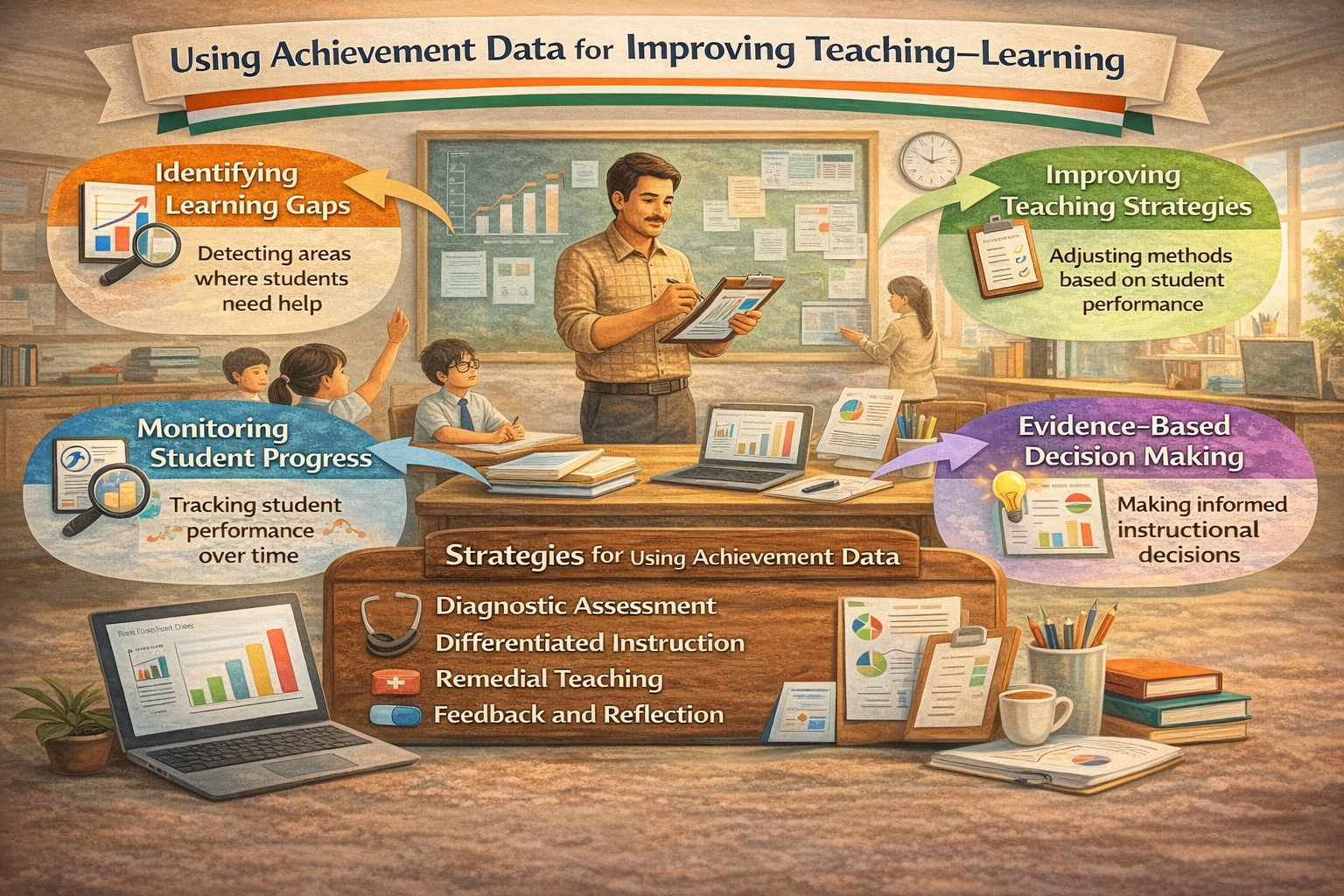
2. Understanding Achievement Data in Education
Achievement data refers to measurable information about students’ academic performance. It helps educators understand how well students are learning and whether instructional strategies are effective.
Types of Achievement Data
- Formative Assessment Data
- Class tests
- Quizzes
- Assignments
- Classroom observations
- Summative Assessment Data
- Term-end examinations
- Board examinations
- Annual assessments
- Standardized Assessment Data
- National Achievement Survey (NAS)
- State-level learning assessments
- Diagnostic Assessment Data
- Pre-tests
- Baseline assessments
Each type of data provides valuable insights into students’ strengths, weaknesses, and learning progress.
3.Importance of Achievement Data in the Indian School System
Using achievement data effectively can transform the teaching–learning process. It provides evidence-based insights that help teachers improve instructional strategies and student learning outcomes.
1. Identifying Learning Gaps
Achievement data helps teachers identify areas where students struggle. For example, if many students score poorly in mathematics problem-solving questions, teachers can modify teaching methods to address conceptual misunderstandings.
2. Improving Teaching Strategies
Data analysis allows teachers to reflect on their teaching practices. If certain topics consistently show poor results, teachers can adopt innovative methods such as:
- Activity-based learning
- Project-based learning
- Collaborative learning
3. Monitoring Student Progress
Achievement data enables continuous monitoring of student performance. Teachers can track progress over time and adjust instruction accordingly.
4. Enhancing Student Motivation
When students receive feedback based on data, they become more aware of their strengths and weaknesses. This encourages them to improve their learning strategies.
5. Supporting Educational Planning
School administrators and policymakers can use achievement data to plan curriculum reforms, teacher training programs, and educational interventions.
Please visit us for more similar topics: https://teacherszone.in/
Please follow us on facebook:https://www.facebook.com/profile.php?id=61586013442564
4.Sources of Achievement Data in India
The Indian education system collects achievement data from multiple sources.
1. Classroom Assessments
Teachers regularly conduct tests, quizzes, and assignments to evaluate students’ understanding of topics.
2. Board Examinations
National and state boards such as:
- Central Board of Secondary Education
- Council for the Indian School Certificate Examinations
provide large-scale achievement data through standardized examinations.
3. National Achievement Survey
The National Achievement Survey evaluates learning outcomes at different grade levels across the country.
4. School-Based Assessments
Many schools conduct internal assessments to track student progress and learning outcomes.
5.Methods of Analyzing Achievement Data
To use achievement data effectively, educators must analyze it systematically.
1. Descriptive Analysis
This involves summarizing data using:
- Mean scores
- Percentage marks
- Grade distributions
2. Comparative Analysis
Teachers compare performance across:
- Different classes
- Different subjects
- Different academic years
3. Trend Analysis
Trend analysis helps identify patterns in student performance over time.
4. Item Analysis
Item analysis examines how students perform on individual test questions. It helps teachers identify:
- Difficult questions
- Misconceptions among students
- Ineffective teaching strategies
6.Using Achievement Data to Improve Teaching–Learning
Achievement data can be used in several ways to enhance the teaching–learning process.
1. Personalized Instruction
Teachers can design personalized learning plans based on students’ individual performance data.
Example:
- Students weak in mathematics may receive additional practice sessions.
- High-performing students may be given advanced learning tasks.
2. Differentiated Teaching
Achievement data helps teachers adopt differentiated instruction, where teaching methods are adjusted according to students’ learning needs.
Strategies include:
- Flexible grouping
- Varied teaching materials
- Different levels of assignments
3. Improving Curriculum Implementation
If achievement data shows poor performance in certain topics, teachers and curriculum planners can revise instructional approaches or teaching materials.
4. Enhancing Teacher Professional Development
Achievement data can highlight areas where teachers need additional training.
For example:
- Teaching difficult concepts in science
- Using technology in classrooms
- Implementing competency-based education
7.Role of Technology in Data-Based Teaching
Digital technologies play a significant role in analyzing and using achievement data.
Educational Technology Tools
- Learning Management Systems (LMS)
- Online assessment platforms
- Data analytics software
These tools help teachers collect, analyze, and interpret student performance data efficiently.
8.Role of Teachers in Achievement Data for Improving Teaching–Learning
Teachers are central to the effective use of achievement data.
Teachers should:
- Collect accurate data from assessments
- Analyze performance patterns
- Provide feedback to students
- Modify teaching strategies based on data insights
By doing so, teachers can create a data-informed classroom environment that supports better learning outcomes.
9.Role of School Leadership in Achievement Data for Improving Teaching–Learning
School leaders play a crucial role in promoting data-driven education.
School administrators should:
- Encourage teachers to analyze achievement data
- Provide training in data interpretation
- Use data for school improvement planning
- Monitor learning outcomes regularly
10.Challenges in Using Achievement Data
Despite its benefits, several challenges limit the effective use of achievement data in Indian schools.
1. Lack of Data Literacy
Many teachers are not trained in data analysis techniques.
2. Limited Technological Resources
Some schools lack access to digital tools for data analysis.
3. Excessive Focus on Exams
Achievement data is often used only for grading rather than improving learning.
4. Inadequate Teacher Training
Teachers may not receive proper guidance on how to use data to improve teaching strategies.
11.Strategies to Improve the Use of Achievement Data
To overcome these challenges, the following strategies can be adopted:
1. Teacher Training Programs
Professional development programs should include training on:
- Data analysis
- Assessment design
- Data-based decision making
2. Integration of Technology
Schools should adopt digital tools for collecting and analyzing achievement data.
3. Continuous Assessment
Regular formative assessments should be used instead of relying only on final examinations.
4. Collaborative Data Analysis
Teachers should work together to analyze data and share effective teaching practices.
12.Achievement Data and Educational Reforms in India
Recent educational reforms emphasize the importance of data-driven teaching practices.
For example, the National Education Policy 2020 promotes:
- Competency-based assessments
- Continuous evaluation
- Holistic progress tracking
These reforms encourage teachers to use achievement data to improve learning outcomes and ensure quality education.
13.Benefits of Data-Driven Teaching
Using achievement data effectively can provide several benefits:
1. Improved Student Learning Outcomes
Teachers can identify learning difficulties early and provide timely support.
2. Better Teaching Strategies
Data helps teachers evaluate the effectiveness of their instructional methods.
3. Increased Accountability
Schools become more accountable for student performance.
4. Evidence-Based Educational Policies
Government agencies can use achievement data to design better educational policies.
14.Future of Data-Based Education in India
The future of education in India is likely to be increasingly data-driven. With advancements in digital technology, schools will be able to:
- Track student learning in real time
- Provide personalized learning experiences
- Use artificial intelligence for educational analytics
These developments will help improve the overall quality of education in the country.

15.Conclusion/Using Achievement Data for Improving Teaching–Learning
Achievement data is a powerful tool for improving teaching and learning in the Indian school system. By analyzing student performance data, teachers can identify learning gaps, adopt effective instructional strategies, and monitor student progress more effectively.
Educational reforms and technological advancements are further strengthening the role of data-driven education. However, to fully realize the benefits of achievement data, teachers and school leaders must develop the skills required to analyze and use data effectively.
Ultimately, the proper use of achievement data can help create a more responsive, inclusive, and effective education system that supports the learning needs of every student in India.
12. Exam-Oriented MCQs of Using Achievement Data for Improving Teaching–Learning
1.
A teacher analyzes students’ test scores to identify weak areas and plans remedial teaching accordingly. This practice mainly reflects:
A. Diagnostic evaluation
B. Norm-referenced testing
C. Summative evaluation
D. Standardized testing
Answer: A
Exam Pattern: CTET / KVS
2.
Achievement data collected from classroom assessments helps teachers primarily to:
A. Rank students
B. Improve teaching strategies
C. Reduce curriculum content
D. Increase homework
Answer: B
Exam Pattern: CTET
3.
A teacher observes that many students scored low marks in mathematics problem-solving questions. The most appropriate action would be to:
A. Ignore the results
B. Provide remedial teaching and modify instructional strategies
C. Increase examination difficulty
D. Reduce classroom discussion
Answer: B
Exam Pattern: DSSSB
4.
Using achievement data to modify teaching methods is an example of:
A. Data-driven instruction
B. Traditional teaching
C. Passive learning
D. Mechanical instruction
Answer: A
Exam Pattern: NET
5.
Achievement data can best support differentiated instruction because it:
A. Identifies different learning levels of students
B. Eliminates classroom assessments
C. Focuses only on high achievers
D. Encourages uniform teaching
Answer: A
Exam Pattern: CTET
6.
A teacher compares students’ performance in two different teaching methods to identify which method is more effective. This process demonstrates:
A. Reflective teaching practice
B. Mechanical teaching
C. Traditional instruction
D. Passive learning
Answer: A
Exam Pattern: NET
7.
Achievement data collected through continuous assessment helps teachers mainly to:
A. Monitor student progress regularly
B. Conduct final examinations only
C. Reduce teaching responsibilities
D. Avoid feedback
Answer: A
Exam Pattern: CTET / KVS
8.
When teachers use student performance data to plan individualized learning support, they are promoting:
A. Inclusive and learner-centered education
B. Competitive evaluation
C. Rote learning
D. Teacher-centered instruction
Answer: A
Exam Pattern: CTET
9.
Which of the following is the most effective use of achievement data in the classroom?
A. Labeling students as weak or strong
B. Planning remedial and enrichment activities
C. Increasing examination frequency
D. Reducing syllabus content
Answer: B
Exam Pattern: DSSSB
10.
A school analyzes achievement data across subjects and finds low performance in science. The principal organizes teacher training workshops. This reflects:
A. Evidence-based decision making
B. Traditional administration
C. Student-centered learning
D. Norm-referenced evaluation
Answer: A
Exam Pattern: NET
11.
Achievement data from formative assessments is most useful for:
A. Immediate improvement of teaching and learning
B. Determining final grades only
C. Ranking schools
D. Conducting board examinations
Answer: A
Exam Pattern: CTET
12.
A teacher uses achievement data to design different learning activities for advanced and slow learners. This practice reflects:
A. Differentiated instruction
B. Standardized teaching
C. Uniform evaluation
D. Competitive learning
Answer: A
Exam Pattern: NET
13.
Which of the following is a major challenge in using achievement data effectively?
A. Lack of teacher training in data analysis
B. High student participation
C. Use of technology in classrooms
D. Continuous assessment
Answer: A
Exam Pattern: DSSSB
14.
Achievement data analysis helps teachers identify:
A. Learning gaps among students
B. Only examination marks
C. School infrastructure problems
D. Teacher attendance
Answer: A
Exam Pattern: CTET
15.
If teachers only use achievement data for ranking students, the main educational limitation would be:
A. Neglect of learning improvement
B. Improved teaching strategies
C. Increased student motivation
D. Better learning outcomes
Answer: A
Exam Pattern: NET
16.
A teacher compares students’ performance before and after using activity-based learning. This process is mainly used to:
A. Evaluate the effectiveness of teaching methods
B. Increase homework
C. Reduce class time
D. Avoid classroom interaction
Answer: A
Exam Pattern: KVS
17.
Achievement data used for identifying students’ strengths and weaknesses mainly supports:
A. Personalized learning
B. Uniform instruction
C. Mechanical teaching
D. Traditional assessment
Answer: A
Exam Pattern: CTET
18.
A school uses digital tools to track and analyze student performance data. This reflects:
A. Data-based educational management
B. Traditional education system
C. Teacher-centered learning
D. Passive instruction
Answer: A
Exam Pattern: NET
19.
Achievement data becomes most meaningful when teachers:
A. Interpret it and apply it to improve instruction
B. Store it for administrative records
C. Use it only for report cards
D. Compare students publicly
Answer: A
Exam Pattern: DSSSB
20.
From an educational perspective, the ultimate goal of using achievement data is to:
A. Improve student learning outcomes
B. Increase examination pressure
C. Reduce classroom teaching
D. Rank students in school
Answer: A
Exam Pattern: CTET / NET / KVS