
Explore the history of child rights in the world and India, including key milestones, international declarations, constitutional provisions, and laws protecting children’s rights and welfare.
Table of Contents of History of Child Rights
1. Introduction( परिचय) History of Child Rights
Child rights refer to the fundamental rights and freedoms that every child deserves for survival, development, protection, and participation in society. Historically, children were often considered the property of their parents or families and did not enjoy independent rights. Over time, social reform movements, educational reforms, and international organizations helped establish the concept of child rights.
Today, child rights are recognized globally through legal frameworks, international conventions, and national policies. These rights ensure that children grow up in a safe, nurturing, and supportive environment.
बाल अधिकार उन मूलभूत अधिकारों और स्वतंत्रताओं को कहते हैं जो प्रत्येक बच्चे को जीवन, विकास, सुरक्षा और सहभागिता के लिए प्राप्त होने चाहिए। इतिहास में लंबे समय तक बच्चों को स्वतंत्र अधिकार प्राप्त नहीं थे और उन्हें परिवार की संपत्ति के रूप में देखा जाता था। धीरे-धीरे सामाजिक सुधार आंदोलनों और अंतरराष्ट्रीय प्रयासों के कारण बाल अधिकारों की अवधारणा विकसित हुई।
आज विश्व स्तर पर कई कानून और अंतरराष्ट्रीय संधियाँ बच्चों के अधिकारों की रक्षा करती हैं।
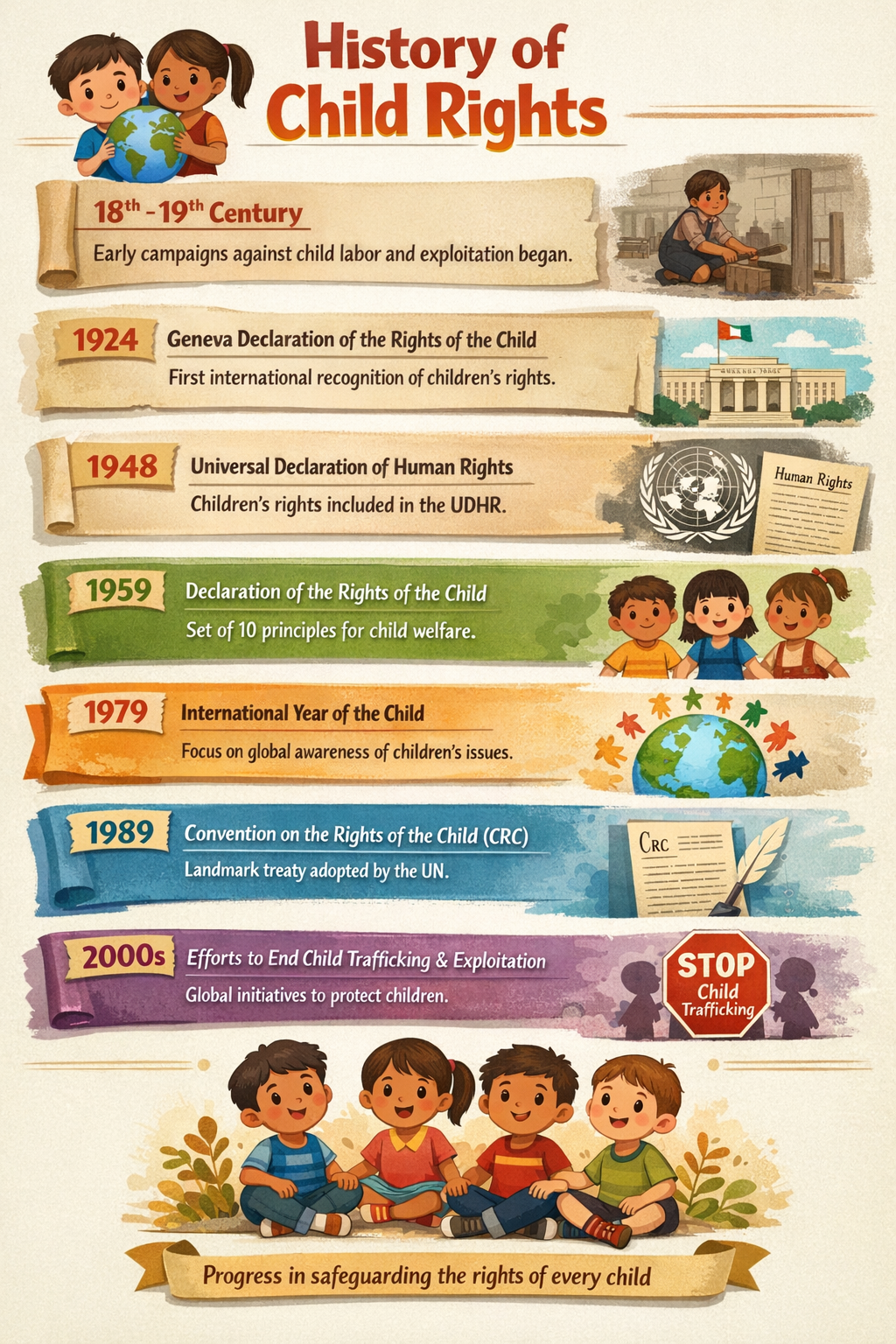
2. Early Development of Child Rights (Before 20th Century) (20वीं सदी से पहले बाल अधिकारों का विकास)
In earlier centuries, children were often required to work in factories, mines, and farms. The Industrial Revolution in Europe during the 18th and 19th centuries exposed millions of children to dangerous working conditions.
Reformers, educators, and social activists began advocating for children’s welfare. Laws gradually emerged to regulate child labor, provide education, and improve living conditions for children.
These early reforms laid the foundation for modern child rights movements.
18वीं और 19वीं शताब्दी में औद्योगिक क्रांति के दौरान बच्चों से खतरनाक परिस्थितियों में काम कराया जाता था। इस स्थिति के खिलाफ कई सामाजिक सुधारकों ने आवाज उठाई और बच्चों की शिक्षा तथा सुरक्षा के लिए आंदोलन शुरू किए।
इन सुधारों ने आगे चलकर बाल अधिकार आंदोलन की नींव रखी।
3. Global Milestones in the History of Child Rights
(विश्व में बाल अधिकारों के प्रमुख मील के पत्थर)
1. 1924 – Geneva Declaration of the Rights of the Child
The Geneva Declaration of the Rights of the Child was the first international document recognizing children’s rights. It emphasized the need to provide children with nutrition, protection, and opportunities for development.
2. 1948 – Universal Declaration of Human Rights
The Universal Declaration of Human Rights recognized that motherhood and childhood are entitled to special care and assistance.
3. 1959 – UN Declaration of the Rights of the Child
The Declaration of the Rights of the Child expanded child protection principles and introduced ten key principles for children’s welfare.
4. 1979 – International Year of the Child
The International Year of the Child brought global attention to the needs and rights of children.
5. 1989 – Convention on the Rights of the Child (CRC)
The most significant milestone in the history of child rights was the United Nations Convention on the Rights of the Child, adopted in 1989. It recognized children as individuals with legal rights and emphasized four key principles:
- Survival
- Protection
- Development
- Participation
This convention became the most widely ratified human rights treaty in the world.
विश्व स्तर पर विकास
विश्व स्तर पर बाल अधिकारों के विकास में कई महत्वपूर्ण घटनाएँ हुईं:
- 1924 – Geneva Declaration of the Rights of the Child
- 1948 – Universal Declaration of Human Rights
- 1959 – Declaration of the Rights of the Child
- 1979 – International Year of the Child
- 1989 – United Nations Convention on the Rights of the Child
इन सभी ने बच्चों के अधिकारों को अंतरराष्ट्रीय स्तर पर मान्यता दिलाई।
4. History of Child Rights in India (भारत में बाल अधिकारों का इतिहास)
India has a long tradition of protecting children through social reform movements, educational initiatives, and legal frameworks.
1. Pre-Independence Period
During the British colonial period, several laws were introduced to protect children.
Important reforms included:
- Regulation of child labor
- Promotion of child education
- Social reform movements against child marriage
Reformers like Raja Ram Mohan Roy and Ishwar Chandra Vidyasagar advocated for the welfare and education of children.
2. Constitutional Provisions After Independence
The Constitution of India provides several protections for children.
Important constitutional provisions include:
Article 21A
Right to free and compulsory education.
Article 24
Prohibits employment of children below 14 years in hazardous occupations.
Article 39 (e) and (f)
Ensures that children are protected from abuse and exploitation.
3. Important Child Protection Laws in India
India has enacted several laws to protect children.
1.
The Right of Children to Free and Compulsory Education Act ensures free education for children aged 6–14 years.
2.
The Protection of Children from Sexual Offences Act protects children from sexual abuse and exploitation.
3.
The Juvenile Justice (Care and Protection of Children) Act ensures care and protection for children in need.
भारत में बाल अधिकारों का विकास
भारत में बाल अधिकारों का विकास सामाजिक सुधार आंदोलनों और कानूनों के माध्यम से हुआ।
मुख्य कदम:
- शिक्षा का प्रसार
- बाल श्रम के खिलाफ कानून
- बाल विवाह के खिलाफ आंदोलन
स्वतंत्रता के बाद भारतीय संविधान ने बच्चों को कई महत्वपूर्ण अधिकार प्रदान किए।
5. Role of International Organizations (अंतरराष्ट्रीय संगठनों की भूमिका)
Organizations such as UNICEF play a major role in promoting child rights worldwide. They support governments in improving education, healthcare, nutrition, and protection systems for children.
These organizations also conduct research, awareness programs, and policy support for child welfare.
अंतरराष्ट्रीय संगठनों की भूमिका
UNICEF जैसे संगठन बच्चों के अधिकारों को बढ़ावा देने के लिए महत्वपूर्ण भूमिका निभाते हैं। ये संगठन शिक्षा, स्वास्थ्य और सुरक्षा से संबंधित कार्यक्रम चलाते हैं।
6. Importance of Child Rights Today (आज के समय में बाल अधिकारों का महत्व)
In modern society, child rights are essential for:
- Protecting children from abuse and exploitation
- Ensuring access to quality education
- Promoting equality and inclusion
- Supporting emotional and psychological well-being
Schools play a vital role in implementing these rights by creating safe and supportive environments.
महत्व
आज के समय में बाल अधिकार इसलिए महत्वपूर्ण हैं क्योंकि ये:
- बच्चों को शोषण से बचाते हैं
- शिक्षा का अधिकार सुनिश्चित करते हैं
- समानता और समावेशन को बढ़ावा देते हैं
- बच्चों के मानसिक और भावनात्मक विकास में सहायता करते हैं
7. Conclusion of History of Child Rights(निष्कर्ष)
The history of child rights reflects the gradual recognition of children as individuals with dignity and rights. From early reform movements to modern international conventions, the protection of children has become a global priority.
In India and across the world, governments, schools, communities, and families must work together to ensure that every child grows up in a safe and nurturing environment.
बाल अधिकारों का इतिहास यह दर्शाता है कि समय के साथ बच्चों को स्वतंत्र अधिकारों वाले व्यक्तियों के रूप में मान्यता मिली है। आज यह आवश्यक है कि सरकार, विद्यालय, समाज और परिवार मिलकर बच्चों के अधिकारों की रक्षा करें।
Please follow us on facebook: https://www.facebook.com/profile.php?id=61586013442564
Please visit for more similar topics: https://teacherszone.in/
8. MCQs with answers on the History of Child Rights
1.
Which document is considered the first international declaration specifically addressing the rights of children?
A. Universal Declaration of Human Rights
B. Geneva Declaration of the Rights of the Child
C. UN Charter
D. Declaration of the Rights of the Child (1959)
Answer: B
2.
The Geneva Declaration of the Rights of the Child was adopted in:
A. 1919
B. 1924
C. 1935
D. 1948
Answer: B
3.
Which organization adopted the Geneva Declaration of the Rights of the Child?
A. United Nations
B. League of Nations
C. UNICEF
D. International Labour Organization
Answer: B
4.
The concept of child rights gained significant global attention during the:
A. Industrial Revolution
B. Renaissance
C. Cold War
D. Scientific Revolution
Answer: A
5.
The Universal Declaration of Human Rights was adopted in:
A. 1945
B. 1948
C. 1950
D. 1955
Answer: B
6.
Which article of the Universal Declaration of Human Rights highlights the need for special care for motherhood and childhood?
A. Article 10
B. Article 15
C. Article 25
D. Article 30
Answer: C
7.
The Declaration of the Rights of the Child adopted by the UN in 1959 consists of:
A. 5 principles
B. 8 principles
C. 10 principles
D. 12 principles
Answer: C
8.
The year declared as the International Year of the Child by the United Nations was:
A. 1975
B. 1977
C. 1979
D. 1985
Answer: C
9.
The Convention on the Rights of the Child was adopted by the United Nations General Assembly in:
A. 1985
B. 1989
C. 1992
D. 1995
Answer: B
10.
The Convention on the Rights of the Child came into force in:
A. 1990
B. 1992
C. 1995
D. 2000
Answer: A
11.
Which of the following principles is central to the Convention on the Rights of the Child?
A. Economic productivity of children
B. Best interests of the child
C. Competitive education
D. National security
Answer: B
12.
Which of the following is NOT one of the four fundamental categories of child rights?
A. Survival
B. Protection
C. Development
D. Ownership
Answer: D
13.
India ratified the Convention on the Rights of the Child in:
A. 1989
B. 1990
C. 1992
D. 1995
Answer: C
14.
Which constitutional article in India guarantees free and compulsory education for children?
A. Article 19
B. Article 21A
C. Article 25
D. Article 30
Answer: B
15.
Article 24 of the Indian Constitution deals with:
A. Freedom of speech
B. Protection from child labour in hazardous employment
C. Equality before law
D. Religious freedom
Answer: B
16.
Which article of the Indian Constitution directs the State to ensure that children are protected against exploitation?
A. Article 32
B. Article 39
C. Article 45
D. Article 51
Answer: B
17.
The Right of Children to Free and Compulsory Education Act was enacted in:
A. 2005
B. 2007
C. 2009
D. 2011
Answer: C
18.
The RTE Act became operational in India in:
A. 2009
B. 2010
C. 2011
D. 2012
Answer: B
19.
Which act specifically addresses sexual offences against children in India?
A. Juvenile Justice Act
B. POCSO Act
C. Child Labour Act
D. Domestic Violence Act
Answer: B
20.
The Protection of Children from Sexual Offences (POCSO) Act was enacted in:
A. 2008
B. 2010
C. 2012
D. 2014
Answer: C
21.
Which Indian commission is responsible for monitoring child rights protection?
A. National Human Rights Commission
B. National Commission for Women
C. National Commission for Protection of Child Rights
D. Law Commission of India
Answer: C
22.
The National Commission for Protection of Child Rights was established under which act?
A. Juvenile Justice Act
B. Commissions for Protection of Child Rights Act
C. Child Labour Act
D. RTE Act
Answer: B
23.
The Commissions for Protection of Child Rights Act was passed in:
A. 2003
B. 2005
C. 2007
D. 2009
Answer: B
24.
Which international agency plays a key role in promoting child rights globally?
A. IMF
B. UNICEF
C. WTO
D. UNESCO
Answer: B
25.
Which principle emphasizes that all children must be treated equally regardless of their background?
A. Participation principle
B. Non-discrimination principle
C. Survival principle
D. Protection principle
Answer: B
26.
The concept of “child participation” in child rights implies:
A. Children’s involvement in labour
B. Children’s right to express opinions and be heard
C. Children’s right to vote
D. Children’s right to property
Answer: B
27.
Which law in India deals with care and protection of children in conflict with law?
A. Child Labour Act
B. Juvenile Justice Act
C. POCSO Act
D. RTE Act
Answer: B
28.
The Juvenile Justice (Care and Protection of Children) Act was most recently amended in:
A. 2010
B. 2013
C. 2015
D. 2018
Answer: C
29.
Which global convention recognizes children as independent rights holders?
A. Geneva Convention
B. Convention on the Rights of the Child
C. Universal Declaration of Human Rights
D. International Covenant on Civil and Political Rights
Answer: B
30.
The recognition of child rights globally reflects a shift from viewing children as:
A. Citizens
B. Learners
C. Dependents with rights
D. Property of adults
Answer: D