
Explore the evolution of Educational Policies in India Since 1813: A Comprehensive Perspective, including major commissions, reforms, and national policies that shaped the Indian education system.
Table of Contents
Introduction /Educational Policies in India Since 1813/ प्रस्तावना
Education has always played a crucial role in shaping the social, political, and economic development of a nation. In India, the evolution of educational policies reflects the changing priorities of society, government, and national development. The history of educational policies in India can be traced back to the early 19th century, particularly from the year 1813, when the British Parliament passed the Charter Act of 1813.
शिक्षा किसी भी राष्ट्र के सामाजिक, राजनीतिक और आर्थिक विकास में महत्वपूर्ण भूमिका निभाती है। भारत में शैक्षिक नीतियों का विकास समाज, सरकार और राष्ट्रीय विकास की बदलती आवश्यकताओं को दर्शाता है। भारत में शैक्षिक नीतियों का इतिहास 1813 से प्रारम्भ माना जाता है, जब ब्रिटिश संसद ने चार्टर एक्ट 1813 पारित किया।
This act marked the beginning of government involvement in education in India. Since then, several educational policies, commissions, and reforms have been introduced to shape the Indian education system.
इस अधिनियम ने भारत में शिक्षा के क्षेत्र में सरकारी हस्तक्षेप की शुरुआत की। इसके बाद शिक्षा प्रणाली को विकसित करने के लिए कई शिक्षा नीतियाँ, आयोग और सुधार लागू किए गए।
Charter Act of 1813 / चार्टर एक्ट 1813
The Charter Act of 1813 is considered the starting point of modern educational policy in India. For the first time, the British government accepted responsibility for promoting education in India.
चार्टर एक्ट 1813 को भारत में आधुनिक शिक्षा नीति की शुरुआत माना जाता है। पहली बार ब्रिटिश सरकार ने भारत में शिक्षा के प्रसार की जिम्मेदारी स्वीकार की।
Major Features
- A sum of 1 lakh rupees per year was allocated for education.
- Promotion of Western education.
- Entry of Christian missionaries for educational work.
प्रमुख विशेषताएँ
- शिक्षा के लिए 1 लाख रुपये प्रति वर्ष का प्रावधान।
- पश्चिमी शिक्षा को बढ़ावा।
- मिशनरियों को शिक्षा के क्षेत्र में कार्य करने की अनुमति।
Macaulay’s Minute (1835) / मैकाले का मिनट (1835)
In 1835, Thomas Babington Macaulay presented his famous Minute on Education, which strongly advocated English education in India.
1835 में थॉमस बैबिंगटन मैकाले ने अपना प्रसिद्ध मिनट ऑन एजुकेशन प्रस्तुत किया, जिसमें अंग्रेजी शिक्षा का समर्थन किया गया।
Major Objectives
- Promotion of English language
- Creation of a class of educated Indians
- Spread of Western knowledge
प्रमुख उद्देश्य
- अंग्रेजी भाषा का प्रसार
- शिक्षित भारतीय वर्ग का निर्माण
- पश्चिमी ज्ञान का प्रचार
Macaulay believed that education should create individuals who were “Indian in blood and colour but English in taste and intellect.”
Wood’s Despatch (1854) / वुड्स डिस्पैच (1854)
The Wood’s Despatch of 1854 is often called the Magna Carta of English Education in India.
1854 का वुड्स डिस्पैच भारत में अंग्रेजी शिक्षा का मैग्ना कार्टा माना जाता है।
Major Recommendations
- Establishment of universities in India
- Promotion of female education
- Teacher training institutions
- Development of primary education
प्रमुख सिफारिशें
- भारत में विश्वविद्यालयों की स्थापना
- महिला शिक्षा को बढ़ावा
- शिक्षक प्रशिक्षण संस्थानों की स्थापना
- प्राथमिक शिक्षा का विकास
As a result, universities were established in Calcutta, Bombay, and Madras in 1857.
Hunter Commission (1882) / हंटर आयोग (1882)
The Hunter Commission was appointed to review the progress of education after Wood’s Despatch.
वुड्स डिस्पैच के बाद शिक्षा की प्रगति का मूल्यांकन करने के लिए हंटर आयोग (1882) नियुक्त किया गया।
Major Recommendations
- Development of primary education
- Local bodies should manage primary schools
- Encouragement of indigenous schools
प्रमुख सुझाव
- प्राथमिक शिक्षा का विस्तार
- स्थानीय निकायों को विद्यालय प्रबंधन की जिम्मेदारी
- स्वदेशी विद्यालयों को प्रोत्साहन
Indian Universities Act (1904)/भारतीय विश्वविद्यालय अधिनियम 1904
This act was introduced to improve the functioning of universities in India.
इस अधिनियम का उद्देश्य भारत के विश्वविद्यालयों के कार्यप्रणाली में सुधार करना था।
Key Features
- Greater government control over universities
- Improvement in teaching and research
- Better regulation of university administration
Saddler Commission (1917–1919) / सैडलर आयोग (1917–1919)
The Saddler Commission was appointed to examine the problems of the University of Calcutta.
सैडलर आयोग को कलकत्ता विश्वविद्यालय की समस्याओं का अध्ययन करने के लिए नियुक्त किया गया था।
Major Recommendations
- 12 years of school education before university
- Improvement of secondary education
- Establishment of intermediate colleges
Hartog Committee (1929) / हार्टोग समिति (1929)
The Hartog Committee focused mainly on improving the quality of primary education.
हार्टोग समिति का मुख्य उद्देश्य प्राथमिक शिक्षा की गुणवत्ता में सुधार करना था।
Major Suggestions
- Reduce dropout rates
- Improve teacher training
- Focus on quality rather than expansion
Wardha Scheme of Education (1937) / वर्धा शिक्षा योजना (1937)
The Wardha Scheme, also known as Basic Education or Nai Talim, was proposed by Mahatma Gandhi.
वर्धा शिक्षा योजना, जिसे बेसिक एजुकेशन या नई तालीम भी कहा जाता है, महात्मा गांधी द्वारा प्रस्तावित की गई थी।
Key Features
- Craft-centered education
- Free and compulsory education for 7 years
- Learning through productive work
Sergeant Plan (1944) / सार्जेंट योजना (1944)
The Sergeant Plan aimed to provide universal education in India.
सार्जेंट योजना का उद्देश्य भारत में सार्वभौमिक शिक्षा प्रदान करना था।
Major Recommendations
- Free and compulsory education for children aged 6–14
- Development of teacher training
- Expansion of secondary education
Educational Policies After Independence / स्वतंत्रता के बाद की शैक्षिक नीतियाँ
After independence, India focused on developing an education system suitable for a democratic and developing nation.
स्वतंत्रता के बाद भारत ने लोकतांत्रिक और विकासशील समाज के लिए उपयुक्त शिक्षा प्रणाली विकसित करने पर जोर दिया।
Please visit for more similar topics:https://teacherszone.in/
Please follow us on Facebook: https://www.facebook.com/profile.php?id=61586013442564
University Education Commission (1948–49) / विश्वविद्यालय शिक्षा आयोग (1948–49)
This commission was chaired by Dr. S. Radhakrishnan.
इस आयोग की अध्यक्षता डॉ. सर्वपल्ली राधाकृष्णन ने की।
Objectives
- Improve university education
- Promote research and higher learning
Secondary Education Commission (1952–53) / माध्यमिक शिक्षा आयोग (1952–53)
Chaired by Dr. A. Lakshmanaswami Mudaliar.
यह आयोग डॉ. लक्ष्मणस्वामी मुदालियर की अध्यक्षता में गठित हुआ।
Major Focus
- Diversification of secondary education
- Vocational education
Education Commission (1964–66) / कोठारी आयोग (1964–66)
The Kothari Commission provided a comprehensive framework for educational reform in India.
कोठारी आयोग ने भारत में शिक्षा सुधार के लिए व्यापक ढांचा प्रस्तुत किया।
Major Recommendations
- 10+2+3 system
- Equal educational opportunity
- National integration through education
National Policy on Education 1968 / राष्ट्रीय शिक्षा नीति 1968
This was India’s first national education policy.
यह भारत की पहली राष्ट्रीय शिक्षा नीति थी।
Major Features
- Three language formula
- Equal access to education
- Promotion of science education
National Policy on Education 1986 / राष्ट्रीय शिक्षा नीति 1986
The 1986 policy aimed to make education more inclusive and accessible.
1986 की नीति का उद्देश्य शिक्षा को अधिक समावेशी और सुलभ बनाना था।
Major Goals
- Universalization of elementary education
- Women’s education
- Adult literacy programs
Programme of Action 1992 / कार्यक्रम क्रियान्वयन योजना 1992
This program was introduced to implement the National Policy on Education effectively.
यह कार्यक्रम राष्ट्रीय शिक्षा नीति को प्रभावी रूप से लागू करने के लिए शुरू किया गया।
Right to Education Act 2009 / शिक्षा का अधिकार अधिनियम 2009
The RTE Act made education a fundamental right for children aged 6–14 years.
आरटीई अधिनियम ने 6–14 वर्ष के बच्चों के लिए शिक्षा को मौलिक अधिकार बना दिया।
Key Provisions
- Free and compulsory education
- 25% reservation in private schools
- Child-friendly learning environment
National Education Policy 2020 / राष्ट्रीय शिक्षा नीति 2020
The NEP 2020 aims to transform the Indian education system into a modern and flexible system.
राष्ट्रीय शिक्षा नीति 2020 का उद्देश्य भारतीय शिक्षा प्रणाली को आधुनिक और लचीला बनाना है।
Major Reforms
- 5+3+3+4 structure
- Early childhood education
- Multidisciplinary higher education
- Digital learning
Importance of Educational Policies in India / भारत में शैक्षिक नीतियों का महत्व
Educational policies help in guiding the development of education in a systematic way.
शैक्षिक नीतियाँ शिक्षा के विकास को व्यवस्थित दिशा प्रदान करती हैं।
Major Contributions
- Expansion of education
- Improvement in quality
- Promotion of equality
- Development of human resources
Challenges in Educational Policy Implementation / शैक्षिक नीतियों के क्रियान्वयन की चुनौतियाँ
Despite numerous reforms, several challenges remain.
कई सुधारों के बावजूद कई चुनौतियाँ अभी भी मौजूद हैं।
Major Challenges
- Lack of infrastructure
- Shortage of trained teachers
- Regional disparities
- Digital divide
Timeline Chart: Educational Policies in India Since 1813
| Year | Policy / Commission | Key Contribution to Indian Education |
|---|---|---|
| 1813 | Charter Act 1813 | First time British Government accepted responsibility for education in India; ₹1 lakh allocated annually for education. |
| 1835 | Macaulay’s Minute | Promoted English as the medium of instruction; introduced Western education system. |
| 1854 | Wood’s Despatch | Known as the Magna Carta of English Education; recommended universities, teacher training, and education departments. |
| 1882 | Hunter Commission | Focused on development of primary education and decentralization of educational administration. |
| 1904 | Indian Universities Act 1904 | Increased government control over universities and improved university administration. |
| 1917–1919 | Saddler Commission | Emphasized the importance of secondary education before university level. |
| 1929 | Hartog Committee | Focused on improving quality of primary education and reducing dropout rates. |
| 1937 | Wardha Scheme of Education | Introduced Gandhian concept of Basic Education (Nai Talim) based on craft-centered learning. |
| 1944 | Sergeant Plan | Proposed universal, free, and compulsory education within 40 years. |
| 1948–49 | University Education Commission | Focused on reforming university education and promoting research and democratic values. |
| 1952–53 | Secondary Education Commission | Recommended diversification of secondary education and introduction of vocational courses. |
| 1964–66 | Kothari Commission | Recommended 10+2+3 system, Common School System, and education for national development. |
| 1968 | National Policy on Education 1968 | Introduced Three Language Formula and emphasized equal educational opportunities. |
| 1986 | National Policy on Education 1986 | Focused on universal elementary education, women’s education, and Operation Blackboard. |
| 1992 | Programme of Action 1992 | Revised NPE 1986 and provided strategies for implementation of reforms. |
| 2009 | Right of Children to Free and Compulsory Education Act 2009 | Made education a fundamental right for children aged 6–14 years. |
| 2020 | National Education Policy 2020 | Introduced 5+3+3+4 structure, multidisciplinary education, and emphasis on skill development and technology. |
Simplified Visual Timeline of Educational Policies in India Since 1813
1813 → Charter Act
⬇
1835 → Macaulay’s Minute
⬇
1854 → Wood’s Despatch
⬇
1882 → Hunter Commission
⬇
1904 → Indian Universities Act
⬇
1917–19 → Saddler Commission
⬇
1929 → Hartog Committee
⬇
1937 → Wardha Scheme (Basic Education)
⬇
1944 → Sergeant Plan
⬇
1948–49 → Radhakrishnan Commission
⬇
1952–53 → Mudaliar Commission
⬇
1964–66 → Kothari Commission
⬇
1968 → National Education Policy
⬇
1986 → New Education Policy
⬇
1992 → Programme of Action
⬇
2009 → RTE Act
⬇
2020 → National Education Policy
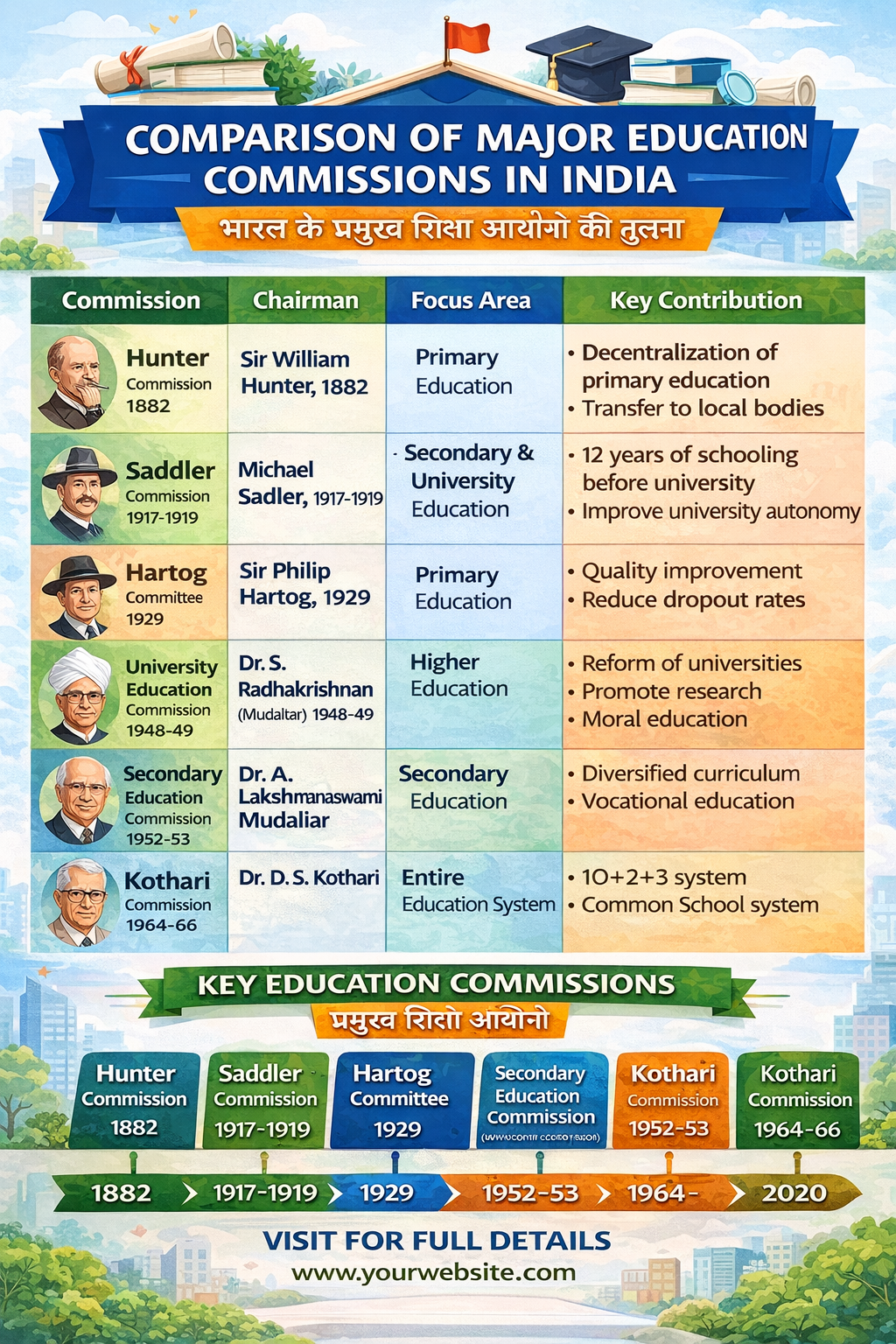
Comparison Chart of Major Education Commissions in India/Educational Policies in India Since 1813
| Commission | Year | Chairman | Level of Education Focus | Major Objectives | Key Recommendations |
|---|---|---|---|---|---|
| Hunter Commission | 1882 | Sir William Hunter | Primary & Secondary Education | Improve administration of education in India | Decentralization of education, development of primary education, transfer of primary education to local bodies |
| Saddler Commission | 1917–1919 | Michael Sadler | University & Secondary Education | Examine problems of Calcutta University | 12 years of schooling before university, importance of secondary education, university autonomy |
| Hartog Committee | 1929 | Sir Philip Hartog | Primary Education | Improve quality of education | Control expansion of primary education, reduce dropout rates, improve teacher training |
| University Education Commission | 1948–49 | Dr. S. Radhakrishnan | Higher Education | Reform university education after independence | Promote research, moral education, improve teacher status |
| Secondary Education Commission | 1952–53 | Dr. A. Lakshmanaswami Mudaliar | Secondary Education | Improve quality of secondary education | Diversified curriculum, vocational education, guidance and counseling |
| Kothari Commission | 1964–66 | Dr. D. S. Kothari | Entire Education System | National development through education | 10+2+3 structure, Common School System, equal educational opportunities |
Simplified Comparison for Quick Revision/ Educational Policies in India Since 1813
| Commission | Focus Area | Most Important Contribution |
|---|---|---|
| Hunter Commission | Primary Education | Decentralization of education |
| Saddler Commission | Secondary & University | 12 years schooling before university |
| Hartog Committee | Primary Education | Quality improvement and dropout reduction |
| Radhakrishnan Commission | Higher Education | Reform of universities |
| Mudaliar Commission | Secondary Education | Diversification and vocational education |
| Kothari Commission | Entire Education System | 10+2+3 system and National Education Policy |
Conclusion / Educational Policies in India Since 1813 / निष्कर्ष
The development of educational policies in India since 1813 shows a gradual transformation of the education system. From colonial education policies to modern reforms like National Education Policy 2020, India has continuously tried to improve access, quality, and inclusiveness in education.
1813 से भारत में शैक्षिक नीतियों का विकास शिक्षा प्रणाली के क्रमिक परिवर्तन को दर्शाता है। औपनिवेशिक शिक्षा नीतियों से लेकर राष्ट्रीय शिक्षा नीति 2020 तक भारत ने शिक्षा में समानता, गुणवत्ता और समावेशिता को बढ़ाने का निरंतर प्रयास किया है।
The effective implementation of these policies will help India build a knowledge-based society and achieve sustainable national development.
इन नीतियों का प्रभावी क्रियान्वयन भारत को ज्ञान आधारित समाज बनाने और सतत राष्ट्रीय विकास प्राप्त करने में मदद करेगा।
High-Order MCQs on Educational Policies in India Since 1813
Educational Policies in India Since 1813
1.
The Charter Act of 1813 is significant in the history of Indian education because it:
A. Introduced compulsory education
B. Marked the beginning of state responsibility for education
C. Established universities in India
D. Introduced vocational education
Answer: B
2.
The educational policy suggested in Macaulay’s Minute (1835) aimed primarily to:
A. Promote indigenous education
B. Spread English education and Western knowledge
C. Encourage Sanskrit learning
D. Expand rural education
Answer: B
3.
Which of the following policies first introduced the idea of a systematic education department in India?
A. Hunter Commission
B. Wood’s Despatch
C. Saddler Commission
D. Hartog Committee
Answer: B
4.
The Wood’s Despatch of 1854 is often called the “Magna Carta of English Education in India” because it:
A. Introduced technical education
B. Provided a comprehensive educational policy
C. Introduced free education
D. Abolished traditional schools
Answer: B
5.
The Hunter Commission (1882) mainly focused on improving:
A. University education
B. Primary education
C. Technical education
D. Teacher education
Answer: B
6.
Which commission emphasized that primary education should be managed by local bodies?
A. Hartog Committee
B. Hunter Commission
C. Saddler Commission
D. Mudaliar Commission
Answer: B
7.
The Indian Universities Act 1904 aimed to:
A. Promote women’s education
B. Increase government control over universities
C. Introduce compulsory education
D. Expand primary schools
Answer: B
8.
The Saddler Commission (1917–1919) recommended:
A. 8 years schooling before university
B. 12 years schooling before university education
C. Vocational training at primary level
D. Free higher education
Answer: B
9.
The Hartog Committee (1929) emphasized improving the:
A. Quantity of education
B. Quality of primary education
C. Technical education
D. University research
Answer: B
10.
The Wardha Scheme of Education (1937) was based on the principle of:
A. Military training
B. Craft-centered education
C. English medium instruction
D. Higher education expansion
Answer: B
11.
Which educational plan proposed free and compulsory education for children aged 6–14 years before independence?
A. Hartog Plan
B. Sergeant Plan
C. Wardha Plan
D. Saddler Plan
Answer: B
12.
The Sergeant Plan (1944) aimed at achieving universal education within approximately:
A. 10 years
B. 20 years
C. 40 years
D. 50 years
Answer: C
13.
The University Education Commission (1948–49) was chaired by:
A. Dr. Radhakrishnan
B. Dr. Zakir Hussain
C. Dr. Kothari
D. Dr. Mudaliar
Answer: A
14.
The main focus of the Radhakrishnan Commission was:
A. Secondary education
B. Primary education
C. University education
D. Vocational education
Answer: C
15.
The Secondary Education Commission (1952–53) was chaired by:
A. Dr. Mudaliar
B. Dr. Kothari
C. Dr. Radhakrishnan
D. Dr. Zakir Hussain
Answer: A
16.
The Mudaliar Commission recommended:
A. 10+2+3 system
B. Diversification of secondary education
C. Free university education
D. Abolition of exams
Answer: B
17.
The famous statement “The destiny of India is being shaped in her classrooms” was made by:
A. Mudaliar Commission
B. Kothari Commission
C. Hunter Commission
D. Hartog Committee
Answer: B
18.
The Kothari Commission (1964–66) recommended which structure of education?
A. 8+4+3
B. 10+2+3
C. 5+3+3+4
D. 7+5+3
Answer: B
19.
The Common School System was recommended by:
A. Hartog Committee
B. Kothari Commission
C. Mudaliar Commission
D. Saddler Commission
Answer: B
20.
The National Policy on Education 1968 was based mainly on recommendations of:
A. Radhakrishnan Commission
B. Mudaliar Commission
C. Kothari Commission
D. Hunter Commission
Answer: C
21.
The Three Language Formula was introduced in:
A. NPE 1968
B. NPE 1986
C. NPE 1992
D. NEP 2020
Answer: A
22.
The National Policy on Education 1986 emphasized:
A. Privatization of education
B. Universalization of elementary education
C. Elimination of higher education
D. Military training in schools
Answer: B
23.
Which policy introduced the concept of Operation Blackboard?
A. NPE 1968
B. NPE 1986
C. RTE Act
D. NEP 2020
Answer: B
24.
The Programme of Action (1992) was related to implementation of:
A. NPE 1968
B. NPE 1986
C. NEP 2020
D. Sergeant Plan
Answer: B
25.
Which act made education a fundamental right in India?
A. RTE Act 2009
B. NEP 2020
C. NPE 1986
D. University Act 1904
Answer: A
26.
The Right to Education Act (2009) covers children aged:
A. 5–14 years
B. 6–14 years
C. 6–16 years
D. 7–15 years
Answer: B
27.
Under the RTE Act, private schools must reserve seats for disadvantaged children:
A. 10%
B. 15%
C. 25%
D. 30%
Answer: C
28.
The National Education Policy 2020 replaced which previous policy?
A. NPE 1968
B. NPE 1986
C. NPE 1992
D. NPE 2000
Answer: B
29.
The new structure of schooling proposed in NEP 2020 is:
A. 10+2+3
B. 8+4+3
C. 5+3+3+4
D. 6+3+3+4
Answer: C
30.
Which stage is introduced for Early Childhood Care and Education in NEP 2020?
A. Foundational Stage
B. Preparatory Stage
C. Secondary Stage
D. Higher Stage
Answer: A
31.
Which policy emphasizes multidisciplinary higher education?
A. NPE 1968
B. NPE 1986
C. NEP 2020
D. RTE 2009
Answer: C
32.
The Kothari Commission recommended spending what percentage of GDP on education?
A. 4%
B. 5%
C. 6%
D. 8%
Answer: C
33.
Which commission stressed quality improvement rather than expansion?
A. Hartog Committee
B. Hunter Commission
C. Saddler Commission
D. Mudaliar Commission
Answer: A
34.
The concept of Basic Education (Nai Talim) was proposed by:
A. Tagore
B. Gandhi
C. Nehru
D. Vivekananda
Answer: B
35.
Which commission first recommended vocational education at secondary level?
A. Mudaliar Commission
B. Hunter Commission
C. Saddler Commission
D. Hartog Committee
Answer: A
36.
The major aim of the Sergeant Plan was:
A. Expand universities
B. Achieve universal education
C. Promote English language
D. Establish private schools
Answer: B
37.
The concept of National Integration through education was strongly emphasized by:
A. Kothari Commission
B. Hunter Commission
C. Hartog Committee
D. Saddler Commission
Answer: A
38.
Which educational reform aimed to reduce dropout rates in primary education?
A. Hartog Committee
B. Saddler Commission
C. Mudaliar Commission
D. Kothari Commission
Answer: A
39.
The Three Language Formula promotes:
A. Linguistic diversity
B. English dominance
C. Single language policy
D. Regional isolation
Answer: A
40.
Which educational policy focused strongly on women’s education and equality?
A. NPE 1986
B. NPE 1968
C. Sergeant Plan
D. Hunter Commission
Answer: A
41.
The concept of child-centered education was emphasized in:
A. Wardha Scheme
B. Macaulay’s Minute
C. Hunter Commission
D. Universities Act
Answer: A
42.
The Saddler Commission highlighted the importance of:
A. Secondary education as a link between school and university
B. Technical education only
C. Military training
D. Teacher training only
Answer: A
43.
Which educational policy aimed to integrate vocational education with mainstream education?
A. NPE 1986
B. Hunter Commission
C. Macaulay’s Policy
D. Hartog Committee
Answer: A
44.
The introduction of teacher training institutions was recommended in:
A. Wood’s Despatch
B. Macaulay’s Minute
C. Hartog Committee
D. Saddler Commission
Answer: A
45.
Which educational policy emphasized education for national development?
A. Kothari Commission
B. Hunter Commission
C. Saddler Commission
D. Hartog Committee
Answer: A
46.
The major aim of RTE Act 2009 is:
A. Privatization of education
B. Universal access to elementary education
C. Free higher education
D. Only digital learning
Answer: B
47.
Which policy introduced continuous and comprehensive evaluation concept in Indian education?
A. NPE 1986 (later reforms)
B. NPE 1968
C. Macaulay Policy
D. Hunter Commission
Answer: A
48.
The Foundational Stage in NEP 2020 covers ages:
A. 3–8 years
B. 6–10 years
C. 8–12 years
D. 10–14 years
Answer: A
49.
The major goal of educational policies since independence has been:
A. Colonial control
B. Human resource development
C. Religious education
D. Military education
Answer: B
50.
The evolution of educational policies in India since 1813 shows a shift from:
A. Colonial control to democratic and inclusive education
B. Technical education to religious education
C. Rural education to urban education
D. Teacher training to exam system
Answer: A