
Learn the complete concept of Preparation of School TimeTable: Concept, Construction Principles, Importance & 50 MCQs with answers, and 50 previous year exam questions for CTET, UGC NET, DSSSB, KVS, NVS, and State TET exams.
Table of Contents
Introduction (परिचय)
(School TimeTable: Concept, Construction Principles, Importance & 50 MCQs)
Preparation of a School Time-Table is one of the most important administrative functions of school management. It ensures proper utilization of time, human resources, infrastructure, and learning opportunities. According to IGNOU, B.Ed and M.Ed educational management materials, a well-planned time-table reflects discipline, psychological understanding of learners, and balanced curriculum implementation.
स्कूल समय-सारणी का निर्माण विद्यालय प्रबंधन का अत्यंत महत्वपूर्ण कार्य है। यह समय, मानव संसाधन, भवन, कक्षाओं और शिक्षण-अधिगम प्रक्रिया का उचित उपयोग सुनिश्चित करता है। IGNOU, B.Ed एवं M.Ed के शैक्षिक प्रबंधन अध्ययन सामग्री के अनुसार एक प्रभावी समय-सारणी विद्यालय की अनुशासन, मनोवैज्ञानिक समझ और संतुलित पाठ्यक्रम क्रियान्वयन को दर्शाती है।
Meaning of School Time-Table (समय-सारणी का अर्थ)
(School TimeTable: Concept, Construction Principles, Importance & 50 MCQs)
A school timetable is a systematic plan that allocates time for various subjects, teachers, classes, and co-curricular activities within available school hours.
विद्यालय समय-सारणी वह व्यवस्थित योजना है जिसमें उपलब्ध समय के भीतर विभिन्न विषयों, शिक्षकों, कक्षाओं तथा सह-शैक्षिक गतिविधियों के लिए समय का निर्धारण किया जाता है।
Objectives of School Time-Table (उद्देश्य)
- Proper utilization of school time
- Avoidance of fatigue
- Balanced curriculum implementation
- Ensuring discipline
- Equal importance to scholastic & co-scholastic areas
- समय का उचित उपयोग
- थकान से बचाव
- संतुलित पाठ्यक्रम क्रियान्वयन
- अनुशासन की स्थापना
- शैक्षिक एवं सह-शैक्षिक गतिविधियों को समान महत्व
Principles of Time-Table Construction (समय-सारणी निर्माण के सिद्धांत)
(School TimeTable: Concept, Construction Principles, Importance & 50 MCQs)
1️⃣ Principle of Fatigue (थकान का सिद्धांत)
Difficult subjects like Mathematics and Science should be placed in early periods.
कठिन विषय जैसे गणित व विज्ञान प्रारंभिक पीरियड में होने चाहिए।
2️⃣ Principle of Variety (विविधता का सिद्धांत)
Avoid consecutive difficult subjects.
लगातार कठिन विषय न रखें।
3️⃣ Principle of Balance (संतुलन का सिद्धांत)
Equal distribution of subjects and activities.
विषयों का संतुलित वितरण।
4️⃣ Principle of Flexibility (लचीलापन)
Adjustments during emergencies.
आपातकाल में परिवर्तन की सुविधा।
5️⃣ Principle of Justice (न्याय का सिद्धांत)
Equal importance to all subjects.
सभी विषयों को उचित महत्व।
Steps in Preparation of School Time-Table (निर्माण की प्रक्रिया): (School TimeTable: Concept, Construction Principles, Importance & 50 MCQs)
- Calculate total working days
- Count total periods per day
- Allocate subjects according to syllabus load
- Fix teacher availability
- Include co-curricular activities
- Provide breaks
- कुल कार्य दिवसों की गणना
- प्रतिदिन पीरियड की संख्या तय करना
- पाठ्यक्रम के अनुसार समय आवंटन
- शिक्षकों की उपलब्धता देखना
- सह-शैक्षिक गतिविधियाँ शामिल करना
- अवकाश निर्धारित करना
Types of Time-Table (समय-सारणी के प्रकार)
- Master Time-Table (प्रधान समय-सारणी)
- Class Time-Table (कक्षा समय-सारणी)
- Teacher’s Time-Table (शिक्षक समय-सारणी)
- Activity Time-Table (गतिविधि समय-सारणी)
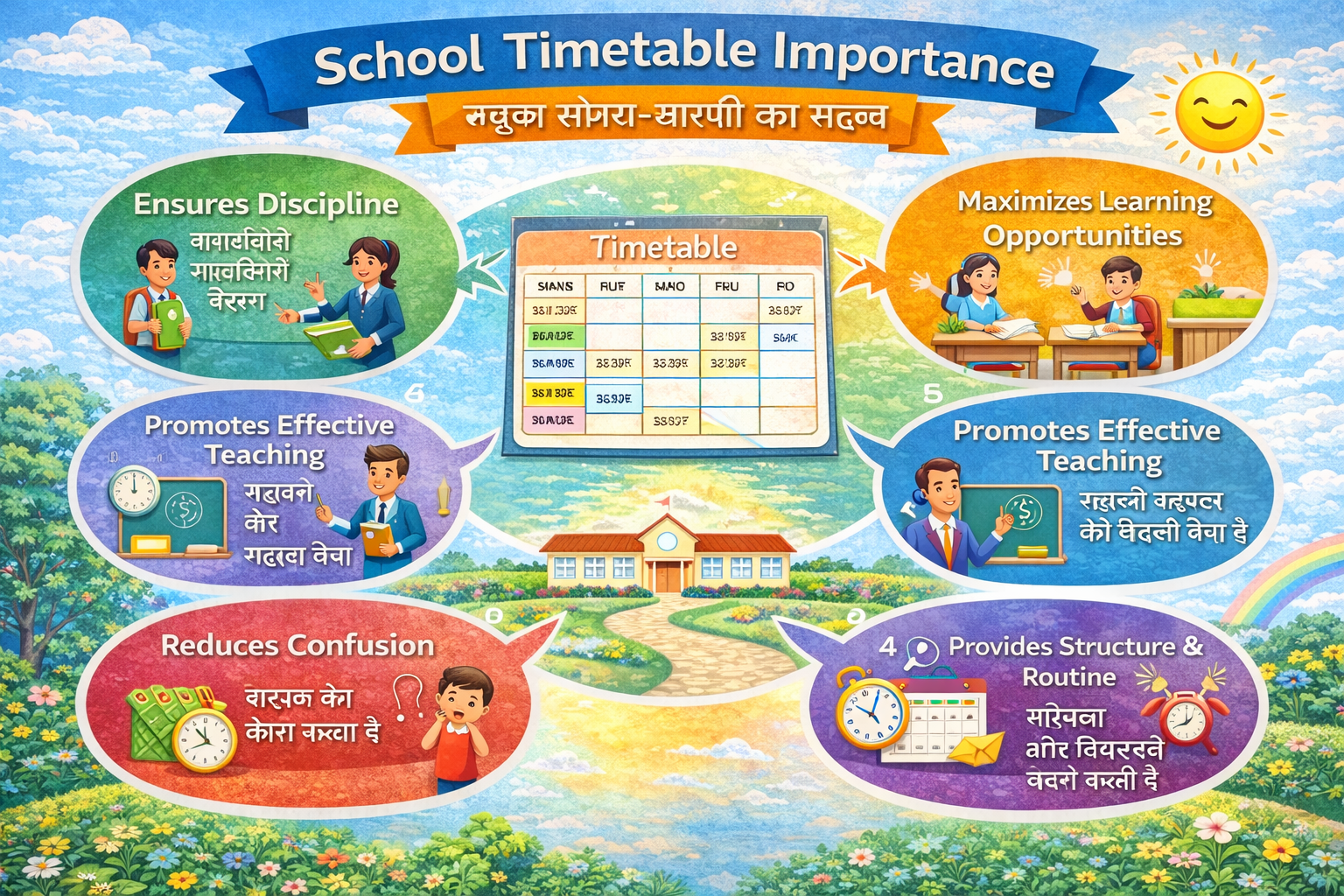
Importance of School Time-Table (महत्व)
- Ensures discipline
- Reduces confusion
- Promotes effective teaching
- Helps supervision
- Saves time and energy
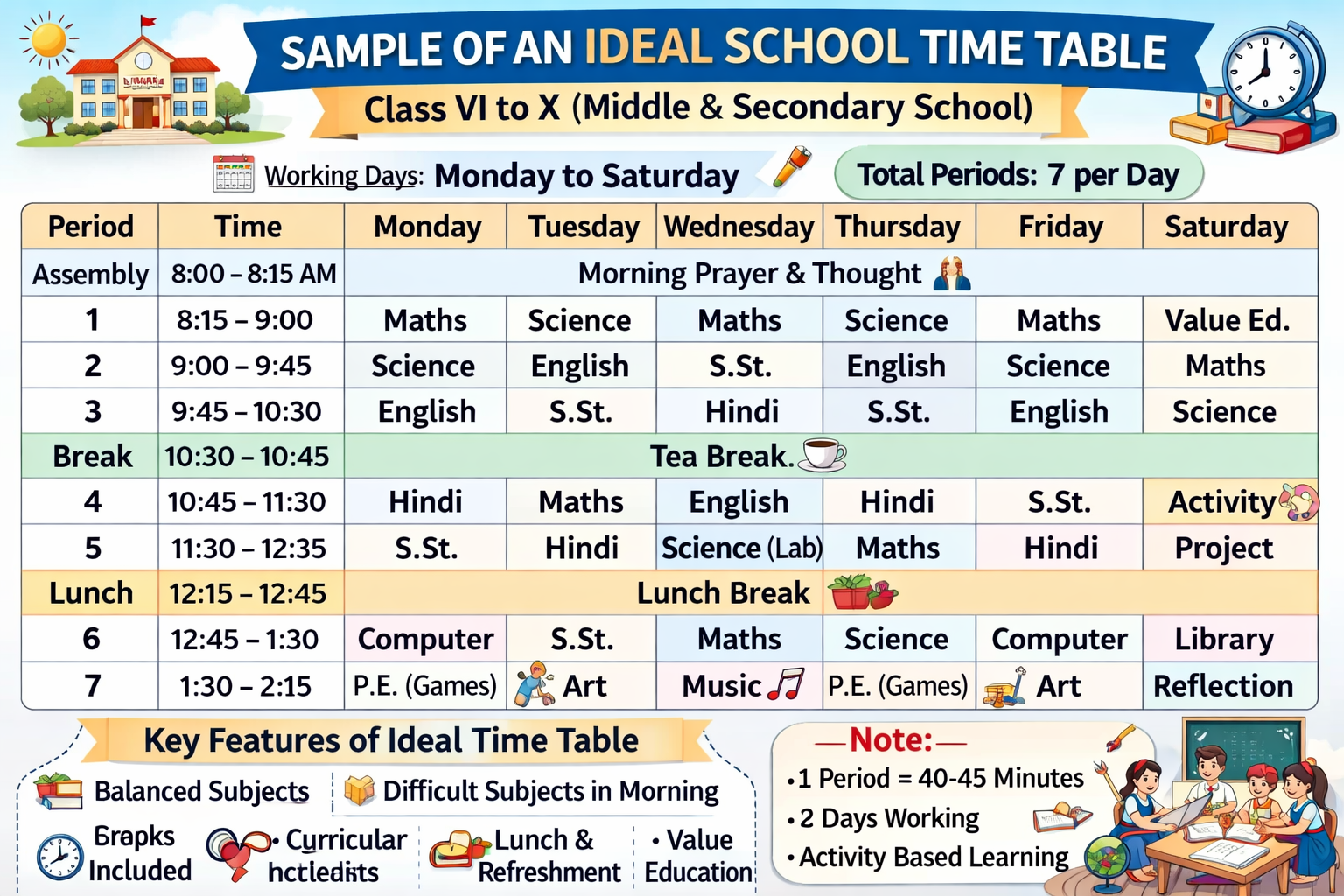
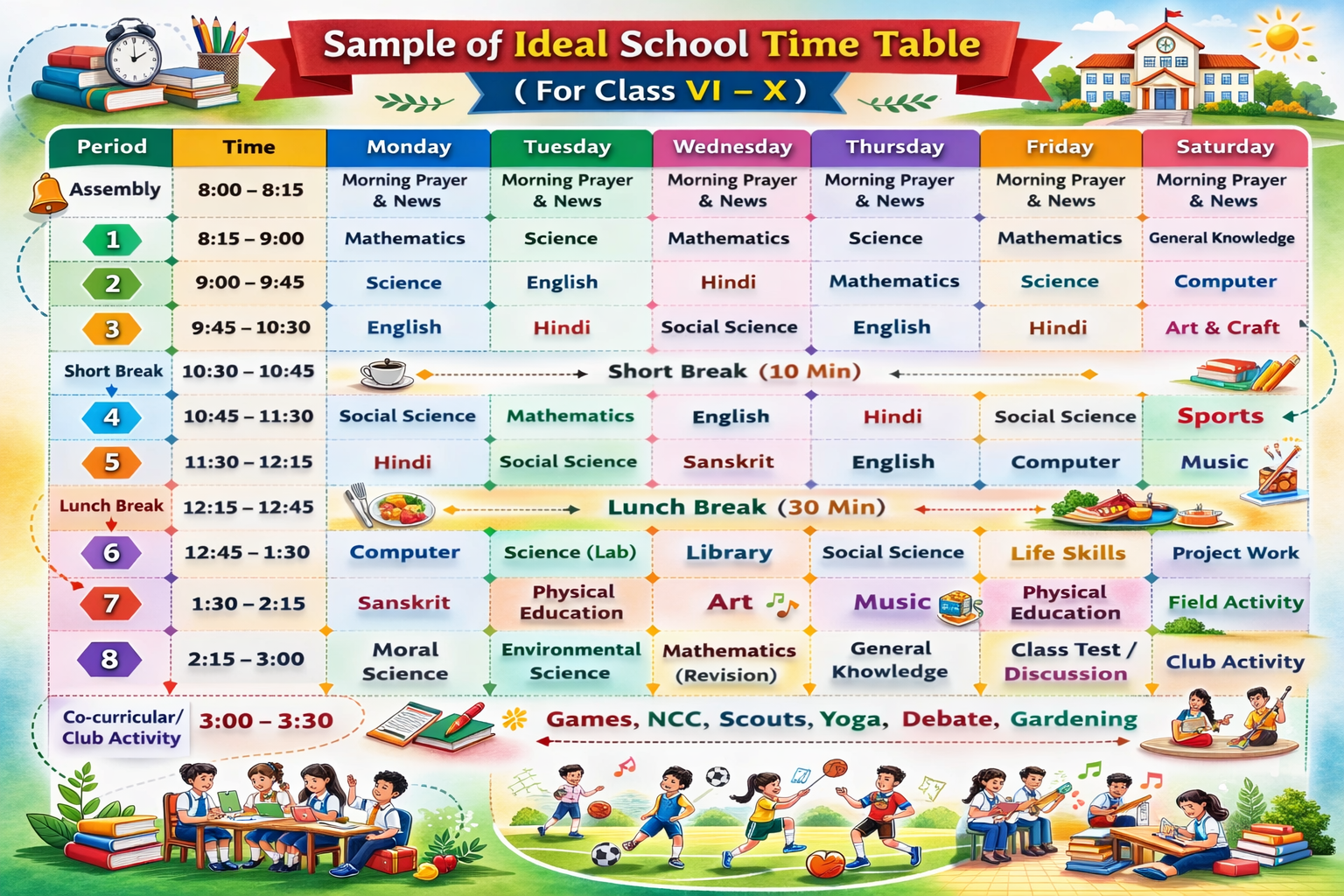
Sample of an Ideal School Time-Table (आदर्श समय-सारणी का नमूना)(School TimeTable: Concept, Construction Principles, Importance & 50 MCQs)
Class VIII (Secondary Level Example)
| Period | Time | Subject |
|---|---|---|
| Assembly | 8:00–8:15 | Morning Prayer |
| 1 | 8:15–9:00 | Mathematics |
| 2 | 9:00–9:45 | Science |
| 3 | 9:45–10:30 | English |
| Break | 10:30–10:45 | Short Break |
| 4 | 10:45–11:30 | Social Science |
| 5 | 11:30–12:15 | Hindi |
| Lunch | 12:15–12:45 | Lunch Break |
| 6 | 12:45–1:30 | Computer |
| 7 | 1:30–2:15 | Physical Education |
✅ Difficult subjects in morning
✅ Activity subject in last period
✅ Proper breaks included
imitations (सीमाएँ)
- Rigid structure may restrict creativity
- Difficult to satisfy all teachers
- Changes required during exams
50 MCQs (With Answers)
(School TimeTable: Concept, Construction Principles, Importance & 50 MCQs)
1. The first principle of time-table construction is:
A) Discipline
B) Fatigue
C) Salary
D) Punishment
Answer: B
2. Difficult subjects should be placed:
A) After lunch
B) Morning hours
C) Last period
D) Games period
Answer: B
3. Master time-table is prepared for:
A) One class
B) One teacher
C) Whole school
D) Parents
Answer: C
4. Double periods are suitable for:
A) Attendance
B) Assembly
C) Laboratory work
D) Moral science
Answer: C
5. Co-curricular activities help in:
A) Personality development
B) Fatigue
C) Disorder
D) Punishment
Answer: A
6. The principle of balance in time-table construction refers to:
A) Equal salary to teachers
B) Equal importance to all subjects and activities
C) Equal punishment
D) Equal holidays
Answer: B) Equal importance to all subjects and activities
7. Shorter periods are most suitable for:
A) University level
B) Primary classes
C) Research scholars
D) College lecturers
Answer: B) Primary classes
8. A school time-table mainly reflects:
A) Building structure
B) Teacher’s mood
C) School discipline and organization
D) Students’ holidays
Answer: C) School discipline and organization
9. The principle of justice in time-table construction means:
A) Equal salary distribution
B) Equal punishment
C) Equal holiday for all
D) Equal importance to all subjects
Answer: D) Equal importance to all subjects
10. Lunch break in a time-table helps to reduce:
A) Homework
B) Fatigue
C) Attendance
D) Discipline
Answer: B) Fatigue
11. Flexibility in a time-table is necessary to:
A) Increase burden
B) Avoid teaching
C) Adjust during emergencies
D) Cancel classes
Answer: C) Adjust during emergencies
12. Consecutive difficult subjects may lead to:
A) Motivation
B) Discipline
C) Fatigue
D) Interest
Answer: C) Fatigue
13. Morning assembly is usually conducted:
A) After lunch
B) At the end of the day
C) Before the first period
D) During games period
Answer: C) Before the first period
14. A well-prepared time-table promotes:
A) Confusion
B) Organized teaching-learning
C) Irregularity
D) Disorder
Answer: B) Organized teaching-learning
15. Games period in a time-table mainly promotes:
A) Academic burden
B) Homework
C) Physical development
D) Examination preparation
Answer: C) Physical development
16. An effective time-table supports:
A) Only exams
B) School management and supervision
C) Only sports
D) Only homework
Answer: B) School management and supervision
17. The principle of variety helps to avoid:
A) Discipline
B) Learning
C) Monotony
D) Attendance
Answer: C) Monotony
18. Teacher’s time-table is useful for:
A) Personal holidays
B) Managing teaching workload
C) Avoiding classes
D) Reducing syllabus
Answer: B) Managing teaching workload
19. The total number of periods in a school depends on:
A) Teacher’s choice
B) Student demand
C) Working days and school hours
D) Holidays only
Answer: C) Working days and school hours
20. School time-table is essential for:
A) Effective teaching-learning process
B) Only examination preparation
C) Only sports activities
D) Only discipline
Preparation of School Time-Table – 50 Objective MCQs
(School TimeTable: Concept, Construction Principles, Importance & 50 MCQs)
1. The main aim of preparing a school time-table is to:
A) Increase homework
B) Ensure proper utilization of time
C) Reduce school hours
D) Control teachers
Answer: B
2. The principle of fatigue suggests that:
A) Easy subjects should be placed in the morning
B) Difficult subjects should be placed in early periods
C) Games should be avoided
D) All subjects should be taught equally
Answer: B
3. The time-table prepared for the entire school is called:
A) Class time-table
B) Teacher’s time-table
C) Master time-table
D) Activity register
Answer: C
4. Double periods are generally allotted for:
A) Attendance
B) Laboratory subjects
C) Assembly
D) Moral science
Answer: B
5. Variety principle in time-table prevents:
A) Discipline
B) Fatigue and monotony
C) Attendance
D) Evaluation
Answer: B
6. The duration of a secondary school period is usually:
A) 20 minutes
B) 30 minutes
C) 35–45 minutes
D) 60 minutes
Answer: C
7. Which subject is most suitable for the last period?
A) Mathematics
B) Physics
C) Games
D) Chemistry
Answer: C
8. The principle of justice means:
A) Equal salary
B) Equal punishment
C) Equal importance to all subjects
D) Equal holidays
Answer: C
9. A good time-table ensures:
A) Confusion
B) Disorder
C) Discipline
D) Irregularity
Answer: C
10. Co-curricular activities help in:
A) Reducing syllabus
B) Personality development
C) Increasing burden
D) Avoiding studies
Answer: B
11. The first step in preparing a time-table is:
A) Fixing examination dates
B) Counting total periods available
C) Preparing report cards
D) Conducting assembly
Answer: B
12. Consecutive difficult subjects should be:
A) Encouraged
B) Avoided
C) Increased
D) Compulsory
Answer: B
13. Flexibility in time-table helps in:
A) Emergencies
B) Avoiding classes
C) Increasing homework
D) Reducing staff
Answer: A
14. Short periods are suitable for:
A) University classes
B) Research scholars
C) Primary classes
D) College students
Answer: C
15. Lunch break is necessary to reduce:
A) Attendance
B) Homework
C) Fatigue
D) Discipline
Answer: C
16. Teacher’s time-table helps in:
A) Managing workload
B) Avoiding classes
C) Reducing syllabus
D) Canceling exams
Answer: A
17. A master time-table is useful for:
A) Students only
B) Teachers only
C) Whole school administration
D) Parents only
Answer: C
18. The principle of balance refers to:
A) Equal salary
B) Equal subject distribution
C) Equal holidays
D) Equal punishment
Answer: B
19. Assembly is generally conducted:
A) After lunch
B) Before first period
C) During games
D) Last period
Answer: B
20. Time-table preparation is part of:
A) Educational administration
B) Banking system
C) Political science
D) Economics
Answer: A
21. Difficult subjects are best taught when students are:
A) Tired
B) Fresh and attentive
C) Sleepy
D) Distracted
Answer: B
22. Overcrowding of subjects leads to:
A) Motivation
B) Efficiency
C) Fatigue
D) Interest
Answer: C
23. Games period mainly develops:
A) Mental fatigue
B) Physical fitness
C) Homework load
D) Examination skills
Answer: B
24. The total number of periods depends upon:
A) Teacher mood
B) Working days
C) Student demand
D) Holidays only
Answer: B
25. A rigid time-table may restrict:
A) Discipline
B) Creativity
C) Attendance
D) Supervision
Answer: B
26. Which is NOT a type of time-table?
A) Master
B) Class
C) Teacher’s
D) Railway
Answer: D
27. The success of school management largely depends on:
A) Salary
B) Infrastructure only
C) Effective time-table
D) Holidays
Answer: C
28. Variety in time-table avoids:
A) Learning
B) Monotony
C) Teaching
D) Supervision
Answer: B
29. Allocation of periods depends on:
A) Subject importance
B) Teacher salary
C) School furniture
D) Student uniform
Answer: A
30. The time-table should balance:
A) Only theory
B) Only practical
C) Scholastic and co-scholastic areas
D) Only exams
Answer: C
31. A school time-table mainly reflects:
A) School infrastructure
B) School discipline and organization
C) Teacher salary
D) Student uniform
Answer: B) School discipline and organization
32. Difficult subjects should generally not be placed:
A) In the morning
B) After lunch break
C) In the first period
D) Before short break
Answer: B) After lunch break
33. Laboratory subjects require:
A) Single short period
B) Double period
C) No fixed time
D) Assembly time
Answer: B) Double period
34. A well-planned time-table ensures:
A) Organized teaching
B) Confusion
C) Irregularity
D) Disorder
Answer: A) Organized teaching
35. The principle of justice in time-table construction ensures:
A) Equal punishment
B) Equal holidays
C) Equal importance to all subjects
D) Equal salary
Answer: C) Equal importance to all subjects
36. The responsibility for preparing the school time-table lies mainly with the:
A) Students
B) Principal
C) Parents
D) Peon
Answer: B) Principal
37. Short breaks between periods help to:
A) Increase efficiency
B) Increase homework
C) Reduce attendance
D) Avoid supervision
Answer: A) Increase efficiency
38. A good time-table helps to reduce:
A) Planning
B) Discipline
C) Teaching
D) Confusion
Answer: D) Confusion
39. Co-curricular activities in the time-table should be:
A) Ignored
B) Included regularly
C) Conducted only on holidays
D) Avoided during exams
Answer: B) Included regularly
40. A master time-table helps the principal in:
A) Reducing school hours
B) Canceling classes
C) Supervision and administration
D) Avoiding inspections
Answer: C) Supervision and administration
41. Difficult subjects require:
A) Minimum attention
B) Maximum attention
C) No planning
D) Shortest period
Answer: B) Maximum attention
42. The principle of balance ensures:
A) Equal salary
B) Equal holidays
C) Equal punishment
D) Equal workload distribution
Answer: D) Equal workload distribution
43. Physical Education is most suitable in the:
A) First period
B) Last period
C) Before assembly
D) During lunch
Answer: B) Last period
44. Flexibility in a time-table is necessary for:
A) Emergencies and adjustments
B) Reducing classes
C) Increasing homework
D) Avoiding exams
Answer: A) Emergencies and adjustments
45. The number of periods per day depends on:
A) School hours
B) Teacher mood
C) Student choice
D) Uniform pattern
Answer: A) School hours
46. A teacher’s time-table mainly shows:
A) Student attendance
B) Teacher workload distribution
C) Principal’s duties
D) School holidays
Answer: B) Teacher workload distribution
47. Morning assembly mainly promotes:
A) Homework
B) Fatigue
C) Discipline and unity
D) Examination preparation
Answer: C) Discipline and unity
48. An effective time-table helps to:
A) Waste time
B) Increase disorder
C) Save time and energy
D) Avoid supervision
Answer: C) Save time and energy
49. Consecutive theory periods may lead to:
A) Motivation
B) Interest
C) Fatigue
D) Discipline
Answer: C) Fatigue
50. Preparation of school time-table is mainly a function of:
A) Educational administration
B) Political management
C) Economic planning
D) Banking system
Answer: A) Educational administration
For more details on the topic School TimeTable: Concept, Construction Principles importance please go through: https://drive.google.com/file/d/1K1UAEyL-GAGolO2_y77tyXj0UUW6Wb1K/view?usp=drive_link
For other updates: https://teacherszone.in/
Please follow up :https://www.facebook.com/profile.php?id=61586013442564